Loading...
This comparison has not been analyzed yet.
One-time AI generation (~1 minute). Scores and timeline are already available below.
Atahualpa vs Rothari
Rothari leads by 6.6 pts · 2 figures compared
…
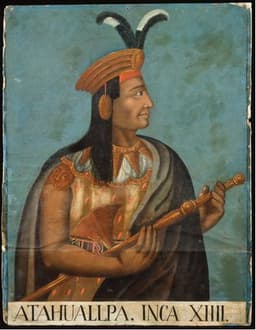
Atahualpa
Emperor · Medieval
44.5Total

Rothari
Emperor · Medieval
51.1Total
Basic Information
Born
1502
606
Died
1533
652
Era
Medieval
Medieval
Nationality
Inca Empire
Lombards
Occupation
Emperor
Emperor
Civilization
Other
Western
Score Comparison
Military (10%)
46.7
38.3
Political (20%)
27.9
68.0
Influence (20%)
57.2
55.7
Legacy (20%)
46.7
49.2
Leadership (15%)
39.0
48.8
Strategy (15%)
38.3
35.0
TOTAL
44.5
51.1
Atahualpa — Complete Timeline
1532 AD
Victory in the Inca Civil WarWar◆ Major
Atahualpa defeated his brother Hu
Civil WarSuccessionInca Empire
Impact: regionaldestructive
Capture at CajamarcaWar
Francisco Pizarro ambushed Atahualpa at Cajamarca, capturing the Inca emperor after a surprise attack. Spanish forces killed thousands of unarmed Inca attendants while Atahualpa was taken prisoner, marking the beginning of Spanish conquest.
Spanish ConquestAmbushPizarro
Impact: globaltragic
1533 AD
Ransom Room PaymentPolitical Action◆ Major
Atahualpa offered to fill a room with gold and silver in exchange for his release. Over several months, the Inca delivered approximately 6 tons of gold and 12 tons of silver, the largest ransom in history, but Pizarro executed him anyway.
RansomGoldSpanish Greed
Impact: regionaltragic
Execution by GarrotePolitical Action
Pizarro ordered Atahualpa's execution by garrote after a mock trial accused him of treason, idolatry, and ordering Hu
ExecutionSpanish ConquestEnd of Empire
Impact: globaltragic
Rothari — Complete Timeline
636 AD
Accession as king of the LombardsPolitical Action◆ Major
Rothari became king of the Lombards after the death of King Arioald. He was a member of the Arodus dynasty and his reign marked a period of consolidation and legal reform for the Lombard Kingdom in Italy.
SuccessionLombard KingdomItaly
Impact: regional
640 AD
Campaigns against the Byzantines in the Po ValleyWar
Rothari led military campaigns against Byzantine forces in the Po Valley, capturing several cities including Oderzo and Altino. These victories consolidated Lombard control over northern Italy and reduced Byzantine influence to the coastal areas of Ravenna and Venice.
Military CampaignByzantine EmpireNorthern Italy
Impact: regional
641 AD
Conquest of LiguriaWar◆ Major
Rothari conquered the Byzantine-held region of Liguria, including the city of Genoa. This expansion extended Lombard control over the northwestern coast of Italy and further weakened Byzantine power in the peninsula.
ConquestByzantine EmpireLiguria
Impact: regional
643 AD
Promulgation of the Edict of RothariReform
Rothari issued the Edict of Rothari, a written code of Lombard law. It was the first codification of Germanic customary law in Italy, written in Latin and covering criminal, civil, and family matters. The Edict helped unify the Lombard tribes and established a legal framework for the kingdom.
Law CodeLegal ReformLombard Kingdom
Impact: regionalconstructive
650 AD
Conversion to Catholicism (disputed)Cultural
Some later sources claim Rothari converted to Catholicism, but this is disputed. He was originally an Arian Christian, and his Edict shows no clear shift in religious policy. The conversion of the Lombards to Catholicism occurred more fully under later kings.
ReligionConversionArianism
Impact: national
This comparison has not been analyzed yet.
One-time AI generation (~1 minute). Scores and timeline are already available below.
Rankings
🥇
RothariLeader
Mil: 38.3Pol: 68.0Inf: 55.7
51.1
🥈
Atahualpa
Mil: 46.7Pol: 27.9Inf: 57.2
44.5
+6.6 behind
How This Comparison Works
Algorithm
Each figure is scored on 6 dimensions (0—100 scale) based on structured historical data: Military (10%), Political (20%), Influence (20%), Legacy (20%), Leadership (15%), Strategy (15%). The weighted total produces the final ranking.
Data Sources
Scores are computed from structured sub-indicators in the database. Scale factors adjust for era (Ancient ×0.85, Modern ×1.0) and civilization size (Eastern ×1.05, Other ×0.80) to account for differences in population and military scale.
Maximum 3 Figures
Comparisons are limited to 2—3 figures to ensure readability and statistical meaningfulness.
Error Margins
±5 points per dimension — Sub-scores are derived from historical records with inherent uncertainty. Two figures within 5 points on a dimension should be considered roughly equivalent in that area.
Total Score Accuracy
±3 points overall — The weighted combination of 6 dimensions produces a total score with approximately ±3 points of uncertainty. Differences of less than 3 points are not statistically significant— the figures are effectively tied.
Known Limitations
- Historical records are incomplete and uneven across civilizations
- Figures from oral-tradition societies may be underrepresented
- Occupation labels can misclassify multi-role figures
- Scores measure capability and impact, not moral character
- Quantitative scoring is a comparison tool, not absolute truth
Capability Radar
Military (10%) — Battles & Warfare
Battles
40
30
Win Rate
35
35
Expansion
20
35
Political (20%) — Governance & Reform
Reform
10
70
Diplomacy
20
45
Economy
15
40
Influence (20%) — Cultural & Global Reach
Cultural
40
45
Global
35
30
Legacy (20%) — Historical Impact
Historical
50
50
Longevity
30
45
Leadership (15%) — Power & Stability
Tenure
15
55
Stability
10
50
Strategy (15%) — Tactics & Innovation
Strategy
25
30
Tactics
30
30
Reform
10
40
Similar Comparisons
Comments & Discussion
No comments yet. Be the first to share your thoughts!