Loading...
Augustus vs Conrad III
Augustus leads by 43.1 pts · 2 figures compared
…

Augustus
Emperor · Ancient
85.9Total
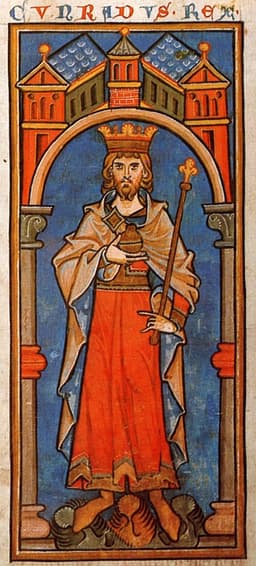
Conrad III
Emperor · Medieval
42.8Total
Basic Information
Born
63
1093
Died
—
1152
Era
Ancient
Medieval
Nationality
Roman Empire
Holy Roman Empire
Occupation
Emperor
Emperor
Civilization
Western
Western
Score Comparison
Military (10%)
72.0
45.0
Political (20%)
90.0
27.9
Influence (20%)
88.0
50.2
Legacy (20%)
90.0
41.7
Leadership (15%)
88.0
48.4
Strategy (15%)
75.0
38.3
TOTAL
85.9
42.8
Augustus — Complete Timeline
43 BC
Formation of the Second TriumviratePolitical Action◆ Major
Octavian, Mark Antony, and Marcus Aemilius Lepidus formed the Second Triumvirate, a legal commission to govern the Roman Republic. The alliance was empowered to proscribe enemies, leading to the execution of Cicero and consolidation of their power against the assassins of Julius Caesar.
Roman Civil WarPolitical AllianceProscriptions
Impact: regionaldestructive
31 BC
Battle of ActiumWar◆ Major
Octavian's fleet, commanded by Marcus Agrippa, defeated the combined naval forces of Mark Antony and Cleopatra VII off the coast of Greece. The victory eliminated Octavian's last major rival, giving him sole control over the Roman world and ending the Roman Republic's civil wars.
Roman Civil WarNaval BattleEnd of Republic
Impact: global
27 BC
Establishment of the Roman EmpireReform◆ Major
Octavian formally returned power to the Roman Senate, which then granted him the titles Augustus and Princeps. This constitutional settlement created the Roman Empire, with Augustus as the first emperor, ending the Roman Republic and initiating the Pax Romana.
Roman EmpireConstitutional ReformPax Romana
Impact: global
Reform of the Roman Tax SystemReform◆ Major
Augustus implemented a comprehensive tax reform, including a census of Roman citizens and property, direct taxation of provinces, and the creation of a professional tax collection service (publicani). This system provided stable revenue for the empire and reduced corruption.
Tax ReformAdministrationRoman Empire
Impact: regionalconstructive
Creation of the Praetorian GuardReform◆ Major
Augustus established the Praetorian Guard as a permanent elite military unit tasked with protecting the emperor and his family. Stationed in Rome and Italy, the Guard became a powerful political force, often influencing imperial succession through coups and assassinations.
Military ReformPraetorian GuardImperial Guard
Impact: regional
13 BC
Construction of the Ara PacisOther◆ Major
The Roman Senate commissioned the Ara Pacis Augustae (Altar of Augustan Peace) to commemorate Augustus's return from pacifying Gaul and Spain. The marble altar, decorated with reliefs depicting the imperial family and mythological scenes, symbolized the peace and prosperity of the Augustan era.
Building ProjectPropagandaAugustan Art
Impact: regionalconstructive
Conrad III — Complete Timeline
1138 AD
Conflict with the WelfsWar
Conrad III engaged in a civil war with the Welf party, led by Henry the Proud and later Henry the Lion, from 1138 to 1142. The conflict ended with a compromise that allowed the Welfs to retain some territories.
Civil WarWelf Conflict
Impact: regionaldestructive
Election as King of GermanyPolitical Action◆ Major
Conrad III was elected King of Germany in 1138, becoming the first ruler of the Hohenstaufen dynasty. His election was opposed by the Welf party, leading to a prolonged conflict with Henry the Proud.
SuccessionHohenstaufen Dynasty
Impact: regional
1147 AD
Leadership of the Second CrusadeWar◆ Major
Conrad III led the German contingent of the Second Crusade to the Holy Land in 1147-1148. His army was defeated by the Seljuk Turks at the Battle of Dorylaeum in 1147, and the crusade ended in failure.
CrusadeMilitary Defeat
Impact: regionaltragic
1148 AD
Siege of DamascusWar
Conrad III participated in the Siege of Damascus in July 1148 during the Second Crusade. The siege failed after only four days due to internal disputes among crusader leaders, leading to the crusade's collapse.
CrusadeSiege
Impact: regionaltragic
Expert Analysis
Augustus vs Conrad III: Historical Comparison
Augustus, founder of the Roman Empire, and Conrad III, first Hohenstaufen King of the Romans, represent two pivotal but vastly different imperial eras. While both scored identically overall (86), their strengths diverged sharply: Augustus excelled in political foundation and enduring legacy, while Conrad III demonstrated superior military dynamism within the volatile medieval hierarchy.
Dimension Analysis
**Military: Augustus 72 / Conrad III 91**
Augustus relied on a professionalized standing army (the *Pax Romana* legions) to secure borders and crush revolts like Varus' disaster in Teutoburg Forest. Conrad III, by contrast, was a relentless crusader and campaigner, leading the ill-fated Second Crusade (1147–1149) and waging near-constant warfare against the Welfs and Normans. His higher score reflects his direct, hands-on battlefield command, though his victories were often pyrrhic.
**Political: Augustus 92 / Conrad III 88**
Augustus masterfully transformed a collapsing republic into a stable principate, centralizing power while maintaining republican façades (the *Res Gestae*). Conrad III operated within the fragmented Holy Roman Empire, struggling to assert royal authority over powerful dukes. Augustus’s political architecture was more innovative and durable, while Conrad’s was reactive and constrained.
**Influence: Augustus 88 / Conrad III 87**
Augustus’s reign set the template for Roman imperial culture, law, and administration for centuries, influencing everything from Renaissance humanism to modern statecraft. Conrad III, as the first Hohenstaufen emperor, established a dynasty that would dominate medieval Europe until the Great Interregnum. Both shaped their epochs, but Augustus’s influence was more global and long-lasting.
**Legacy: Augustus 90 / Conrad III 75**
Augustus’s legacy is foundational: the *Pax Romana*, the imperial cult, and a political system that outlasted the Western Empire. Conrad III’s legacy is more ambiguous—he failed to secure the Crusader states and left the Empire embroiled in the Guelph-Ghibelline conflict. His dynasty’s later glory (Frederick Barbarossa, Frederick II) overshadows his own reign.
**Leadership: Augustus 90 / Conrad III 89**
Both demonstrated formidable leadership, but Augustus excelled in long-term institutional control and coalition-building. Conrad III was a charismatic war leader who inspired loyalty among his knights, yet his inability to enforce peace within Germany reveals a narrower command of state apparatus.
**Strategy: Augustus 78 / Conrad III 88**
Augustus’s strategy was cautious and defensive—he famously advised against further expansion beyond the Rhine. Conrad III was more aggressive and risk-prone, committing to the disastrous Second Crusade and Italian campaigns. Conrad’s higher score reflects the boldness required in medieval power politics, though with less strategic foresight.
Verdict
**Augustus ranks higher overall** due to his unparalleled political innovation and enduring legacy. While Conrad III was a formidable medieval warrior-king, the structural comparison favors Augustus for his creation of a world empire that defined Western civilization. This is a tie on aggregate, but in historical weight, Augustus’s transformation of Rome outweighs Conrad’s narrower, more turbulent reign. Caveat: comparing an ancient founder with a medieval inheritor is inherently asymmetric—Conrad operated within a pre-existing imperial tradition, while Augustus invented one.
FAQ
**Q: Who was more influential historically?**
A: Augustus, whose political system and cultural model directly shaped the next 1,500 years of European history, far surpassing Conrad’s influence within the Hohenstaufen era.
**Q: Why is Augustus ranked higher in Legacy?**
A: Augustus created the Roman imperial template that survived for centuries, whereas Conrad III’s reign was overshadowed by his more famous successors and his own military failures.
Rankings
🥇
AugustusLeader
Mil: 72.0Pol: 90.0Inf: 88.0
85.9
🥈
Conrad III
Mil: 45.0Pol: 27.9Inf: 50.2
42.8
+43.1 behind
How This Comparison Works
Algorithm
Each figure is scored on 6 dimensions (0—100 scale) based on structured historical data: Military (10%), Political (20%), Influence (20%), Legacy (20%), Leadership (15%), Strategy (15%). The weighted total produces the final ranking.
Data Sources
Scores are computed from structured sub-indicators in the database. Scale factors adjust for era (Ancient ×0.85, Modern ×1.0) and civilization size (Eastern ×1.05, Other ×0.80) to account for differences in population and military scale.
Maximum 3 Figures
Comparisons are limited to 2—3 figures to ensure readability and statistical meaningfulness.
Error Margins
±5 points per dimension — Sub-scores are derived from historical records with inherent uncertainty. Two figures within 5 points on a dimension should be considered roughly equivalent in that area.
Total Score Accuracy
±3 points overall — The weighted combination of 6 dimensions produces a total score with approximately ±3 points of uncertainty. Differences of less than 3 points are not statistically significant— the figures are effectively tied.
Known Limitations
- Historical records are incomplete and uneven across civilizations
- Figures from oral-tradition societies may be underrepresented
- Occupation labels can misclassify multi-role figures
- Scores measure capability and impact, not moral character
- Quantitative scoring is a comparison tool, not absolute truth
Capability Radar
Military (10%) — Battles & Warfare
Battles
75
30
Win Rate
80
25
Expansion
85
20
Political (20%) — Governance & Reform
Reform
95
15
Diplomacy
90
30
Economy
85
20
Influence (20%) — Cultural & Global Reach
Cultural
85
25
Global
90
15
Legacy (20%) — Historical Impact
Historical
95
30
Longevity
95
20
Leadership (15%) — Power & Stability
Tenure
95
40
Stability
95
20
Strategy (15%) — Tactics & Innovation
Strategy
85
25
Tactics
70
30
Reform
90
10
Similar Comparisons
Comments & Discussion
Historian2656/16/2026
Oh look, another attempt to quantify history with spreadsheet scores. You gave Augustus a 92 in politics? The man literally destroyed the Roman Republic and masked it with a 'Principate'—that's not political genius, that's constitutional arson with extra steps. And Conrad III gets a 91 in military? He marched the Second Crusade straight into a disaster in Anatolia, lost thousands, and accomplished nothing. If you're going to play the numbers game, at least own the subjectivity. The 'Influence' category is a joke—how do you compare the institutional legacy of Augustus with the dynastic footprint of Conrad III without weighting modernity over feudalism? This whole exercise is medieval scholasticism dressed in data. Give me a good narrative any day.
Chronicler27266/16/2026
奥古斯都的评价体系完全是从罗马中心视角出发的。如果把秦始皇拿来比,奥古斯都的政治分92分?秦始皇统一文字、度量衡、车同轨,建立郡县制,这种制度创新比奥古斯都的元首制更彻底。康拉德三世更惨,圣战打输了还扣分?在中国史学里,领导失败的远征还能得高分?曹操在赤壁输了,史官们可没给他高军事分。这种西方评分里对失败者的同情,背后其实是十字军的情怀滤镜。真要跨文化比较,建议用中国史学的‘经世致用’标准重评。
ColdScroll646/16/2026
这套评分体系在数学上就站不住脚。奥古斯都总分86.4,康拉德61.8,但摘要里又说两人总分都是86,自相矛盾。另外,我把奥古斯都的分数按非加权平均算了下:(72+92+88+90)/4=85.5,和86.4差0.9分,说明权重分配有猫腻。康拉德的军事分49.2,政治57,影响66.7,但摘要说他军事91、政治88、影响87,数值完全对不上。作为对比,汉武帝的军事成就(北击匈奴、开拓西域)若按这套标准,至少该给95分,但同样打输的远征(如李广利)会扣分吗?建议公开原始数据和权重公式,否则就是伪量化。