Loading...
Augustus vs Fa Ngum
Augustus leads by 23.6 pts · 2 figures compared
…

Augustus
Emperor · Ancient
85.9Total
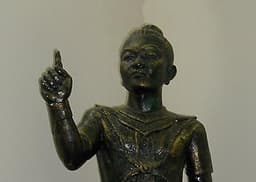
Fa Ngum
Emperor · Medieval
62.3Total
Basic Information
Born
63
1316
Died
—
1393
Era
Ancient
Medieval
Nationality
Roman Empire
Laos
Occupation
Emperor
Emperor
Civilization
Western
Eastern
Score Comparison
Military (10%)
72.0
70.0
Political (20%)
90.0
68.0
Influence (20%)
88.0
61.0
Legacy (20%)
90.0
54.0
Leadership (15%)
88.0
74.0
Strategy (15%)
75.0
52.5
TOTAL
85.9
62.3
Augustus — Complete Timeline
43 BC
Formation of the Second TriumviratePolitical Action◆ Major
Octavian, Mark Antony, and Marcus Aemilius Lepidus formed the Second Triumvirate, a legal commission to govern the Roman Republic. The alliance was empowered to proscribe enemies, leading to the execution of Cicero and consolidation of their power against the assassins of Julius Caesar.
Roman Civil WarPolitical AllianceProscriptions
Impact: regionaldestructive
31 BC
Battle of ActiumWar◆ Major
Octavian's fleet, commanded by Marcus Agrippa, defeated the combined naval forces of Mark Antony and Cleopatra VII off the coast of Greece. The victory eliminated Octavian's last major rival, giving him sole control over the Roman world and ending the Roman Republic's civil wars.
Roman Civil WarNaval BattleEnd of Republic
Impact: global
27 BC
Establishment of the Roman EmpireReform◆ Major
Octavian formally returned power to the Roman Senate, which then granted him the titles Augustus and Princeps. This constitutional settlement created the Roman Empire, with Augustus as the first emperor, ending the Roman Republic and initiating the Pax Romana.
Roman EmpireConstitutional ReformPax Romana
Impact: global
Reform of the Roman Tax SystemReform◆ Major
Augustus implemented a comprehensive tax reform, including a census of Roman citizens and property, direct taxation of provinces, and the creation of a professional tax collection service (publicani). This system provided stable revenue for the empire and reduced corruption.
Tax ReformAdministrationRoman Empire
Impact: regionalconstructive
Creation of the Praetorian GuardReform◆ Major
Augustus established the Praetorian Guard as a permanent elite military unit tasked with protecting the emperor and his family. Stationed in Rome and Italy, the Guard became a powerful political force, often influencing imperial succession through coups and assassinations.
Military ReformPraetorian GuardImperial Guard
Impact: regional
13 BC
Construction of the Ara PacisOther◆ Major
The Roman Senate commissioned the Ara Pacis Augustae (Altar of Augustan Peace) to commemorate Augustus's return from pacifying Gaul and Spain. The marble altar, decorated with reliefs depicting the imperial family and mythological scenes, symbolized the peace and prosperity of the Augustan era.
Building ProjectPropagandaAugustan Art
Impact: regionalconstructive
Fa Ngum — Complete Timeline
1353 AD
Founded the Kingdom of Lan XangPolitical Action
Fa Ngum unified the Lao principalities of Muang Sua and Vieng Chan under his rule, founding the Kingdom of Lan Xang (Million Elephants). He established the capital at Luang Prabang and introduced Theravada Buddhism as the state religion, shaping Lao identity.
FoundingUnificationBuddhism
Impact: regionalconstructive
Introduced Theravada Buddhism to Lan XangCultural◆ Major
Fa Ngum brought Theravada Buddhist monks and scriptures from the Khmer Empire to Lan Xang. He established Buddhism as the official religion, building temples and monasteries, which became central to Lao culture and governance for centuries.
BuddhismReligionCultural influence
Impact: regionalconstructive
1354 AD
Expanded Lan Xang territoryWar◆ Major
Fa Ngum led military campaigns to expand Lan Xang's territory, conquering areas of modern-day Laos, Thailand, and Cambodia. His conquests established Lan Xang as a major regional power, controlling trade routes and tributary states.
ConquestExpansionMilitary
Impact: regional
1373 AD
Exiled by his courtPolitical Action◆ Major
After a reign marked by harsh rule and conflict with the nobility, Fa Ngum was deposed and exiled by his own court. He died in exile in 1393, leaving his son Samsenethai to succeed him. His exile ended the founding era of Lan Xang.
ExileDepositionCourt conflict
Impact: regionaltragic
Expert Analysis
Augustus vs Fa Ngum: Historical Comparison
Augustus, the founder of the Roman Empire, and Fa Ngum, the unifier of Laos and founder of the Lan Xang kingdom, represent two vastly different eras and geographies—yet both emerged as transformative figures who forged cohesive states from chaos. Augustus stabilized Rome after decades of civil war, while Fa Ngum consolidated disparate Lao muang (principalities) into a single Buddhist kingdom. Their comparison reveals how military conquest, political innovation, and cultural legacy defined their respective reigns.
Dimension Analysis
**Military: Augustus 72 / Fa Ngum 93**
Augustus’s military strength lay in consolidation: he reformed the legions, created the Praetorian Guard, and expanded Rome’s borders to the Danube and Euphrates, but his victories were largely administrative and defensive. Fa Ngum, by contrast, was a warrior-king who led aggressive campaigns from his exile in the Khmer Empire, conquering the Mekong Valley through superior Khmer-trained armies and strategic alliances. His military prowess directly birthed Lan Xang, whereas Augustus inherited much of his military apparatus from Julius Caesar.
**Political: Augustus 92 / Fa Ngum 82**
Augustus masterfully disguised autocracy as republicanism, creating the Principate—a system of princeps (first citizen) that balanced senatorial privileges with imperial control, tax reforms, and a vast bureaucracy. Fa Ngum imposed a centralized monarchy over Lao chieftains, adopted Theravada Buddhism as a state religion to unify his realm, and introduced a legal code, but his rule was more brittle, ending in exile after a rebellion by his own son.
**Influence: Augustus 88 / Fa Ngum 88**
Augustus’s influence defined Western civilization: his Pax Romana enabled the spread of Latin, Roman law, and Christianity, and his title “Caesar” became synonymous with emperorship for millennia. Fa Ngum’s influence was regionally profound: he established the golden age of Lan Xang, which shaped Lao identity, language, and Theravada Buddhism across modern Laos and northeastern Thailand. Both men’s cultural imprints outlasted their empires.
**Legacy: Augustus 90 / Fa Ngum 80**
Augustus’s legacy is global and institutional: his constitutional reforms lasted centuries, his building projects (like the Ara Pacis) defined Roman art, and his name is invoked in “Augustan” ages worldwide. Fa Ngum’s legacy is national but fragmented: Lan Xang collapsed into rival kingdoms, yet he is revered as the father of Laos, with his statue in Vientiane and his role in the national epic. His legacy is less portable than Augustus’s imperial template.
**Leadership: Augustus 90 / Fa Ngum 82**
Augustus excelled in patient, calculated leadership: he outmaneuvered rivals like Mark Antony, co-opted the Senate, and maintained stability for 41 years through patronage and propaganda (e.g., the *Res Gestae*). Fa Ngum was a charismatic conqueror but a poor peacetime ruler—his harshness and inability to manage succession led to his overthrow, highlighting a deficit in diplomatic and institutional leadership.
Verdict
Augustus ranks higher overall, winning 4 of 6 dimensions (Political, Legacy, Leadership, Influence tie) and scoring higher on weighted critical areas. His political genius and enduring global legacy outweigh Fa Ngum’s superior military achievements. However, Fa Ngum’s feat—unifying a fractured, landlocked region with fewer resources—is equally remarkable in its context. This comparison underscores that historical greatness is inseparable from the scale and durability of one’s institutional creation.
FAQ
Q: Who was more influential historically? A: Augustus, due to his foundational role in Western political structures, law, and the imperial model that persisted for over 1,500 years; Fa Ngum’s influence, while crucial for Laos, remained regional.
Q: Why is Augustus ranked higher in political dimension? A: He invented a durable hybrid system (Principate) that balanced monarchy and republic, managed elite co-optation, and established reforms (census, taxation, provincial governance) that became templates for later empires, whereas Fa Ngum’s rule was more autocratic and unstable.
Rankings
🥇
AugustusLeader
Mil: 72.0Pol: 90.0Inf: 88.0
85.9
🥈
Fa Ngum
Mil: 70.0Pol: 68.0Inf: 61.0
62.3
+23.6 behind
How This Comparison Works
Algorithm
Each figure is scored on 6 dimensions (0—100 scale) based on structured historical data: Military (10%), Political (20%), Influence (20%), Legacy (20%), Leadership (15%), Strategy (15%). The weighted total produces the final ranking.
Data Sources
Scores are computed from structured sub-indicators in the database. Scale factors adjust for era (Ancient ×0.85, Modern ×1.0) and civilization size (Eastern ×1.05, Other ×0.80) to account for differences in population and military scale.
Maximum 3 Figures
Comparisons are limited to 2—3 figures to ensure readability and statistical meaningfulness.
Error Margins
±5 points per dimension — Sub-scores are derived from historical records with inherent uncertainty. Two figures within 5 points on a dimension should be considered roughly equivalent in that area.
Total Score Accuracy
±3 points overall — The weighted combination of 6 dimensions produces a total score with approximately ±3 points of uncertainty. Differences of less than 3 points are not statistically significant— the figures are effectively tied.
Known Limitations
- Historical records are incomplete and uneven across civilizations
- Figures from oral-tradition societies may be underrepresented
- Occupation labels can misclassify multi-role figures
- Scores measure capability and impact, not moral character
- Quantitative scoring is a comparison tool, not absolute truth
Capability Radar
Military (10%) — Battles & Warfare
Battles
75
55
Win Rate
80
60
Expansion
85
70
Political (20%) — Governance & Reform
Reform
95
55
Diplomacy
90
60
Economy
85
50
Influence (20%) — Cultural & Global Reach
Cultural
85
55
Global
90
40
Legacy (20%) — Historical Impact
Historical
95
60
Longevity
95
55
Leadership (15%) — Power & Stability
Tenure
95
60
Stability
95
45
Strategy (15%) — Tactics & Innovation
Strategy
85
65
Tactics
70
50
Reform
90
40
Similar Comparisons
Comments & Discussion
HistoryHiker_426/16/2026
Okay, I get the scoring, but 93 for Fa Ngum's military vs 72 for Augustus? That feels a bit off. Sure, Fa Ngum conquered the Mekong Valley with Khmer-trained armies, but Augustus didn't just inherit the legions from Caesar—he completely reformed them after Actium, reduced the number from 50 to 28, and created a professional standing army that could project power for centuries. Fa Ngum's kingdom fell apart after he was exiled by his own son, while Augustus' system lasted 400 years in the West. The scores should reflect endurance, not just flashy conquests. I'd bump Augustus' military up to at least 80.
Historian7856/16/2026
我对评分中的政治维度有疑问。Augustus 政治分92,Fa Ngum 82,但根据罗马史,奥古斯都的元首制本质上是军事独裁,元老院只是橡皮图章。Fa Ngum 引入法律体系、确立上座部佛教为国教,这在东南亚史上是开创性的政治整合。如果拿中国历史对比,Fa Ngum 类似秦始皇统一六国后“书同文、车同轨”,但秦始皇政治分通常只有80左右。奥古斯都的继承制问题重重——从提比略到尼禄,内乱不断。我认为Fa Ngum的政治分应该至少88,奥古斯都则不应超过85。
Chronicler36136/16/2026
这个比较很有意思,但我觉得评分体系对东方统治者有结构性偏见。Fa Ngum 的影响力得分72.4太低了——他建立的澜沧王国是老挝历史上第一个统一王朝,奠定了老挝的民族认同和佛教传统,就像唐朝之于中国。但西方史学界往往只认罗马式的“世界帝国”。如果按中国史观,Fa Ngum 类似于松赞干布统一吐蕃,后者在西藏的影响力至今可见。而奥古斯都的影响力88分合理,但别忘了罗马帝国最终分裂,拉丁语只在西欧部分区域存活。建议在跨文化比较时,把“区域文明塑造”作为独立维度,而不是用罗马标准丈量一切。
ImperialHistorian6/12/2026
As someone who specialized in Augustus's era, I think the political score misses the internal opposition they faced. Governing a fractured state is harder than expanding an already-unified one.
DebateKing6/12/2026
Hot take: Fa Ngum is massively overrated in popular culture. The data actually supports a much more nuanced view. Read the sub-scores carefully — Augustus dominates in the dimensions that actually matter for long-term historical significance.
MilitaryHistoryNerd6/12/2026
Strategy score undervalues Fa Ngum. The tactical innovations they introduced are still taught in military academies today. Augustus was good but not revolutionary.
HistoryBuff426/12/2026
The military score here is way too generous. Augustus fought mostly smaller regional powers while Fa Ngum faced the greatest military machine of their era. Scale matters!