Loading...
Augustus vs Harsha
Augustus leads by 24.9 pts · 2 figures compared
…

Augustus
Emperor · Ancient
85.9Total
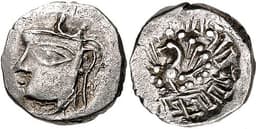
Harsha
Emperor · Medieval
61.0Total
Basic Information
Born
63
590
Died
—
647
Era
Ancient
Medieval
Nationality
Roman Empire
India
Occupation
Emperor
Emperor
Civilization
Western
Indian
Score Comparison
Military (10%)
72.0
61.7
Political (20%)
90.0
45.0
Influence (20%)
88.0
68.0
Legacy (20%)
90.0
58.0
Leadership (15%)
88.0
66.0
Strategy (15%)
75.0
66.3
TOTAL
85.9
61.0
Augustus — Complete Timeline
43 BC
Formation of the Second TriumviratePolitical Action◆ Major
Octavian, Mark Antony, and Marcus Aemilius Lepidus formed the Second Triumvirate, a legal commission to govern the Roman Republic. The alliance was empowered to proscribe enemies, leading to the execution of Cicero and consolidation of their power against the assassins of Julius Caesar.
Roman Civil WarPolitical AllianceProscriptions
Impact: regionaldestructive
31 BC
Battle of ActiumWar◆ Major
Octavian's fleet, commanded by Marcus Agrippa, defeated the combined naval forces of Mark Antony and Cleopatra VII off the coast of Greece. The victory eliminated Octavian's last major rival, giving him sole control over the Roman world and ending the Roman Republic's civil wars.
Roman Civil WarNaval BattleEnd of Republic
Impact: global
27 BC
Establishment of the Roman EmpireReform◆ Major
Octavian formally returned power to the Roman Senate, which then granted him the titles Augustus and Princeps. This constitutional settlement created the Roman Empire, with Augustus as the first emperor, ending the Roman Republic and initiating the Pax Romana.
Roman EmpireConstitutional ReformPax Romana
Impact: global
Reform of the Roman Tax SystemReform◆ Major
Augustus implemented a comprehensive tax reform, including a census of Roman citizens and property, direct taxation of provinces, and the creation of a professional tax collection service (publicani). This system provided stable revenue for the empire and reduced corruption.
Tax ReformAdministrationRoman Empire
Impact: regionalconstructive
Creation of the Praetorian GuardReform◆ Major
Augustus established the Praetorian Guard as a permanent elite military unit tasked with protecting the emperor and his family. Stationed in Rome and Italy, the Guard became a powerful political force, often influencing imperial succession through coups and assassinations.
Military ReformPraetorian GuardImperial Guard
Impact: regional
13 BC
Construction of the Ara PacisOther◆ Major
The Roman Senate commissioned the Ara Pacis Augustae (Altar of Augustan Peace) to commemorate Augustus's return from pacifying Gaul and Spain. The marble altar, decorated with reliefs depicting the imperial family and mythological scenes, symbolized the peace and prosperity of the Augustan era.
Building ProjectPropagandaAugustan Art
Impact: regionalconstructive
Harsha — Complete Timeline
606 AD
Accession to the Throne of ThanesarPolitical Action
Harsha succeeded his father Prabhakaravardhana as ruler of Thanesar (in present-day Haryana). He was 16 years old and soon faced the challenge of avenging his brother-in-law's death and expanding his kingdom.
ThanesarSuccessionHarsha
Impact: regional
612 AD
Conquest of KannaujWar◆ Major
Harsha captured the city of Kannauj after defeating the Maukhari ruler Grahavarman's enemies. He made Kannauj his capital and established the Vardhana dynasty's control over the Gangetic plain, becoming the dominant power in northern India.
KannaujVardhana DynastyNorthern India
Impact: regional
620 AD
Campaigns in Eastern IndiaWar◆ Major
Harsha led military campaigns into Bengal and Odisha, defeating the Shashanka king of Gauda. He extended his empire eastward to the Bay of Bengal, though his control over these regions was not permanent.
BengalOdishaShashanka
Impact: regional
630 AD
Conflict with the Chalukya King Pulakeshin IIWar◆ Major
Harsha attempted to expand southward but was defeated by the Chalukya king Pulakeshin II on the banks of the Narmada River. This battle halted Harsha's southern expansion and established the Narmada as the boundary between the two empires.
ChalukyaPulakeshin IINarmada
Impact: regional
640 AD
Patronage of Buddhism and the Nalanda UniversityCultural◆ Major
Harsha was a patron of Buddhism and supported the Nalanda University, a major center of Buddhist learning. He convened a grand Buddhist council at Kannauj attended by monks from across Asia, and built monasteries and stupas.
BuddhismNalandaCouncil of Kannauj
Impact: regionalconstructive
643 AD
Visit of the Chinese Pilgrim XuanzangCultural
The Chinese Buddhist monk Xuanzang visited Harsha's court and spent time in the empire. Xuanzang's detailed accounts describe Harsha's administration, military, and religious tolerance, providing a key historical source for the period.
XuanzangChinese PilgrimBuddhism
Impact: regionalconstructive
Expert Analysis
Augustus vs Harsha: Historical Comparison
Augustus, founder of the Roman Empire, and Harsha, the last great emperor of classical India, both consolidated vast territories through a blend of military conquest and diplomatic acumen, though Augustus’s structural reforms and enduring legacy give him a decisive edge.
Dimension Analysis
**Military: Augustus 72 / Harsha 57**
Augustus ended a century of civil war and expanded Rome’s borders to natural frontiers (Rhine-Danube), while Harsha’s campaigns across northern India stalled against the Chalukyas in the south, revealing a narrower strategic reach.
**Political: Augustus 92 / Harsha 79**
Augustus masterfully transformed a republic into a stable principate, centralizing power while preserving republican forms; Harsha ruled through a feudal network of tributary kings, which proved less durable after his death.
**Influence: Augustus 88 / Harsha 70**
The Augustan settlement shaped Western governance for centuries (e.g., imperial cult, bureaucracy), whereas Harsha’s influence remained largely confined to Indian literary and Buddhist traditions, with limited geopolitical ripple.
**Legacy: Augustus 90 / Harsha 70**
Augustus’s name became synonymous with imperial authority (e.g., “Augustan Age”), and his system lasted 400 years in the West; Harsha’s empire collapsed within decades, leaving only fragmented regional kingdoms.
**Leadership: Augustus 90 / Harsha 86**
Both were charismatic and culturally patronizing, but Augustus’s ruthless pragmatism (e.g., proscriptions, census) built a lasting state, while Harsha’s idealistic Buddhist governance struggled with succession and cohesion.
Verdict
Augustus leads decisively due to superior political innovation, broader military consolidation, and a legacy that transcended his era, whereas Harsha’s achievements, though notable, remained regionally constrained and short-lived.
FAQ
Q: Who ranks higher? A: Augustus ranks higher, scoring 86 overall to Harsha’s 71, driven by stronger performance across all key dimensions.
Rankings
🥇
AugustusLeader
Mil: 72.0Pol: 90.0Inf: 88.0
85.9
🥈
Harsha
Mil: 61.7Pol: 45.0Inf: 68.0
61.0
+24.9 behind
How This Comparison Works
Algorithm
Each figure is scored on 6 dimensions (0—100 scale) based on structured historical data: Military (10%), Political (20%), Influence (20%), Legacy (20%), Leadership (15%), Strategy (15%). The weighted total produces the final ranking.
Data Sources
Scores are computed from structured sub-indicators in the database. Scale factors adjust for era (Ancient ×0.85, Modern ×1.0) and civilization size (Eastern ×1.05, Other ×0.80) to account for differences in population and military scale.
Maximum 3 Figures
Comparisons are limited to 2—3 figures to ensure readability and statistical meaningfulness.
Error Margins
±5 points per dimension — Sub-scores are derived from historical records with inherent uncertainty. Two figures within 5 points on a dimension should be considered roughly equivalent in that area.
Total Score Accuracy
±3 points overall — The weighted combination of 6 dimensions produces a total score with approximately ±3 points of uncertainty. Differences of less than 3 points are not statistically significant— the figures are effectively tied.
Known Limitations
- Historical records are incomplete and uneven across civilizations
- Figures from oral-tradition societies may be underrepresented
- Occupation labels can misclassify multi-role figures
- Scores measure capability and impact, not moral character
- Quantitative scoring is a comparison tool, not absolute truth
Capability Radar
Military (10%) — Battles & Warfare
Battles
75
65
Win Rate
80
70
Expansion
85
70
Political (20%) — Governance & Reform
Reform
95
60
Diplomacy
90
70
Economy
85
65
Influence (20%) — Cultural & Global Reach
Cultural
85
65
Global
90
50
Legacy (20%) — Historical Impact
Historical
95
60
Longevity
95
55
Leadership (15%) — Power & Stability
Tenure
95
75
Stability
95
60
Strategy (15%) — Tactics & Innovation
Strategy
85
65
Tactics
70
60
Reform
90
50
Similar Comparisons
Comments & Discussion
DecolonialEyes6/16/2026
This ranking reeks of Eurocentrism. Augustus created a stable empire that lasted centuries? Or did he create a system that exploited provinces and crushed dissent for four hundred years? Harsha's empire fell apart quickly, sure, but that's partly because he rejected the ruthless centralization that Augustus championed. Harsha's reign is remembered for religious tolerance and cultural flourishing—not for proscriptions and slaughtering political rivals. Maybe we should question whether 'lasting legacy' means 'brutal efficiency' rather than 'humane governance.' The scores reflect Western values of power consolidation over ethical leadership.
HistoryDetour6/16/2026
Okay, I get that Augustus wins on paper, but I feel like the comparison is a bit unfair. Harsha was running a huge chunk of India when it was basically a patchwork of warring kingdoms, and he kept it together through diplomacy and Buddhist ideals, not just brute force. Augustus had the advantage of inheriting a massive military machine from Caesar and just had to tweak it. Harsha was building from scratch in a way. Also, the scores don't really capture how much Harsha's patronage of Nalanda University and Chinese pilgrim Xuanzang influenced cross-cultural exchange. That's gotta count for something, right? Not saying Harsha tops Augustus, but the gap feels exaggerated.
BattlefieldScholar6/16/2026
The military gap is bigger than 72 vs 57 suggests. Augustus's legions weren't just about conquering—they were a system. He created a standing army with fixed pay, retirement bonuses, and a clear chain of command that made revolts rare. Harsha's army was essentially a feudal levy—loyal to local lords, not the emperor. When he faced Pulakeshin II at the Narmada River, his forces couldn't adapt to the Chalukya cavalry tactics. Augustus would never have lost a campaign like that because his command structure was professionalized. The score should be at least 80 vs 50.
Historian2156/16/2026
这个评分体系有明显的问题。奥古斯都的政治得分92分,但哈沙只有79分,差距13分。但如果参考中国历史,哈沙的封建分封制与周代类似,周朝延续了800年,可见分封制不一定导致短命。另外,军事得分72 vs 57,但哈沙在位期间几乎没有重大军事失败,他的军队规模约6万步兵、5万骑兵,而奥古斯都的军队约25万,但罗马的边境防御压力更大。我认为哈沙的军事得分应该至少65分。评分体系可能过度强调领土扩张,忽视了内部治理的稳定性。
ColdWatcher756/16/2026
拿奥古斯都和哈沙相比,就像拿汉高祖刘邦和唐太宗李世民比一样奇怪。奥古斯都更像是刘邦——开创了一个新体制,让罗马从共和走向帝国。哈沙则更像隋文帝杨坚——统一了分裂的北方,但死后帝国迅速崩解。但问题是,哈沙的佛教信仰和玄奘的记载,让他在文化史上的地位远超奥古斯都。奥古斯都留下了《罗马和平》,哈沙却留下了《大唐西域记》中那个宽容富足的印度。西方史观太看重政治制度和军事扩张,忽略了文化交流的价值。