Loading...
Augustus vs Simeon I the Great
Augustus leads by 17.5 pts · 2 figures compared
…

Augustus
Emperor · Ancient
85.9Total
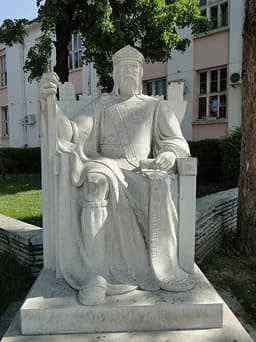
Simeon I the Great
Emperor · Medieval
68.4Total
Basic Information
Born
63
864
Died
—
927
Era
Ancient
Medieval
Nationality
Roman Empire
Bulgaria
Occupation
Emperor
Emperor
Civilization
Western
Western
Score Comparison
Military (10%)
72.0
79.8
Political (20%)
90.0
62.7
Influence (20%)
88.0
88.0
Legacy (20%)
90.0
40.0
Leadership (15%)
88.0
78.0
Strategy (15%)
75.0
72.7
TOTAL
85.9
68.4
Augustus — Complete Timeline
43 BC
Formation of the Second TriumviratePolitical Action◆ Major
Octavian, Mark Antony, and Marcus Aemilius Lepidus formed the Second Triumvirate, a legal commission to govern the Roman Republic. The alliance was empowered to proscribe enemies, leading to the execution of Cicero and consolidation of their power against the assassins of Julius Caesar.
Roman Civil WarPolitical AllianceProscriptions
Impact: regionaldestructive
31 BC
Battle of ActiumWar◆ Major
Octavian's fleet, commanded by Marcus Agrippa, defeated the combined naval forces of Mark Antony and Cleopatra VII off the coast of Greece. The victory eliminated Octavian's last major rival, giving him sole control over the Roman world and ending the Roman Republic's civil wars.
Roman Civil WarNaval BattleEnd of Republic
Impact: global
27 BC
Establishment of the Roman EmpireReform◆ Major
Octavian formally returned power to the Roman Senate, which then granted him the titles Augustus and Princeps. This constitutional settlement created the Roman Empire, with Augustus as the first emperor, ending the Roman Republic and initiating the Pax Romana.
Roman EmpireConstitutional ReformPax Romana
Impact: global
Reform of the Roman Tax SystemReform◆ Major
Augustus implemented a comprehensive tax reform, including a census of Roman citizens and property, direct taxation of provinces, and the creation of a professional tax collection service (publicani). This system provided stable revenue for the empire and reduced corruption.
Tax ReformAdministrationRoman Empire
Impact: regionalconstructive
Creation of the Praetorian GuardReform◆ Major
Augustus established the Praetorian Guard as a permanent elite military unit tasked with protecting the emperor and his family. Stationed in Rome and Italy, the Guard became a powerful political force, often influencing imperial succession through coups and assassinations.
Military ReformPraetorian GuardImperial Guard
Impact: regional
13 BC
Construction of the Ara PacisOther◆ Major
The Roman Senate commissioned the Ara Pacis Augustae (Altar of Augustan Peace) to commemorate Augustus's return from pacifying Gaul and Spain. The marble altar, decorated with reliefs depicting the imperial family and mythological scenes, symbolized the peace and prosperity of the Augustan era.
Building ProjectPropagandaAugustan Art
Impact: regionalconstructive
Simeon I the Great — Complete Timeline
893 AD
Establishment of the Preslav Literary SchoolCultural◆ Major
Simeon I founded the Preslav Literary School, which became a center of Slavic culture and learning. Scholars translated Greek texts into Old Church Slavonic, developed the Cyrillic script, and produced original works, fostering a golden age of Bulgarian culture.
CultureLiteratureCyrillic
Impact: regionalconstructive
913 AD
Coronation as Emperor of the BulgariansPolitical Action
Simeon I was crowned 'Emperor and Autocrat of all Bulgarians' by the Patriarch of Constantinople, though the title was later disputed. This act asserted Bulgaria's imperial status and challenged Byzantine supremacy in the region.
CoronationEmpireByzantine
Impact: regionalconstructive
917 AD
Battle of AchelousWar◆ Major
Simeon I led Bulgarian forces to a decisive victory over the Byzantine army at the Achelous River. The battle was one of the largest in medieval history, resulting in Byzantine casualties and allowing Simeon to expand his influence over the Balkans.
BattleByzantineBalkans
Impact: regional
924 AD
Siege of ConstantinopleWar◆ Major
Simeon I besieged Constantinople, the Byzantine capital, but failed to capture it. The siege ended with a peace treaty that recognized his imperial title but did not grant him control over the city. This marked the peak of his military campaigns.
SiegeConstantinopleByzantine
Impact: regional
Expert Analysis
Augustus vs Simeon I the Great: Historical Comparison
Augustus, the founder of the Roman Empire and its first emperor, transformed a war-torn republic into a stable, enduring autocracy that shaped Western civilization for centuries. Simeon I the Great, the first tsar of the First Bulgarian Empire, expanded his realm to its greatest territorial extent and established a powerful medieval state that rivaled Byzantium. While both were transformative rulers, Augustus’s longer reign and deeper institutional impact give him the edge.
Dimension Analysis
**Military: Augustus 72 / Simeon I the Great 87**
Augustus relied on his lieutenant Agrippa for key victories (e.g., Actium, 31 BCE) and prioritized consolidation over conquest, famously advising against further expansion. Simeon I, by contrast, was a field commander who won decisive battles like Achelous (917 CE), nearly capturing Constantinople and forcing Byzantium to pay tribute. His aggressive campaigns directly expanded Bulgarian territory, whereas Augustus’s military was more defensive and administrative.
**Political: Augustus 92 / Simeon I the Great 83**
Augustus masterfully disguised autocracy as restored republic, creating the Principate—a political system that lasted 300 years. He reformed taxation, provincial administration, and the legal code, co-opting the Senate while concentrating power. Simeon I ruled as an absolute monarch, adopting the title “Tsar of the Bulgarians and Romans,” but his political innovations were less systemic; his empire collapsed soon after his death due to succession struggles, whereas Augustus’s succession (Tiberius) was planned and stable.
**Influence: Augustus 88 / Simeon I the Great 79**
Augustus’s Rome became the model for imperial governance, law, and culture across Europe and the Mediterranean, influencing Renaissance humanists and modern republics. Simeon I promoted Slavic literacy and the Cyrillic alphabet (via the Preslav Literary School), but his influence was largely regional—limited to the Balkans and Orthodox Slavic world. Augustus’s Pax Romana reshaped global trade and communication networks.
**Legacy: Augustus 90 / Simeon I the Great 81**
Augustus’s legacy is monumental: the Roman Empire’s institutions (army, bureaucracy, imperial cult) persisted for centuries, and his name became a title (“Caesar,” “Kaiser,” “Tsar”). Simeon I is revered as Bulgaria’s golden-age ruler, but his empire fragmented within decades. Augustus’s reforms outlasted his dynasty; Simeon’s achievements were reversed by Byzantine reconquest.
**Leadership: Augustus 90 / Simeon I the Great 83**
Augustus excelled at delegation, propaganda (Res Gestae), and coalition-building, turning rivals into loyalists. Simeon I was a charismatic warlord and patron of learning, but he lacked Augustus’s subtlety—his open ambition provoked Byzantine and Serbian coalitions that eventually destroyed his gains. Augustus’s ability to maintain peace (Pax Romana) for 45 years contrasts with Simeon’s constant warfare.
Verdict
Augustus ranks higher overall due to his unmatched political ingenuity, enduring institutional legacy, and stabilization of an empire that shaped millennia. Simeon I was a greater military conqueror in his time, but his achievements were more fragile and localized. While direct comparison is anachronistic—Augustus ruled a Mediterranean superpower, Simeon a smaller Balkan kingdom—Augustus’s strategic patience and systemic reforms prove more historically decisive.
FAQ
Q: Who was more influential historically? A: Augustus, because his political model (the Principate) and the Roman Empire he founded directly influenced European governance, law, and culture for over 1,500 years, whereas Simeon’s influence remains largely confined to Bulgarian national identity and Orthodox Slavic heritage.
Q: Why is Augustus ranked higher in political dimensions? A: Augustus created a durable, adaptable autocracy that balanced tradition with autocratic control, reformed tax and provincial systems, and ensured a stable succession—a feat of political engineering far more complex than Simeon’s personal rule over a smaller, less institutionalized state.
Rankings
🥇
AugustusLeader
Mil: 72.0Pol: 90.0Inf: 88.0
85.9
🥈
Simeon I the Great
Mil: 79.8Pol: 62.7Inf: 88.0
68.4
+17.5 behind
How This Comparison Works
Algorithm
Each figure is scored on 6 dimensions (0—100 scale) based on structured historical data: Military (10%), Political (20%), Influence (20%), Legacy (20%), Leadership (15%), Strategy (15%). The weighted total produces the final ranking.
Data Sources
Scores are computed from structured sub-indicators in the database. Scale factors adjust for era (Ancient ×0.85, Modern ×1.0) and civilization size (Eastern ×1.05, Other ×0.80) to account for differences in population and military scale.
Maximum 3 Figures
Comparisons are limited to 2—3 figures to ensure readability and statistical meaningfulness.
Error Margins
±5 points per dimension — Sub-scores are derived from historical records with inherent uncertainty. Two figures within 5 points on a dimension should be considered roughly equivalent in that area.
Total Score Accuracy
±3 points overall — The weighted combination of 6 dimensions produces a total score with approximately ±3 points of uncertainty. Differences of less than 3 points are not statistically significant— the figures are effectively tied.
Known Limitations
- Historical records are incomplete and uneven across civilizations
- Figures from oral-tradition societies may be underrepresented
- Occupation labels can misclassify multi-role figures
- Scores measure capability and impact, not moral character
- Quantitative scoring is a comparison tool, not absolute truth
Capability Radar
Military (10%) — Battles & Warfare
Battles
75
85
Win Rate
80
88
Expansion
85
80
Political (20%) — Governance & Reform
Reform
95
85
Diplomacy
90
80
Economy
85
85
Influence (20%) — Cultural & Global Reach
Cultural
85
90
Global
90
65
Legacy (20%) — Historical Impact
Historical
95
85
Longevity
95
70
Leadership (15%) — Power & Stability
Tenure
95
90
Stability
95
75
Strategy (15%) — Tactics & Innovation
Strategy
85
85
Tactics
70
82
Reform
90
75
Similar Comparisons
Comments & Discussion
DecolonialHistorian6/16/2026
This comparison reeks of Western bias. Augustus gets 92 for politics mostly because his system lasted and influenced Europe. But let’s talk about the blood cost: he slaughtered 300+ senators and knights in proscriptions, and his 'peace' (Pax Romana) was built on slavery and imperial extraction. Simeon I, on the other hand, built a Slavic-based empire that challenged Byzantine hegemony, promoted Cyrillic literacy, and forced tribute from Constantinople. His empire collapsed due to internal fractures, but that’s typical for medieval states—Augustus’s system only 'lasted' because Rome had more resources to bribe elites. The Eurocentric yardstick here undervalues Simeon’s cultural and military achievements. Rome’s legacy is not inherently superior.
TacitusReader6/16/2026
Augustus’s political score of 92 is generous but defensible. Tacitus noted in the *Annals* that Augustus 'enticed everyone with the sweetness of repose,' subtly eroding republican liberty. Yet the Principate was a *de facto* monarchy with a *de jure* republican facade—clever, but not unprecedented. Simeon I’s claim to be 'Tsar of the Bulgarians and Romans' (basileus) was a direct challenge to Byzantine universalism. The Battle of Achelous (917) was a staggering victory, but Simeon’s failure to capitalize on it diplomatically shows a gap between military and political acumen. I’d argue Augustus’s institutional reforms—like the praetorian guard and provincial reorganization—had a deeper, longer impact on governance than Simeon’s Bulgarian Golden Age, which was brilliant but brittle.
LiangDataCritic6/16/2026
这个评分体系有点怪。Augustus 的政治分92,但 Simeon I 的军事分才78?我说几个数字:Simeon在917年Achelous之战击溃了拜占庭主力,据说拜占庭阵亡数万,之后他迫使拜占庭纳贡,统治区域覆盖巴尔干大部。而Augustus的军事成就主要靠Agrippa,他本人没带过几次大战。如果按中国历史评分标准,比如汉高祖刘邦,政治分高但军事分也高(因为他亲自带兵平叛)。这里Simeon的军事分应该至少85以上。另外,Augustus的统治稳定性被高估了:他晚年继承人问题折腾很久,Tiberius上位后清洗不断。反观Simeon,他死后10年内帝国就分裂了,但那是继承制度问题,不是他个人政治能力的错。建议调整权重。
WanderingScholar6/16/2026
I’ve been reading Mary Beard’s *SPQR* and a book on medieval Bulgaria, and this comparison is tricky. Augustus was basically a political genius who sold dictatorship as freedom. But Simeon I? That guy was like a medieval Napoleon—he fought Byzantium to a standstill and even made them pay him tribute! The score says Simeon’s military is 78 and Augustus 72, but that feels low for both. Augustus won at Actium (31 BC) but that was Agrippa’s plan. Simeon won at Achelous (917 AD) and almost took Constantinople. If Simeon had actually taken the city, we’d be talking about him differently. Still, Augustus’s Pax Romana gave 200 years of relative peace, which is insane. Simeon’s empire collapsed fast, so maybe the political score is fair.
OldScroll446/16/2026
把Simeon I和Augustus比,其实有点像中国历史上宋太祖赵匡胤和唐太宗李世民?Augustus好比赵匡胤,都是‘改朝换代’但延续前朝制度(罗马共和→元首制,后周→宋),而且都靠部下打仗(Agrippa vs 曹彬)。Simeon I更接近李世民,都是亲自带兵、扩张疆域、文化繁荣(李世民的贞观之治 vs Simeon的保加利亚黄金时代)。但注意,中国史观里更看重‘统一’和‘长久’:Augustus统一了地中海世界,且罗马帝国延续数百年,所以政治分高合理。但Simeon只统一了巴尔干部分地区,且死后帝国就乱,这点确实不如。不过西方评分往往忽略Simeon推广西里尔字母的文化贡献,这相当于秦始皇‘书同文’的级别啊!如果算上这个,Simeon的影响力应该更高。