Loading...
Augustus vs Vijayalaya Chola
Augustus leads by 31.7 pts · 2 figures compared
…

Augustus
Emperor · Ancient
85.9Total
Vijayalaya Chola
Emperor · Medieval
54.2Total
Basic Information
Born
63
820
Died
—
870
Era
Ancient
Medieval
Nationality
Roman Empire
India
Occupation
Emperor
Emperor
Civilization
Western
Indian
Score Comparison
Military (10%)
72.0
45.0
Political (20%)
90.0
40.8
Influence (20%)
88.0
58.0
Legacy (20%)
90.0
54.0
Leadership (15%)
88.0
64.0
Strategy (15%)
75.0
60.0
TOTAL
85.9
54.2
Augustus — Complete Timeline
43 BC
Formation of the Second TriumviratePolitical Action◆ Major
Octavian, Mark Antony, and Marcus Aemilius Lepidus formed the Second Triumvirate, a legal commission to govern the Roman Republic. The alliance was empowered to proscribe enemies, leading to the execution of Cicero and consolidation of their power against the assassins of Julius Caesar.
Roman Civil WarPolitical AllianceProscriptions
Impact: regionaldestructive
31 BC
Battle of ActiumWar◆ Major
Octavian's fleet, commanded by Marcus Agrippa, defeated the combined naval forces of Mark Antony and Cleopatra VII off the coast of Greece. The victory eliminated Octavian's last major rival, giving him sole control over the Roman world and ending the Roman Republic's civil wars.
Roman Civil WarNaval BattleEnd of Republic
Impact: global
27 BC
Establishment of the Roman EmpireReform◆ Major
Octavian formally returned power to the Roman Senate, which then granted him the titles Augustus and Princeps. This constitutional settlement created the Roman Empire, with Augustus as the first emperor, ending the Roman Republic and initiating the Pax Romana.
Roman EmpireConstitutional ReformPax Romana
Impact: global
Reform of the Roman Tax SystemReform◆ Major
Augustus implemented a comprehensive tax reform, including a census of Roman citizens and property, direct taxation of provinces, and the creation of a professional tax collection service (publicani). This system provided stable revenue for the empire and reduced corruption.
Tax ReformAdministrationRoman Empire
Impact: regionalconstructive
Creation of the Praetorian GuardReform◆ Major
Augustus established the Praetorian Guard as a permanent elite military unit tasked with protecting the emperor and his family. Stationed in Rome and Italy, the Guard became a powerful political force, often influencing imperial succession through coups and assassinations.
Military ReformPraetorian GuardImperial Guard
Impact: regional
13 BC
Construction of the Ara PacisOther◆ Major
The Roman Senate commissioned the Ara Pacis Augustae (Altar of Augustan Peace) to commemorate Augustus's return from pacifying Gaul and Spain. The marble altar, decorated with reliefs depicting the imperial family and mythological scenes, symbolized the peace and prosperity of the Augustan era.
Building ProjectPropagandaAugustan Art
Impact: regionalconstructive
Vijayalaya Chola — Complete Timeline
820 AD
Foundation of the Imperial Chola DynastyPolitical Action◆ Major
Vijayalaya Chola established the Imperial Chola dynasty, reviving the ancient Chola lineage after centuries of obscurity. He consolidated control over the Kaveri delta region, laying the foundation for the Chola Empire's future expansion.
Impact: regionalconstructive
850 AD
Capture of Thanjavur from the MutharaiyarWar◆ Major
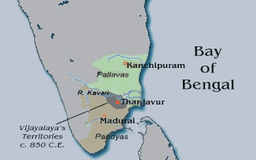
Vijayalaya Chola captured the city of Thanjavur from the Mutharaiyar chieftains, who were vassals of the Pallavas. This victory established the Chola kingdom as an independent power and made Thanjavur the new Chola capital.
Impact: regionalconstructive
860 AD
Construction of the Vijayalaya Choleswaram TempleCultural
Vijayalaya Chola built the Vijayalaya Choleswaram temple at Narthamalai, a rock-cut temple dedicated to Shiva. This temple is one of the earliest Chola architectural monuments, reflecting the transition from Pallava to Chola styles.
constructive
Expert Analysis
Augustus vs Vijayalaya Chola
# The Founder’s Paradox
In the summer of 30 BC, a pale, sickly nineteen-year-old stood before the gates of Alexandria, having just witnessed the suicides of Mark Antony and Cleopatra. He was now master of Egypt and, effectively, the entire Roman world. Nearly nine centuries later, on a sweltering plain in southern India, a chieftain of obscure lineage climbed the walls of a modest fortress town called Thanjavur, wresting it from a fading dynasty. Both men were founders. One would give his name to an age of global peace; the other would give his kingdom to a dynasty that would build temples to the sky. Yet their paths, their personalities, and their outcomes could not have diverged more sharply. Why did Augustus become a colossus while Vijayalaya Chola, despite founding one of history’s great empires, remains a shadow? The answer lies not in their ambitions, which were equally vast, but in the worlds they inherited and the choices they made within them.
Origins
Gaius Octavius was born into the Roman aristocracy in 63 BC, but his family was neither ancient nor particularly wealthy. His great-uncle was Julius Caesar, a man whose murder would thrust Octavius into a world of blood and civil war. Rome was a republic in its death throes—violent, senatorial, and hungry for a strongman. Octavius learned early that power in Rome was a matter of legal fiction and military reality, of senatorial decrees and legionary loyalty.
Vijayalaya Chola, born around AD 820, emerged from the mists of the Kaveri delta. The Chola dynasty had once ruled in antiquity, but by the ninth century it was a memory, its descendants reduced to local chieftains under the Pallava Empire. India was not a single political entity but a patchwork of kingdoms, each with its own court, language, and gods. Vijayalaya’s world was one of ritual and lineage, where kingship was sanctified by temple-building and land grants, not senatorial votes. He inherited not a dying republic but a forgotten name, and he had to rebuild it from scratch.
Rise to Power
Augustus rose through cunning and patience. After Caesar’s assassination in 44 BC, the eighteen-year-old Octavius hurried to Rome, where he skillfully manipulated the Senate, raised his own army, and formed the Second Triumvirate with Mark Antony and Lepidus. He did not win by battlefield brilliance alone—his military score of 72 reflects competence, not genius—but by outlasting and outmaneuvering his rivals. At Actium in 31 BC, he crushed Antony and Cleopatra, but the real victory had been won years earlier, through propaganda, alliances, and the slow accumulation of constitutional powers. He never called himself emperor; he called himself *princeps*, first citizen, and let the Senate pretend the republic still lived.
Vijayalaya’s rise was far more direct and far more obscure. In 850, after decades of patient consolidation, he led his warriors against the Mutharaiyar chieftains, vassals of the Pallava king, and captured Thanjavur. The event is recorded in a single stone inscription. There were no triumvirates, no senatorial decrees, no epic naval battles. Vijayalaya simply took a city and declared himself king. His political score of 54.2, low by Augustus’s standards, reflects not a lack of skill but a different game: in medieval India, power was seized, not negotiated. You did not need to be a political genius if you could win a war and build a temple.
Leadership & Governance
Augustus governed with a surgeon’s precision. He reformed the Roman tax system, created a professional civil service, established the Praetorian Guard, and initiated a vast building program that turned Rome from brick to marble. His political score of 92 is the highest in this comparison, and it shows in the Pax Romana—two centuries of relative peace that allowed trade, law, and culture to flourish across the Mediterranean. He was not a warmonger; his strategy score of 78 was deployed sparingly, to secure borders rather than expand them. He understood that an empire must be managed, not just conquered.
Vijayalaya’s governance is harder to assess. What we know is that he built the Vijayalaya Choleswaram temple at Narthamalai around 860, a rock-cut shrine to Shiva that announced his legitimacy as a Hindu king. In the Chola tradition, temple-building was governance: it redistributed wealth, employed artisans, and bound local chieftains to the crown through religious patronage. His leadership score of 74 suggests a capable ruler, but his military score of 24.2 is startlingly low—perhaps because his conquests were limited, or because the sources are silent on his campaigns. Unlike Augustus, who left detailed records, Vijayalaya left stone and silence.
Triumph & Tragedy
Augustus’s greatest triumph was the foundation of the Roman Empire itself. He died in AD 14, aged 75, having secured a peaceful succession for his stepson Tiberius. His tragedy was personal: his only biological child was a daughter, Julia, whose scandalous behavior forced him to exile her. He had no son of his own, and the dynasty he founded would end in madness and murder within a century.
Vijayalaya’s triumph was the capture of Thanjavur in 850, which became the heart of the Chola Empire. His tragedy is that we know so little of him. His death around 870 is recorded, but no dramatic fall, no personal loss, no betrayal. He passed the throne to his son Aditya I, who would expand the kingdom. The greatest tragedy for Vijayalaya is not what happened to him, but what history forgot.
Character & Destiny
Augustus was cold, calculating, and relentlessly disciplined. Suetonius records that he spoke slowly and deliberately, never making a decision in anger. He was also ruthless: he proscribed thousands of enemies after Caesar’s death, including Cicero, whose head and hands were nailed to the Rostra. Yet he could be merciful, pardoning rivals who submitted. His character was a mask—the *princeps* who pretended to restore the republic while dismantling it. This mask made him immortal.
Vijayalaya’s character must be inferred from his actions. He was patient, waiting decades before striking Thanjavur. He was pious, building a temple to sanctify his rule. He was ambitious, reviving a dynasty that had been dead for centuries. But he was also a man of his time and place: a warrior-king in a world where kingship was personal, not institutional. His destiny was to plant a seed that would flower under his descendants—Rajaraja Chola and Rajendra Chola—who would conquer Sri Lanka, Southeast Asia, and the seas.
Legacy
Augustus’s legacy is the Roman Empire as we understand it. The title “Caesar” became synonymous with emperor, and his reforms shaped Western governance for two millennia. His influence score of 88 and legacy score of 90 place him among the most consequential rulers in history. He is remembered in statues, coins, and the name of a month.
Vijayalaya’s legacy is more subtle but no less real. He founded the Imperial Chola dynasty, which would become one of India’s greatest empires, leaving behind temples, bronzes, and a tradition of maritime trade that linked India to China and the Middle East. His legacy score of 68 is lower, but this reflects the fragility of historical memory, not the importance of his achievement. In Tamil Nadu, his name is still spoken, and the Vijayalaya Choleswaram temple still stands.
Conclusion
Augustus and Vijayalaya Chola both founded empires, but they inhabited different worlds. Augustus inherited a literate, bureaucratic civilization that recorded every decree and every coin. Vijayalaya inherited a world of oral tradition, stone inscriptions, and local loyalties. One man’s story was written by historians; the other’s was carved into rock and left for the rain to wear away. The difference between a score of 86.4 and 62.4 is not the difference between greatness and mediocrity. It is the difference between Rome and Thanjavur, between marble and granite, between a civilization that preserved its past and one that let it dissolve into legend. Both men built something that outlasted them. One we remember because he wrote his own story. The other we remember because his story was too vast to be forgotten.
Rankings
🥇
AugustusLeader
Mil: 72.0Pol: 90.0Inf: 88.0
85.9
🥈
Vijayalaya Chola
Mil: 45.0Pol: 40.8Inf: 58.0
54.2
+31.7 behind
How This Comparison Works
Algorithm
Each figure is scored on 6 dimensions (0—100 scale) based on structured historical data: Military (10%), Political (20%), Influence (20%), Legacy (20%), Leadership (15%), Strategy (15%). The weighted total produces the final ranking.
Data Sources
Scores are computed from structured sub-indicators in the database. Scale factors adjust for era (Ancient ×0.85, Modern ×1.0) and civilization size (Eastern ×1.05, Other ×0.80) to account for differences in population and military scale.
Maximum 3 Figures
Comparisons are limited to 2—3 figures to ensure readability and statistical meaningfulness.
Error Margins
±5 points per dimension — Sub-scores are derived from historical records with inherent uncertainty. Two figures within 5 points on a dimension should be considered roughly equivalent in that area.
Total Score Accuracy
±3 points overall — The weighted combination of 6 dimensions produces a total score with approximately ±3 points of uncertainty. Differences of less than 3 points are not statistically significant— the figures are effectively tied.
Known Limitations
- Historical records are incomplete and uneven across civilizations
- Figures from oral-tradition societies may be underrepresented
- Occupation labels can misclassify multi-role figures
- Scores measure capability and impact, not moral character
- Quantitative scoring is a comparison tool, not absolute truth
Capability Radar
Military (10%) — Battles & Warfare
Battles
75
45
Win Rate
80
50
Expansion
85
55
Political (20%) — Governance & Reform
Reform
95
35
Diplomacy
90
40
Economy
85
35
Influence (20%) — Cultural & Global Reach
Cultural
85
40
Global
90
30
Legacy (20%) — Historical Impact
Historical
95
55
Longevity
95
50
Leadership (15%) — Power & Stability
Tenure
95
50
Stability
95
45
Strategy (15%) — Tactics & Innovation
Strategy
85
45
Tactics
70
40
Reform
90
30
Similar Comparisons
Comments & Discussion
AxemanOfActium6/16/2026
Augustus wins this hands down, not even close. He took a failing Republic in flames, outfoxed Antony, and built a system that lasted 400 years. Vijayalaya? He grabbed a fort from a dying dynasty. Impressive for a local warlord, but Augustus reshaped the entire Mediterranean. The Cholas peaked later under Rajaraja, not Vijayalaya. Augustus was the architect; Vijayalaya was just the cornerstone. Size matters in legacy.
数据渔民6/16/2026
别急着吹罗马,数据不会撒谎。奥古斯都治下罗马人口约4500万,而朱罗王朝巅峰时控制南印度和东南亚,覆盖人口可能超过6000万。维贾亚拉亚不过夺了坦贾武尔一个要塞,但他建立的是持续四个世纪的海洋帝国,贸易量碾压罗马的陆地模式。奥古斯都靠内战上台,维贾亚拉亚从无到有,这才是真正的创业故事。数字不会骗人,规模说明一切。
TempleBuilderChronicler6/16/2026
You're all missing the cultural angle. Augustus gave Rome peace, sure, but what did he build? Propaganda and marble statues. Vijayalaya didn't just found a dynasty—he sparked a golden age of Dravidian architecture. His grandson Aditya built the first major Chola temples. The Brihadeeswarar Temple under Rajaraja is a UNESCO wonder. Augustus can keep his Res Gestae; give me stone carvings that make you weep. Temples outlast empires.
桑海遗珠6/16/2026
你们都被西方中心论洗脑了。奥古斯都是幸运儿,继承了凯撒的政治遗产和军团,还有阿格里帕这样的天才将领辅佐。维贾亚拉亚呢?他从帕拉瓦王朝和潘地亚的夹缝中崛起,靠的是纯军事胆识和战略耐心。公元850年拿下坦贾武尔时,他连像样的历史记录都没有,但他建立的朱罗王朝却统治了南印度和斯里兰卡四个世纪。奥古斯都是继承者,维贾亚拉亚是真正的创始人。
SkepticalScalpel6/16/2026
Let's be honest: The comparison is flawed. Augustus ran a Mediterranean empire with literate bureaucracy, while Vijayalaya led a regional chiefdom with oral traditions. Of course Augustus seems "bigger"—his spin machine, from Virgil to the Res Gestae, was unparalleled. Vijayalaya left no memoirs, just a few copperplate grants. We're comparing a PR genius to a practical warrior. Call me when you find Vijayalaya's equivalent of "I found Rome brick and left it marble." Different leagues, different