Loading...
Aung San Suu Kyi vs Julio Prestes
Aung San Suu Kyi leads by 5.9 pts · 2 figures compared
…
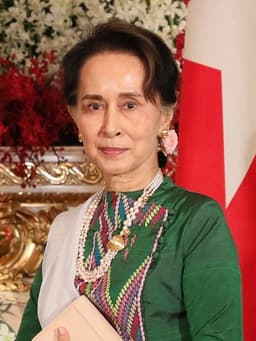
Aung San Suu Kyi
Politician · Modern
48.4Total

Julio Prestes
Politician · Modern
42.5Total
Basic Information
Born
1945
1882
Died
—
1946
Era
Modern
Modern
Nationality
Myanmar
Brazil
Occupation
Politician
Politician
Civilization
Eastern
Western
Score Comparison
Military (10%)
15.3
50.0
Political (20%)
46.6
27.9
Influence (20%)
55.0
45.5
Legacy (20%)
54.0
35.8
Leadership (15%)
64.0
58.8
Strategy (15%)
30.6
42.0
TOTAL
48.4
42.5
Aung San Suu Kyi — Complete Timeline
1989 AD
House arrest under SLORCPolitical Action◆ Major
Aung San Suu Kyi was placed under house arrest by the State Law and Order Restoration Council (SLORC) after leading pro-democracy protests. She was offered release if she left Myanmar but refused, remaining under detention for nearly 15 years total.
House arrestPro-democracySLORC
Impact: nationaldestructive
1991 AD
Nobel Peace Prize awardCultural◆ Major
Aung San Suu Kyi was awarded the Nobel Peace Prize for her non-violent struggle for democracy and human rights in Myanmar. Her sons accepted on her behalf as she remained under house arrest.
Nobel PrizePeaceDemocracy
Impact: globalconstructive
2010 AD
Release from house arrestPolitical Action◆ Major
Aung San Suu Kyi was released from house arrest six days after Myanmar's general election. Her release followed years of international pressure and marked a turning point in Myanmar's political transition.
ReleasePolitical transitionDemocracy
Impact: nationalprogressive
2012 AD
Elected to parliamentPolitical Action◆ Major
Aung San Suu Kyi won a seat in Myanmar's parliament in by-elections, becoming an opposition MP. Her National League for Democracy party won 43 of 45 contested seats, marking her entry into formal politics.
ElectionParliamentNLD
Impact: nationalprogressive
2016 AD
Appointed State CounsellorPolitical Action◆ Major
Aung San Suu Kyi was appointed State Counsellor of Myanmar, a position created for her, effectively making her the de facto leader. The constitution barred her from the presidency due to her foreign spouse and children.
State CounsellorLeadershipConstitution
Impact: nationalconstructive
2017 AD
Rohingya genocide defensePolitical Action◆ Major
Aung San Suu Kyi defended Myanmar's military actions against the Rohingya minority at the International Court of Justice, denying genocide allegations. This stance severely damaged her international reputation as a human rights icon.
RohingyaGenocideICJHuman rights
Impact: globaldestructive
2021 AD
Detained in 2021 coupPolitical Action◆ Major
Aung San Suu Kyi was detained by Myanmar's military in a coup that overturned the 2020 election results. She was charged with multiple offenses including corruption and violating the Official Secrets Act, leading to long prison sentences.
CoupDetentionMilitaryElection
Impact: nationaltragic
Julio Prestes — Complete Timeline
1927 AD
Served as Governor of São PauloPolitical Action
Before his presidential election, Prestes served as Governor of S
GovernorshipSão PauloInfrastructure
Impact: regionalconstructive
1930 AD
Elected President of Brazil (but not inaugurated)Political Action◆ Major
Júlio Prestes was elected President of Brazil in the 1930 election, but he was prevented from taking office by the Revolution of 1930. The coup led by Getúlio Vargas overthrew the government before his inauguration.
1930 ElectionRevolutionNon-Inauguration
Impact: nationaltragic
Exiled to EuropePolitical Action◆ Major
After the 1930 Revolution, Prestes was arrested and then exiled to Europe. He lived in Portugal and France for several years, unable to return to Brazil due to the political climate.
Exile1930 RevolutionPost-Election
Impact: nationaltragic
1934 AD
Returned to Brazil and Retired from PoliticsPolitical Action
Prestes returned to Brazil after the political situation stabilized, but he retired from active politics. He lived quietly until his death in 1946, never holding public office again.
ReturnRetirementPolitical Inactivity
Impact: national
Expert Analysis
Origins
**Aung San Suu Kyi** was born on June 19, 1945, in Rangoon, Burma (now Myanmar). Her father, General Aung San, is considered the father of modern Myanmar, but he was assassinated when she was two years old. Her mother, Khin Kyi, was a diplomat. Suu Kyi studied at the University of Delhi and later at St Hugh's College, Oxford, earning degrees in philosophy, politics, and economics. She worked at the UN and married Michael Aris, a British academic.
**Julio Prestes** was born on March 15, 1882, in Itapetininga, São Paulo, Brazil. He came from a political family; his father was a colonel. Prestes studied law at the University of São Paulo and became a lawyer. He entered politics early, serving as a state deputy and later as a federal deputy. He was a member of the Republican Party of São Paulo (PRP), representing the coffee oligarchy.
Rise to Power
**Suu Kyi** rose to prominence during the 8888 Uprising in Myanmar. After the military crackdown, she co-founded the National League for Democracy (NLD) in 1988. In 1990, the NLD won a landslide victory in elections, but the military annulled the results. Suu Kyi was placed under house arrest from 1989 to 1995, and again intermittently until 2010. Her non-violent struggle earned her the Nobel Peace Prize in 1991. She was released in 2010 and entered parliament in 2012 after by-elections.
**Prestes** rose through the ranks of São Paulo politics. He served as Governor of São Paulo from 1927 to 1930, focusing on infrastructure and public works. In 1930, he was elected President of Brazil with support from the ruling elite. However, before his inauguration, the Revolution of 1930 led by Getúlio Vargas ousted the government. Prestes was arrested and exiled to Europe, never assuming office.
Leadership & Governance
**Suu Kyi** became State Counsellor in 2016, effectively leading Myanmar's civilian government. She prioritized national reconciliation, economic reforms, and peace talks with ethnic armed groups. However, her leadership was criticized for failing to address the Rohingya crisis. She defended the military's actions, which led to international condemnation and a drop in her reputation. Her governance score of 64.0 reflects initial success but later decline.
**Prestes** never governed as president. His only executive experience was as Governor of São Paulo (1927–1930). He implemented infrastructure projects, such as road construction and railway expansion. His leadership score of 58.8 is based on his gubernatorial tenure, but he lacked national-level experience. His political strategies (42.0) were insufficient to prevent the coup.
Triumph & Tragedy
**Suu Kyi's** triumph was her peaceful struggle for democracy, winning the Nobel Peace Prize (1991) and leading the NLD to power. Her tragedy is the Rohingya genocide. In 2017, the Myanmar military launched a brutal crackdown, and Suu Kyi defended the army, tarnishing her legacy. She was convicted in 2021 after a military coup and is now imprisoned.
**Prestes'** triumph was being democratically elected president in 1930, a milestone in Brazil's First Republic. His tragedy is that he never took office. The Revolution of 1930 ended the Old Republic and led to Vargas's dictatorship. Prestes lived in exile and died in obscurity in 1946.
Character & Destiny
**Suu Kyi** is disciplined, resilient, and committed to non-violence. Her character shaped her fate: her refusal to compromise with the military led to long house arrest. But her loyalty to the military over the Rohingya cost her moral authority. Her legacy score of 54.0 is mixed.
**Prestes** was a competent administrator but lacked the political acumen to navigate the turbulent 1930s. He was a product of the oligarchic system, and his destiny was sealed by forces beyond his control. His influence (45.5) was limited by his short political career.
Legacy
**Suu Kyi** is remembered as a democracy icon who fell from grace. Her legacy is contested: she inspired pro-democracy movements but failed to protect minorities. Her impact on Myanmar is profound, but her reputation is damaged.
**Prestes** is a footnote in Brazilian history, remembered as the president who never was. His legacy is minor, mainly studied as a symbol of the end of the Old Republic.
Conclusion
Aung San Suu Kyi (total score 48.4) has had a greater impact than Julio Prestes (42.5). Her role in Myanmar's transition to democracy, despite later failures, outweighs Prestes' brief governorship and unfulfilled presidency. Suu Kyi's influence on global human rights discourse is significant, while Prestes remains a historical curiosity. Thus, Suu Kyi's legacy, though flawed, is more substantial.
Rankings
🥇
Aung San Suu KyiLeader
Mil: 15.3Pol: 46.6Inf: 55.0
48.4
🥈
Julio Prestes
Mil: 50.0Pol: 27.9Inf: 45.5
42.5
+5.9 behind
How This Comparison Works
Algorithm
Each figure is scored on 6 dimensions (0—100 scale) based on structured historical data: Military (10%), Political (20%), Influence (20%), Legacy (20%), Leadership (15%), Strategy (15%). The weighted total produces the final ranking.
Data Sources
Scores are computed from structured sub-indicators in the database. Scale factors adjust for era (Ancient ×0.85, Modern ×1.0) and civilization size (Eastern ×1.05, Other ×0.80) to account for differences in population and military scale.
Maximum 3 Figures
Comparisons are limited to 2—3 figures to ensure readability and statistical meaningfulness.
Error Margins
±5 points per dimension — Sub-scores are derived from historical records with inherent uncertainty. Two figures within 5 points on a dimension should be considered roughly equivalent in that area.
Total Score Accuracy
±3 points overall — The weighted combination of 6 dimensions produces a total score with approximately ±3 points of uncertainty. Differences of less than 3 points are not statistically significant— the figures are effectively tied.
Known Limitations
- Historical records are incomplete and uneven across civilizations
- Figures from oral-tradition societies may be underrepresented
- Occupation labels can misclassify multi-role figures
- Scores measure capability and impact, not moral character
- Quantitative scoring is a comparison tool, not absolute truth
Capability Radar
Military (10%) — Battles & Warfare
Battles
13
29
Win Rate
19
32
Expansion
18
32
Political (20%) — Governance & Reform
Reform
40
10
Diplomacy
55
10
Economy
20
10
Influence (20%) — Cultural & Global Reach
Cultural
65
5
Global
65
5
Legacy (20%) — Historical Impact
Historical
60
10
Longevity
55
5
Leadership (15%) — Power & Stability
Tenure
60
0
Stability
15
5
Strategy (15%) — Tactics & Innovation
Strategy
21
37
Tactics
26
43
Reform
32
41
Similar Comparisons
Comments & Discussion
No comments yet. Be the first to share your thoughts!