Loading...
Aung San Suu Kyi vs Napoleon Bonaparte
Napoleon Bonaparte leads by 22.5 pts · 2 figures compared
…
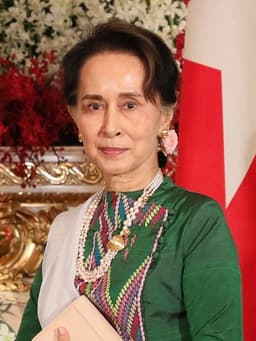
Aung San Suu Kyi
Politician · Modern
48.4Total

Napoleon Bonaparte
General · Modern
70.9Total
Basic Information
Born
1945
1769
Died
—
1821
Era
Modern
Modern
Nationality
Myanmar
France
Occupation
Politician
General
Civilization
Eastern
Western
Score Comparison
Military (10%)
15.3
94.0
Political (20%)
46.6
72.0
Influence (20%)
55.0
40.0
Legacy (20%)
54.0
80.0
Leadership (15%)
64.0
78.0
Strategy (15%)
30.6
90.0
TOTAL
48.4
70.9
Aung San Suu Kyi — Complete Timeline
1989 AD
House arrest under SLORCPolitical Action◆ Major
Aung San Suu Kyi was placed under house arrest by the State Law and Order Restoration Council (SLORC) after leading pro-democracy protests. She was offered release if she left Myanmar but refused, remaining under detention for nearly 15 years total.
House arrestPro-democracySLORC
Impact: nationaldestructive
1991 AD
Nobel Peace Prize awardCultural◆ Major
Aung San Suu Kyi was awarded the Nobel Peace Prize for her non-violent struggle for democracy and human rights in Myanmar. Her sons accepted on her behalf as she remained under house arrest.
Nobel PrizePeaceDemocracy
Impact: globalconstructive
2010 AD
Release from house arrestPolitical Action◆ Major
Aung San Suu Kyi was released from house arrest six days after Myanmar's general election. Her release followed years of international pressure and marked a turning point in Myanmar's political transition.
ReleasePolitical transitionDemocracy
Impact: nationalprogressive
2012 AD
Elected to parliamentPolitical Action◆ Major
Aung San Suu Kyi won a seat in Myanmar's parliament in by-elections, becoming an opposition MP. Her National League for Democracy party won 43 of 45 contested seats, marking her entry into formal politics.
ElectionParliamentNLD
Impact: nationalprogressive
2016 AD
Appointed State CounsellorPolitical Action◆ Major
Aung San Suu Kyi was appointed State Counsellor of Myanmar, a position created for her, effectively making her the de facto leader. The constitution barred her from the presidency due to her foreign spouse and children.
State CounsellorLeadershipConstitution
Impact: nationalconstructive
2017 AD
Rohingya genocide defensePolitical Action◆ Major
Aung San Suu Kyi defended Myanmar's military actions against the Rohingya minority at the International Court of Justice, denying genocide allegations. This stance severely damaged her international reputation as a human rights icon.
RohingyaGenocideICJHuman rights
Impact: globaldestructive
2021 AD
Detained in 2021 coupPolitical Action◆ Major
Aung San Suu Kyi was detained by Myanmar's military in a coup that overturned the 2020 election results. She was charged with multiple offenses including corruption and violating the Official Secrets Act, leading to long prison sentences.
CoupDetentionMilitaryElection
Impact: nationaltragic
Napoleon Bonaparte — Complete Timeline
1799 AD
Coup of 18 BrumaireOther◆ Major
Napoleon Bonaparte, with support from his brother Lucien and key political figures, overthrew the Directory in a bloodless coup. He established the Consulate with himself as First Consul, effectively becoming the ruler of France. This event ended the French Revolution's most unstable period.
French RevolutionCoupRise to Power
Impact: regional
1804 AD
Promulgation of the Napoleonic CodeOther◆ Major
Napoleon enacted the Civil Code of the French, known as the Napoleonic Code, a comprehensive set of laws that replaced the fragmented feudal legal systems. The code established legal equality, protected property rights, and secularized law. It became the basis for legal systems in many European and world countries.
Legal ReformNapoleonic CodeCivil Law
Impact: globalconstructive
1805 AD
Battle of AusterlitzWar◆ Major
Napoleon's Grande Arm
Napoleonic WarsBattleDecisive Victory
Impact: global
1812 AD
Invasion of RussiaWar◆ Major
Napoleon led the Grande Arm
Napoleonic WarsInvasionDisaster
Impact: globaldestructive
1815 AD
Battle of WaterlooWar◆ Major
Napoleon's French army was defeated by the combined forces of the Duke of Wellington's Anglo-Allied army and Gebhard Leberecht von Bl
Napoleonic WarsBattleFinal Defeat
Impact: globaldestructive
Expert Analysis
aung-san-suu-kyi-vs-napoleon-bonaparte
# The General and the Peacemaker: Two Paths to Power, Two Tragedies of Legacy
On a June morning in 1815, Napoleon Bonaparte watched his Imperial Guard march toward the smoking ridges of Mont-Saint-Jean, their bearskin caps silhouetted against a gray sky. He had staked everything on this single, desperate charge. Less than two centuries later, in a humid courtroom in Naypyidaw, another leader sat in silence as judges read verdicts that would sentence her to decades in prison. Aung San Suu Kyi, once the world’s symbol of peaceful resistance, now faced the same machinery of military oppression she had fought her entire life. One man conquered Europe with cannon and cavalry; one woman challenged a junta with words and will. Yet both ended in defeat, their names forever tangled with the question of what power does to those who pursue it.
Origins
Napoleon was born on Corsica in 1769, the same year the island passed from Genoese to French rule. He grew up speaking Italian, a perpetual outsider in the French military academies where he learned artillery. His family was minor nobility, impoverished but proud, and young Napoleon devoured books on military history and philosophy. The French Revolution shattered the old order just as he came of age, creating opportunities that would never have existed under a king. He was a child of chaos, trained to exploit it.
Aung San Suu Kyi entered the world in 1945, the daughter of General Aung San, the man who negotiated Burma’s independence from Britain. When she was two, her father was assassinated by political rivals. She grew up in India and England, studying politics and philosophy at Oxford, marrying a British scholar. For years she lived far from Myanmar, raising her children in the quiet English countryside. She was an outsider too, but one who returned to her homeland only when her mother fell ill in 1988—just as a nationwide pro-democracy uprising erupted. She had not planned to lead a revolution. The revolution chose her.
Rise to Power
Napoleon’s ascent was a study in audacity. At twenty-four, he drove the British out of Toulon with a brilliant artillery deployment. At twenty-six, he saved the French government from a royalist mob with a “whiff of grapeshot”—cannon fire into the streets of Paris. Then came Italy, where he led half-starved armies across the Alps to defeat Austria in a series of lightning campaigns. Each victory made him more indispensable. By 1799, he was powerful enough to stage a coup and crown himself First Consul. In 1804, he made himself Emperor. Every step was calculated, every risk measured against ambition.
Suu Kyi’s path was slower, quieter, and far more dangerous. In 1988, she addressed a crowd of half a million people in Rangoon, calling for democracy. The military responded with bullets—thousands died. But instead of fleeing, she stayed. The junta placed her under house arrest in 1989, expecting her to fade into obscurity. Instead, she became a symbol. In 1991, while still confined to her crumbling lakeside villa, she won the Nobel Peace Prize. Her husband, a British academic, was denied entry to Myanmar; she chose not to leave the country to see him, even when he lay dying of cancer. She sacrificed everything for a cause that offered no guarantee of victory.
Leadership & Governance
As Emperor, Napoleon was a whirlwind of reform. He centralized the French state, created the Bank of France, and established lycées to educate a new elite. His Napoleonic Code standardized law across Europe, abolishing feudalism and establishing principles of equality before the law—though women’s rights were sharply curtailed. On the battlefield, he was nearly peerless: he won sixty battles, from Austerlitz in 1805 to Wagram in 1809, outmaneuvering larger armies with speed and deception. His political wisdom, however, was flawed. He appointed his brothers to thrones across Europe, treating kingdoms as family property. He invaded Russia in 1812 with 600,000 men; fewer than 100,000 returned.
Suu Kyi’s governance was a tragedy of unrealized potential. When she finally became State Counsellor in 2016, effectively Myanmar’s leader, she inherited a country still dominated by a military that had written the constitution to guarantee its own power. She could not control the army, could not amend the charter, could not even call herself President. Yet she was held responsible for everything. Her greatest failure came in 2017, when the military launched a brutal campaign against the Rohingya Muslim minority, driving hundreds of thousands into Bangladesh. At the International Court of Justice, she defended the army, denying genocide. The woman who had spent fifteen years under house arrest for opposing military rule now stood beside the generals.
Triumph & Tragedy
Napoleon’s greatest moment was Austerlitz, where he lured the combined Russian and Austrian armies into a trap and destroyed them. His empire stretched from Spain to Poland. But his tragedy was the Russian campaign, a disaster of hubris. He underestimated the winter, the distance, and the enemy’s willingness to burn their own land. The Grand Army dissolved in snow and ice. Exiled to Elba, he escaped, raised another army, and met his final defeat at Waterloo in 1815. The British and Prussians broke his guard, and he spent his last six years on the remote island of Saint Helena, dictating memoirs and dying of stomach cancer.
Suu Kyi’s triumph was her release from house arrest in 2010, after nearly two decades of confinement. She walked free to a crowd of thousands, her face weathered but unchanged. In 2012, she was elected to parliament. In 2015, her party won a landslide. The world celebrated. But her tragedy unfolded slowly, in courtrooms and refugee camps. When the military seized power again in 2021, arresting her on trumped-up charges, she faced a different world—one where her moral authority had been shattered by her defense of the Rohingya genocide. She is still in prison, serving a sentence of thirty-three years.
Character & Destiny
Napoleon was driven by an insatiable hunger for glory. “I live only for posterity,” he once said, and he meant it. He believed he could shape history through sheer force of will, and for a time, he was right. But his arrogance blinded him to limits. He could not stop expanding, could not share power, could not accept defeat. His personality—brilliant, restless, tyrannical—built an empire and then destroyed it.
Suu Kyi was driven by a different force: the memory of her father. She believed in moral leadership, in the power of nonviolence and international opinion. But when power finally came, she discovered that morality alone could not control an army or protect a minority. She chose political survival over principle, and in doing so, she lost the very thing that had made her invincible. Her personality—disciplined, stubborn, solitary—sustained her through years of isolation but failed her when compromise was required.
Legacy
Napoleon’s legacy is a contradiction. He spread the ideals of the French Revolution—nationalism, legal equality, meritocracy—across Europe, but he also caused millions of deaths and restored slavery in French colonies. He is remembered as a military genius and a tyrant, a reformer and a conqueror. His name still appears in the Napoleonic Code, in the streets of Paris, in the shape of modern warfare.
Suu Kyi’s legacy is even more painful. She was once a symbol of hope, a reminder that one person could stand against a dictatorship. Now she is a symbol of how power corrupts, how even the purest ideals can be betrayed. Historians will debate whether she had any choice, whether she could have stopped the genocide, whether she was a prisoner of circumstance or an accomplice to atrocity. The answer is not simple, and that is the tragedy.
Conclusion
Two figures, separated by centuries and continents, yet bound by a common thread: the pursuit of power and the price of its possession. Napoleon conquered Europe but could not hold it. Suu Kyi conquered injustice but could not govern with it. Both ended their careers isolated, one on a volcanic island, the other in a military prison. Their stories remind us that history judges leaders not by their intentions but by their outcomes, and that the distance between triumph and tragedy is often measured not in miles, but in the choices made when no good choice remains.
Rankings
🥇
Napoleon BonaparteLeader
Mil: 94.0Pol: 72.0Inf: 40.0
70.9
🥈
Aung San Suu Kyi
Mil: 15.3Pol: 46.6Inf: 55.0
48.4
+22.5 behind
How This Comparison Works
Algorithm
Each figure is scored on 6 dimensions (0—100 scale) based on structured historical data: Military (10%), Political (20%), Influence (20%), Legacy (20%), Leadership (15%), Strategy (15%). The weighted total produces the final ranking.
Data Sources
Scores are computed from structured sub-indicators in the database. Scale factors adjust for era (Ancient ×0.85, Modern ×1.0) and civilization size (Eastern ×1.05, Other ×0.80) to account for differences in population and military scale.
Maximum 3 Figures
Comparisons are limited to 2—3 figures to ensure readability and statistical meaningfulness.
Error Margins
±5 points per dimension — Sub-scores are derived from historical records with inherent uncertainty. Two figures within 5 points on a dimension should be considered roughly equivalent in that area.
Total Score Accuracy
±3 points overall — The weighted combination of 6 dimensions produces a total score with approximately ±3 points of uncertainty. Differences of less than 3 points are not statistically significant— the figures are effectively tied.
Known Limitations
- Historical records are incomplete and uneven across civilizations
- Figures from oral-tradition societies may be underrepresented
- Occupation labels can misclassify multi-role figures
- Scores measure capability and impact, not moral character
- Quantitative scoring is a comparison tool, not absolute truth
Capability Radar
Military (10%) — Battles & Warfare
Battles
13
95
Win Rate
19
90
Expansion
18
95
Political (20%) — Governance & Reform
Reform
40
95
Diplomacy
55
80
Economy
20
85
Influence (20%) — Cultural & Global Reach
Cultural
65
85
Global
65
90
Legacy (20%) — Historical Impact
Historical
60
95
Longevity
55
90
Leadership (15%) — Power & Stability
Tenure
60
85
Stability
15
70
Strategy (15%) — Tactics & Innovation
Strategy
21
95
Tactics
26
98
Reform
32
92
Similar Comparisons
Comments & Discussion
火炮诗人6/17/2026
拿波仑是艺术化的暴君,崇拜效率与纪律;昂山素季是道德化的囚徒,被西方捧上神坛却暴露人性瑕疵。她的诺贝尔和平奖光环在罗兴亚问题上彻底碎裂——沉默不是智慧,而是纵容。拿破仑至少懂得:当你不开枪,历史就用你的名字致敬敌人。两位都在终点背叛了起点,但背叛自己的和平主义更令人失望。
数据刺客6/17/2026
比战力?拿破仑最差战绩是滑铁卢损失25,000人,但他在奥斯特里茨以少胜多。昂山素季最多动员几十万平民游行,军事政变后零战场成果。如果说政治是概率游戏,拿破仑胜率80%以上,她?全国民主联盟执政五年,GDP增速仅6.8%——不如军政府时期。数字不会撒谎:一个用火炮改写地图,一个用选票换虚名,结局都一样,但拿破仑的遗产是法典,她的标签只剩“囚徒”。
Historian2026/17/2026
Napoleon understood power as a kinetic force—unleash it or be crushed by it. Suu Kyi saw power as moral authority you possess by refusing to wield it. One was a warhorse, the other a martyr. But here’s the twist: Suu Kyi wasn’t martyred. She ended up enabling the same military she once condemned. Napoleon at least died with his delusions intact. Suu Kyi betrayed hers—and that’s the harder tragedy to stomach.
Historian6366/17/2026
Both are cautionary tales in the old Greek sense: hubris before the fall. Napoleon’s nemesis was his overreach into Russia’s winter; Suu Kyi’s was her belief that personal virtue could check military brutality. But here’s what the comparison misses—Napoleon’s failure was spectacular, Suu Kyi’s was slow and bureaucratic. One died in exile writing memoirs, the other sits alone in a house arrest she helped legitimize. History prefers the dramatic, not the quiet decay.
Chronicler83696/17/2026
The comparison is too neat: ‘Both lost everything.’ Wrong. Napoleon built an empire that reshaped Europe—legal codes, infrastructure, modern statecraft. Suu Kyi? A Nobel Prize and years of house arrest that translated into nothing structural. The real tragedy is that one man’s defeat ended his ambitions, but one woman’s principles couldn’t survive her rise. She’s not Napoleon’s equal; she’s the tragic mirror of what happens when pacifism meets the machine guns it refuses to acknowledge.