Loading...
Ba Maw vs Julius Caesar
Julius Caesar leads by 38.7 pts · 2 figures compared
…
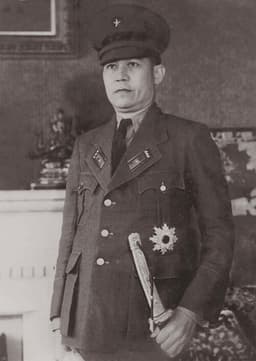
Ba Maw
Politician · Modern
44.1Total

Julius Caesar
General · Ancient
82.8Total
Basic Information
Born
1893
-100
Died
1977
-44
Era
Modern
Ancient
Nationality
Burma
Roman Republic
Occupation
Politician
General
Civilization
Eastern
Western
Score Comparison
Military (10%)
14.4
88.0
Political (20%)
40.8
78.0
Influence (20%)
54.9
85.0
Legacy (20%)
43.3
82.0
Leadership (15%)
58.8
80.0
Strategy (15%)
31.9
85.0
TOTAL
44.1
82.8
Ba Maw — Complete Timeline
1937 AD
Became first premier of British BurmaPolitical Action◆ Major
Ba Maw was appointed as the first Premier of British Burma under the new constitution that separated Burma from British India. He led a government focused on self-governance and economic development, but faced challenges from both colonial authorities and nationalist factions.
PremiershipSelf-governanceColonial politics
Impact: nationalconstructive
1939 AD
Formed the Freedom BlocPolitical Action◆ Major
Ba Maw founded the Freedom Bloc, a coalition of nationalist parties demanding immediate independence from Britain. The bloc organized protests and strikes, pressuring the British government and uniting various factions under a common goal.
NationalismCoalitionIndependence movement
Impact: nationalconstructive
1942 AD
Collaborated with Japan during WWIIPolitical Action◆ Major
Ba Maw collaborated with the Japanese Imperial Army during their invasion of Burma, serving as head of the Burmese government under Japanese occupation. He declared Burma independent in 1943, but the regime was a puppet state controlled by Japan.
CollaborationJapanese occupationPuppet state
Impact: nationaldestructive
1943 AD
Declared independence under JapanPolitical Action◆ Major
Ba Maw declared Burma an independent state under Japanese sponsorship, with himself as head of state. The declaration was not recognized by the Allies and ended with Japan's defeat in 1945, leaving Ba Maw's reputation tarnished.
IndependenceJapanese sponsorshipWWII
Impact: national
1945 AD
Arrested by British after warPolitical Action
After Japan's surrender, British authorities arrested Ba Maw for collaboration. He was imprisoned but later released without trial. His political career effectively ended, and he spent his later years in obscurity.
ArrestCollaborationPost-war
Impact: nationaltragic
Julius Caesar — Complete Timeline
58 BC
Gallic WarsWar◆ Major
Caesar, as proconsul of Gaul, launched a series of campaigns that conquered all of Gaul (modern France, Belgium, and parts of Switzerland). He fought numerous battles, including against the Helvetii, the Belgae, and the Gallic chieftain Vercingetorix. The wars brought immense wealth and a loyal army to Caesar.
Gallic WarsConquestRoman Expansion
Impact: regional
49 BC
Crossing the RubiconPolitical Action◆ Major
Caesar led Legio XIII across the Rubicon River into Italy, defying the Roman Senate's order to disband his army. This act triggered a civil war against Pompey and the Optimates, ultimately leading to Caesar's dictatorship and the end of the Roman Republic.
Roman Civil WarEnd of RepublicPower Struggle
Impact: global
48 BC
Battle of PharsalusWar◆ Major
Caesar's outnumbered army defeated the larger forces of Pompey the Great at Pharsalus in Greece. Caesar's tactical use of a reserve line to counter Pompey's cavalry charge proved decisive. Pompey fled to Egypt, where he was assassinated, leaving Caesar as the undisputed master of the Roman world.
Roman Civil WarBattleDecisive Victory
Impact: regional
44 BC
Appointment as Dictator for LifePolitical Action◆ Major
The Roman Senate appointed Caesar dictator perpetuo (dictator for life), granting him unprecedented personal power. This move concentrated military, legislative, and judicial authority in one person, effectively ending the Roman Republic's traditional system of checks and balances and alarming many senators.
DictatorshipEnd of RepublicPower Consolidation
Impact: regionaldestructive
Assassination on the Ides of MarchPolitical Action◆ Major
A group of Roman senators, led by Marcus Junius Brutus and Gaius Cassius Longinus, stabbed Caesar to death at a meeting of the Senate in the Theatre of Pompey. The assassination was intended to restore the Republic, but instead triggered another civil war that led to the rise of the Roman Empire.
AssassinationRoman PoliticsEnd of Republic
Impact: globaldestructive
Expert Analysis
ba-maw-vs-julius-caesar
### The Dictator and the Collaborator: Two Paths to Power, Two Ends of Empire
On a January morning in 49 BCE, Julius Caesar stood at the banks of the Rubicon, a small river that marked the boundary of his command. He knew that crossing it with his legions would mean civil war, the destruction of the Republic he served, and his own transformation from general to outlaw. He crossed anyway. Nineteen centuries later, in the sweltering heat of a Burmese summer in 1942, Ba Maw stood before a microphone in Rangoon, announcing his collaboration with the invading Japanese Imperial Army. He knew that this alliance would brand him a traitor in the eyes of the British Empire he had once served as premier. He spoke anyway. One man would be murdered by his peers, his name immortalized as the father of an empire. The other would be arrested, imprisoned, and largely forgotten. What drove these two men—both brilliant politicians, both ambitious, both willing to break the rules of their world—to such different fates? The answer lies not in their character alone, but in the tectonic forces of their respective eras.
### Origins
Julius Caesar was born into a patrician family during the dying days of the Roman Republic, a world of violent factionalism where the old senatorial aristocracy was crumbling under the weight of its own corruption. His father died when he was sixteen, leaving him to navigate a treacherous political landscape with nothing but his name, his wits, and a desperate need for money. The Republic rewarded boldness, and Caesar learned early that audacity—whether in the Forum or on the battlefield—was the only currency that mattered. He was shaped by a culture that worshipped military glory and political cunning in equal measure.
Ba Maw, by contrast, was born in 1893 in British Burma, a colony where the local elite could rise only so far. His father was a judge, his family part of a small, educated class that served the Empire while resenting it. Ba Maw studied law in England, absorbing the ideals of Western democracy even as he felt the sting of colonial subjugation. He returned to Burma a nationalist, but one who understood that power in a colony required a delicate dance: you had to fight the British while knowing they held all the cards. His world was not one of legions and civil wars, but of petitions, negotiations, and the brutal reality that Burma was a pawn in a global game.
### Rise to Power
Caesar’s path to dominance was a masterpiece of calculated risk. He borrowed fortunes to fund public spectacles, allied with the wealthy Crassus and the popular Pompey, and then spent eight years conquering Gaul—a campaign that made him a legend and gave him an army loyal to him alone, not to Rome. When the Senate ordered him to disband his legions, he knew that obedience meant political extinction. The Rubicon was not a moment of madness; it was the logical culmination of a life spent betting everything on the next throw of the dice.
Ba Maw’s rise was slower, more constrained. In 1937, he became the first Premier of British Burma under a new constitution that gave the colony limited self-rule. It was a genuine achievement, but the power was hollow: the British governor still held ultimate authority over defense, finance, and foreign affairs. Ba Maw tried to push for full independence, founding the Freedom Bloc in 1939, a coalition of nationalist parties that demanded immediate freedom. But when the British refused, and when the Japanese invaded in 1942, Ba Maw faced a choice that Caesar never had to consider: collaborate with an occupying power, or resist and likely be crushed. He chose collaboration, believing it was the only way to achieve the independence he had dreamed of.
### Leadership & Governance
Caesar governed as he fought: with speed, clarity, and a willingness to break precedent. As dictator, he reformed the calendar, granted citizenship to allies, launched massive public works, and centralized power in his own hands. His military genius was inseparable from his political strategy—every campaign was designed to weaken his rivals and strengthen his personal authority. He was ruthless but also merciful, pardoning former enemies in a calculated display of magnanimity. Yet his governance was a high-wire act: he never built a stable system, only a personal dominance that depended on his own survival.
Ba Maw’s leadership was defined by limitation. As head of state under Japanese occupation from 1943, he declared Burma independent, but it was a puppet regime in every sense. The Japanese controlled the army, the economy, and the secret police. Ba Maw’s political score of 77.2 reflects his genuine skill in navigating this impossible situation—he managed to maintain a semblance of Burmese administration, and his speeches were filled with genuine nationalist fervor. But his military score of 22.8 tells the real story: he had no army, no power to enforce his will, and no strategy beyond survival. Where Caesar commanded legions, Ba Maw commanded only words.
### Triumph & Tragedy
Caesar’s greatest triumph was his conquest of Gaul, a feat that doubled Rome’s territory and made him the most famous man in the Republic. His tragedy was the Ides of March, 44 BCE, when his own senators—men he had pardoned and promoted—stabbed him to death in the Senate chamber. He died not from a foreign enemy, but from the very system he had tried to transcend.
Ba Maw’s triumph was the declaration of independence in 1943, a moment when he stood before his people and declared Burma free. But it was a hollow victory, and his tragedy came in 1945, when the Japanese surrendered and the British returned. He was arrested for collaboration, imprisoned, and then released—but his reputation was destroyed. He lived until 1977, a forgotten figure in a country that had moved on without him.
### Character & Destiny
Caesar was a man of boundless ambition and cold calculation. He understood that in the Roman Republic, power was a zero-sum game: either you dominated, or you were destroyed. His personality—arrogant, charismatic, and utterly unafraid of risk—pushed him toward the edge again and again, until finally the edge pushed back. His death was the price of his audacity.
Ba Maw was equally ambitious, but his ambition was tempered by the realities of colonialism. He was a pragmatist, not a revolutionary; he believed in negotiation and alliance, not civil war. When the Japanese offered him a chance to lead, he took it, believing it was the only path forward. But collaboration is a gamble that rarely pays off in history. His character—patient, intellectual, and cautious—led him to a different kind of tragedy: not a dramatic assassination, but a slow fade into irrelevance.
### Legacy
Caesar’s legacy is monumental. His name became a title—Kaiser, Tsar—and his reforms laid the foundation for the Roman Empire that would endure for centuries. He is remembered as a military genius, a political visionary, and a cautionary tale about the dangers of unchecked power. His influence score of 85.0 and legacy score of 82.0 reflect a man who reshaped the Western world.
Ba Maw’s legacy is far more modest. His influence score of 73.9 and legacy score of 60.8 place him as a footnote in the story of Burmese independence. He is remembered, if at all, as a man who made a terrible choice in a desperate time. Yet his story holds a mirror to Caesar’s: both men sought power in a world that was crumbling around them. Caesar’s world was the Roman Republic, which he shattered and rebuilt into an empire. Ba Maw’s world was the British Empire, which he tried to use and was used by in turn.
### Conclusion
Standing at the Rubicon, Caesar knew he was crossing into history. Standing at the microphone in 1942, Ba Maw knew he was crossing into infamy. Both men were driven by the same hunger for power and independence, but their eras gave them different tools and different fates. Caesar had an army; Ba Maw had only a promise from a foreign invader. Caesar could reshape the world; Ba Maw could only try to survive its reshaping. In the end, the difference between triumph and tragedy is not always character—it is circumstance. And the hardest lesson of history is that some men are born to cross rivers, while others are born to be swept away by the current.
Rankings
🥇
Julius CaesarLeader
Mil: 88.0Pol: 78.0Inf: 85.0
82.8
🥈
Ba Maw
Mil: 14.4Pol: 40.8Inf: 54.9
44.1
+38.7 behind
How This Comparison Works
Algorithm
Each figure is scored on 6 dimensions (0—100 scale) based on structured historical data: Military (10%), Political (20%), Influence (20%), Legacy (20%), Leadership (15%), Strategy (15%). The weighted total produces the final ranking.
Data Sources
Scores are computed from structured sub-indicators in the database. Scale factors adjust for era (Ancient ×0.85, Modern ×1.0) and civilization size (Eastern ×1.05, Other ×0.80) to account for differences in population and military scale.
Maximum 3 Figures
Comparisons are limited to 2—3 figures to ensure readability and statistical meaningfulness.
Error Margins
±5 points per dimension — Sub-scores are derived from historical records with inherent uncertainty. Two figures within 5 points on a dimension should be considered roughly equivalent in that area.
Total Score Accuracy
±3 points overall — The weighted combination of 6 dimensions produces a total score with approximately ±3 points of uncertainty. Differences of less than 3 points are not statistically significant— the figures are effectively tied.
Known Limitations
- Historical records are incomplete and uneven across civilizations
- Figures from oral-tradition societies may be underrepresented
- Occupation labels can misclassify multi-role figures
- Scores measure capability and impact, not moral character
- Quantitative scoring is a comparison tool, not absolute truth
Capability Radar
Military (10%) — Battles & Warfare
Battles
13
95
Win Rate
18
92
Expansion
20
97
Political (20%) — Governance & Reform
Reform
30
90
Diplomacy
45
85
Economy
20
82
Influence (20%) — Cultural & Global Reach
Cultural
20
88
Global
20
94
Legacy (20%) — Historical Impact
Historical
25
95
Longevity
15
96
Leadership (15%) — Power & Stability
Tenure
40
75
Stability
15
60
Strategy (15%) — Tactics & Innovation
Strategy
23
94
Tactics
25
96
Reform
32
88
Similar Comparisons
Comments & Discussion
No comments yet. Be the first to share your thoughts!