Loading...
Ban Ki-moon vs Giuseppe Conte
Giuseppe Conte leads by 2.2 pts · 2 figures compared
…
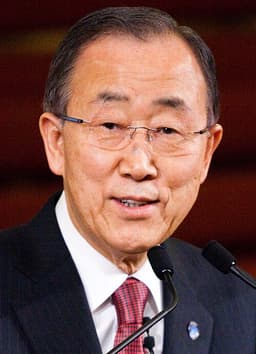
Ban Ki-moon
Politician · Modern
53.2Total

Giuseppe Conte
Politician · Modern
55.4Total
Basic Information
Born
1944
1964
Died
—
—
Era
Modern
Modern
Nationality
Korea
Italy
Occupation
Politician
Politician
Civilization
Eastern
Western
Score Comparison
Military (10%)
15.2
50.0
Political (20%)
68.0
68.0
Influence (20%)
58.0
56.4
Legacy (20%)
46.7
43.3
Leadership (15%)
72.0
74.0
Strategy (15%)
44.8
42.1
TOTAL
53.2
55.4
Ban Ki-moon — Complete Timeline
2007 AD
Elected Secretary-General of the United NationsPolitical Action◆ Major
Ban Ki-moon became the eighth Secretary-General of the United Nations, succeeding Kofi Annan. His election was seen as a consensus choice, and he focused on climate change, peacekeeping, and UN reform.
UN Secretary-GeneralLeadershipGlobal Governance
Impact: globalconstructive
2011 AD
Launched the Sustainable Energy for All initiativeReform◆ Major
Ban launched the Sustainable Energy for All initiative, aiming to achieve universal energy access, double energy efficiency, and double renewable energy use by 2030. The initiative mobilized governments and private sector partners.
EnergySustainabilityClimate Change
Impact: globalconstructive
Oversaw UN response to the Syrian Civil WarPolitical Action◆ Major
Ban Ki-moon led UN efforts to address the Syrian Civil War, including humanitarian aid and peace negotiations. The UN faced criticism for failing to stop the conflict, which killed hundreds of thousands and displaced millions.
SyriaHumanitarian CrisisUN Failure
Impact: globaltragic
2015 AD
Adopted the Sustainable Development GoalsReform◆ Major
Ban oversaw the adoption of the 2030 Agenda for Sustainable Development, including 17 Sustainable Development Goals to end poverty, protect the planet, and ensure prosperity for all by 2030.
SDGsDevelopmentGlobal Goals
Impact: globalconstructive
Adopted the Paris Agreement on climate changePolitical Action◆ Major
Ban played a key role in the adoption of the Paris Agreement at COP21, a global treaty to limit global warming to well below 2
Climate ChangeParis AgreementCOP21
Impact: globalconstructive
Giuseppe Conte — Complete Timeline
2018 AD
Appointed Prime Minister of ItalyPolitical Action◆ Major
Conte was appointed Prime Minister by President Mattarella, leading a coalition between the Five Star Movement and the League. A law professor with no prior political experience, he became the head of a populist government.
PopulismCoalitionGovernment Formation
Impact: national
2019 AD
Formed Second Government with Five Star and PDPolitical Action◆ Major
After the League left the coalition, Conte formed a new government with the Five Star Movement and the Democratic Party. This shift moved the government from right-wing populism to a more centrist, pro-European stance.
Coalition ChangeGovernment FormationPro-European
Impact: national
2020 AD
Managed COVID-19 Pandemic ResponsePolitical Action◆ Major
Conte's government implemented one of Europe's strictest lockdowns to contain the COVID-19 pandemic. Italy became the first Western country to impose a nationwide quarantine, with significant economic and social costs.
COVID-19LockdownPublic Health
Impact: national
2021 AD
Resigned as Prime MinisterPolitical Action◆ Major
Conte resigned after the Italia Viva party withdrew support from his coalition, triggering a government crisis. He was succeeded by Mario Draghi, who formed a national unity government.
Government CrisisCoalition CollapseTransition
Impact: nationaldestructive
Expert Analysis
Origins
Ban Ki-moon was born on June 13, 1944, in Eumseong, Japanese Korea (now South Korea). His family was poor, and his father worked as a warehouse clerk. Ban excelled academically, winning a competition to visit the US in 1962, where he met President John F. Kennedy. He studied international relations at Seoul National University (1966) and later earned a master's in public administration from Harvard's Kennedy School (1985). His early career included serving as a diplomat in India and the US.
Giuseppe Conte was born on August 8, 1964, in Volturara Appula, Italy, to a middle-class family; his father was a municipal employee. Conte studied law at Sapienza University of Rome, graduating in 1988, and later pursued a PhD in private law. He became a law professor and practiced as a civil lawyer, with no prior political experience before becoming prime minister.
Rise to Power
Ban Ki-moon's rise was gradual through South Korea's foreign service. He served as ambassador to Austria and to the UN, and as foreign minister from 2004 to 2006. In 2006, he was elected UN Secretary-General, succeeding Kofi Annan, after a consensus vote (scored 68.0 in political skill). His election was uncontroversial, reflecting his reputation as a steady bureaucrat.
Giuseppe Conte rose unexpectedly. In 2018, after Italy's general election, the Five Star Movement and League formed a coalition and proposed Conte as prime minister. He was a political outsider, appointed on June 1, 2018. His rise was swift, driven by coalition dynamics rather than personal ambition.
Leadership & Governance
Ban Ki-moon's leadership style was diplomatic and consensus-building. He focused on multilateralism, launching the Sustainable Energy for All initiative (2011) and overseeing the adoption of the Paris Agreement (2015) and the Sustainable Development Goals (2015). He scored 72.0 in leadership, but his approach was criticized as passive during crises like the Syrian Civil War, where the UN failed to stop atrocities.
Conte's governance was more hands-on during the COVID-19 pandemic. He implemented Italy's strict national lockdown on March 9, 2020, the first in Europe, which reduced infection rates but damaged the economy. He also managed a coalition shift from the League to the Democratic Party in 2019, showing political flexibility. His leadership score of 74.0 reflects his crisis management, though his strategy score is lower (42.1).
Triumph & Tragedy
Ban Ki-moon's greatest triumph was the Paris Agreement, a historic climate treaty signed by 196 parties. He also achieved the adoption of the SDGs in 2015, setting global development targets. However, his tenure was marred by the UN's ineffective response to the Syrian Civil War, with over 500,000 deaths and a humanitarian crisis. He also faced criticism for mishandling the UN's response to the 2010 Haiti cholera outbreak.
Conte's triumph was managing Italy's COVID-19 crisis during the first wave, with the lockdown reducing transmission. He also secured EU recovery funds. His tragedy was the government collapse in January 2021 after Italia Vita withdrew support, leading to his resignation and replacement by Mario Draghi. The economic cost of lockdowns caused a 9% GDP contraction in 2020.
Character & Destiny
Ban Ki-moon was known as a diligent, low-key diplomat, often called a "typical bureaucrat." His cautious style enabled consensus but also drew criticism for lacking moral clarity. His character shaped his legacy as a facilitator rather than a transformative leader.
Conte was a pragmatic, calm figure, described as a "professor" in politics. His lack of political experience initially made him a placeholder, but he grew into the role during the pandemic. His destiny was tied to Italy's volatile coalition politics, which ultimately ended his premiership.
Legacy
Ban Ki-moon's legacy is tied to the Paris Agreement and SDGs, which remain central UN frameworks. He scored 46.7 in legacy, reflecting the ongoing impact of these agreements, though their implementation is incomplete. He is remembered as a steady manager who advanced global cooperation.
Conte's legacy is more recent and uncertain. His COVID-19 lockdown set a precedent for European responses, but Italy's economic recovery is pending. He scored 43.3 in legacy, lower than Ban, as his impact is national and short-term.
Conclusion
Ban Ki-moon had greater global impact. His work on climate change and development goals shaped international policy for decades, while Conte's influence was largely confined to Italy's pandemic response. Despite Conte's higher total score (55.4 vs. 53.2), Ban's achievements in multilateralism and global governance are more enduring. The 2.2-point gap reflects Conte's higher leadership under crisis, but Ban's legacy in shaping international norms is more significant.
Rankings
🥇
Giuseppe ConteLeader
Mil: 50.0Pol: 68.0Inf: 56.4
55.4
🥈
Ban Ki-moon
Mil: 15.2Pol: 68.0Inf: 58.0
53.2
+2.2 behind
How This Comparison Works
Algorithm
Each figure is scored on 6 dimensions (0—100 scale) based on structured historical data: Military (10%), Political (20%), Influence (20%), Legacy (20%), Leadership (15%), Strategy (15%). The weighted total produces the final ranking.
Data Sources
Scores are computed from structured sub-indicators in the database. Scale factors adjust for era (Ancient ×0.85, Modern ×1.0) and civilization size (Eastern ×1.05, Other ×0.80) to account for differences in population and military scale.
Maximum 3 Figures
Comparisons are limited to 2—3 figures to ensure readability and statistical meaningfulness.
Error Margins
±5 points per dimension — Sub-scores are derived from historical records with inherent uncertainty. Two figures within 5 points on a dimension should be considered roughly equivalent in that area.
Total Score Accuracy
±3 points overall — The weighted combination of 6 dimensions produces a total score with approximately ±3 points of uncertainty. Differences of less than 3 points are not statistically significant— the figures are effectively tied.
Known Limitations
- Historical records are incomplete and uneven across civilizations
- Figures from oral-tradition societies may be underrepresented
- Occupation labels can misclassify multi-role figures
- Scores measure capability and impact, not moral character
- Quantitative scoring is a comparison tool, not absolute truth
Capability Radar
Military (10%) — Battles & Warfare
Battles
16
27
Win Rate
16
29
Expansion
18
33
Political (20%) — Governance & Reform
Reform
40
45
Diplomacy
75
50
Economy
30
40
Influence (20%) — Cultural & Global Reach
Cultural
20
30
Global
60
40
Legacy (20%) — Historical Impact
Historical
40
35
Longevity
30
25
Leadership (15%) — Power & Stability
Tenure
65
55
Stability
60
35
Strategy (15%) — Tactics & Innovation
Strategy
25
37
Tactics
28
39
Reform
31
46
Similar Comparisons
Comments & Discussion
No comments yet. Be the first to share your thoughts!