Loading...
Barkat Gourad Hamadou vs Ruhollah Khomeini
Ruhollah Khomeini leads by 25.6 pts · 2 figures compared
…
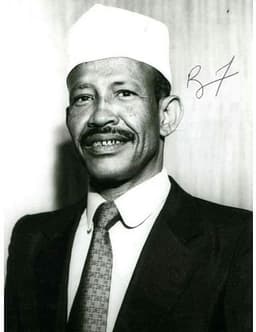
Barkat Gourad Hamadou
Politician · Modern
49.5Total

Ruhollah Khomeini
Politician · Modern
75.1Total
Basic Information
Born
1930
1902
Died
—
1989
Era
Modern
Modern
Nationality
Djibouti
Iran
Occupation
Politician
Politician
Civilization
Other
Middle Eastern
Score Comparison
Military (10%)
33.1
41.6
Political (20%)
61.3
65.0
Influence (20%)
47.1
85.0
Legacy (20%)
40.0
90.0
Leadership (15%)
72.0
80.0
Strategy (15%)
44.1
54.3
TOTAL
49.5
75.1
Barkat Gourad Hamadou — Complete Timeline
1978 AD
Appointed Prime Minister of DjiboutiPolitical Action◆ Major
Barkat Gourad Hamadou was appointed Prime Minister of Djibouti by President Hassan Gouled Aptidon. He served for over 22 years, making him the longest-serving prime minister in Djibouti's history.
LeadershipDjiboutiGovernment
Impact: national
1994 AD
Signed the 1994 Peace Agreement with FRUDPolitical Action◆ Major
Barkat Gourad Hamadou played a key role in negotiating and signing the 1994 peace agreement with the Front for the Restoration of Unity and Democracy (FRUD), ending a three-year rebellion. The agreement brought stability to Djibouti.
Peace AgreementCivil WarDjibouti
Impact: nationalconstructive
2001 AD
Resigned as Prime MinisterPolitical Action◆ Major
Barkat Gourad Hamadou resigned as Prime Minister in 2001, citing health reasons. His resignation marked the end of an era in Djiboutian politics, as he had been a central figure in the government for over two decades.
ResignationPoliticsDjibouti
Impact: national
Ruhollah Khomeini — Complete Timeline
1964 AD
Exile to Iraq and FrancePolitical Action◆ Major
Khomeini was exiled from Iran after criticizing the Shah's White Revolution and granting of diplomatic immunity to US personnel. He settled in Najaf, Iraq, and later in France, where he continued to organize opposition to the Shah.
ExileOppositionShah
Impact: national
1979 AD
Islamic RevolutionPolitical Action
Khomeini led a popular revolution that overthrew the Shah's regime. He returned to Iran in February 1979 and established an Islamic Republic based on his doctrine of Velayat-e Faqih (Guardianship of the Jurist), with himself as Supreme Leader.
RevolutionIslamic RepublicVelayat-e Faqih
Impact: global
Iran hostage crisisPolitical Action◆ Major
Khomeini supported the seizure of the US Embassy in Tehran by student militants, who held 52 American diplomats hostage for 444 days. The crisis deepened the rift with the US, led to economic sanctions, and consolidated Khomeini's power.
Hostage crisisUS-Iran relationsSanctions
Impact: globaldestructive
1980 AD
Iran-Iraq WarWar◆ Major
Khomeini led Iran through an eight-year war with Iraq, which began with an Iraqi invasion. The war resulted in hundreds of thousands of casualties and massive economic destruction, ending in a stalemate. Khomeini accepted a UN ceasefire in 1988.
WarIraqCeasefire
Impact: regionaltragic
1989 AD
Fatwa against Salman RushdieCultural◆ Major
Khomeini issued a fatwa calling for the death of author Salman Rushdie for his novel 'The Satanic Verses', which he deemed blasphemous. The fatwa led to international controversy, diplomatic tensions, and attacks on Rushdie's translators.
FatwaBlasphemyInternational controversy
Impact: globaldestructive
Expert Analysis
Origins
Barkat Gourad Hamadou was born in 1930 in Djibouti City, French Somaliland, into a prominent political family. He received a French colonial education and entered civil service. Ruhollah Khomeini was born in 1902 in Khomeyn, Iran, into a religious family. He studied Islamic jurisprudence in Qom and became a marja' (grand ayatollah).
Rise to Power
Hamadou rose through Djibouti's civil service, becoming a close advisor to President Hassan Gouled Aptidon. He was appointed Prime Minister in 1978, a position he held for 22 years. Khomeini gained prominence in the 1960s for opposing the Shah's reforms. Exiled in 1964, he led a network of clerics and activists from Iraq and France, culminating in the 1979 Islamic Revolution.
Leadership & Governance
Hamadou's leadership was characterized by stability and diplomacy. He managed Djibouti's multi-ethnic society and negotiated the 1994 peace agreement with the FRUD rebels, ending a three-year civil war. His governance focused on economic development and maintaining Djibouti's strategic alliances. Khomeini established a theocratic system with himself as Supreme Leader. He centralized power under the principle of velayat-e faqih (guardianship of the jurist), suppressing political dissent and enforcing Islamic law. His governance scored 80.0 in leadership, while Hamadou scored 72.0.
Triumph & Tragedy
Hamadou's greatest success was the 1994 peace agreement, which restored stability and allowed for political reconciliation. His resignation in 2001 due to health concerns was a quiet end to a long tenure. Khomeini's triumph was the revolution itself, overthrowing a monarchy and creating a new state. His tragedies include the Iran-Iraq War (1980-1988), which caused hundreds of thousands of casualties and economic devastation, and the international isolation resulting from the hostage crisis and the Rushdie fatwa.
Character & Destiny
Hamadou was a pragmatic consensus-builder, preferring negotiation over confrontation. His long tenure reflected his ability to navigate Djibouti's complex clan politics. Khomeini was an uncompromising ideologue, willing to sacrifice lives for his vision. His character led to both the revolution's success and the subsequent conflicts. Historians note his charisma and single-mindedness, which scored 85.0 in influence.
Legacy
Hamadou's legacy is a stable Djibouti, though his impact is largely domestic. He is remembered as the architect of peace and a steady hand. Khomeini's legacy is global: he established the world's only Shia theocracy, inspired Islamist movements worldwide, and transformed Iran's political identity. His legacy score of 90.0 reflects this enduring impact.
Conclusion
While Hamadou provided stability to a small nation, Khomeini reshaped the Middle East and global politics. With a total score of 75.1 against Hamadou's 49.5, Khomeini's influence and legacy far exceed his counterpart's. Khomeini had greater impact due to his revolutionary changes and lasting ideological footprint.
Rankings
🥇
Ruhollah KhomeiniLeader
Mil: 41.6Pol: 65.0Inf: 85.0
75.1
🥈
Barkat Gourad Hamadou
Mil: 33.1Pol: 61.3Inf: 47.1
49.5
+25.6 behind
How This Comparison Works
Algorithm
Each figure is scored on 6 dimensions (0—100 scale) based on structured historical data: Military (10%), Political (20%), Influence (20%), Legacy (20%), Leadership (15%), Strategy (15%). The weighted total produces the final ranking.
Data Sources
Scores are computed from structured sub-indicators in the database. Scale factors adjust for era (Ancient ×0.85, Modern ×1.0) and civilization size (Eastern ×1.05, Other ×0.80) to account for differences in population and military scale.
Maximum 3 Figures
Comparisons are limited to 2—3 figures to ensure readability and statistical meaningfulness.
Error Margins
±5 points per dimension — Sub-scores are derived from historical records with inherent uncertainty. Two figures within 5 points on a dimension should be considered roughly equivalent in that area.
Total Score Accuracy
±3 points overall — The weighted combination of 6 dimensions produces a total score with approximately ±3 points of uncertainty. Differences of less than 3 points are not statistically significant— the figures are effectively tied.
Known Limitations
- Historical records are incomplete and uneven across civilizations
- Figures from oral-tradition societies may be underrepresented
- Occupation labels can misclassify multi-role figures
- Scores measure capability and impact, not moral character
- Quantitative scoring is a comparison tool, not absolute truth
Capability Radar
Military (10%) — Battles & Warfare
Battles
24
10
Win Rate
22
10
Expansion
25
10
Political (20%) — Governance & Reform
Reform
40
90
Diplomacy
60
75
Economy
30
40
Influence (20%) — Cultural & Global Reach
Cultural
10
85
Global
10
85
Legacy (20%) — Historical Impact
Historical
20
90
Longevity
20
80
Leadership (15%) — Power & Stability
Tenure
70
85
Stability
50
50
Strategy (15%) — Tactics & Innovation
Strategy
30
15
Tactics
34
10
Reform
36
20
Similar Comparisons
Comments & Discussion
No comments yet. Be the first to share your thoughts!