Loading...
Giulio Andreotti vs Ruhollah Khomeini
Ruhollah Khomeini leads by 18.6 pts · 2 figures compared
…
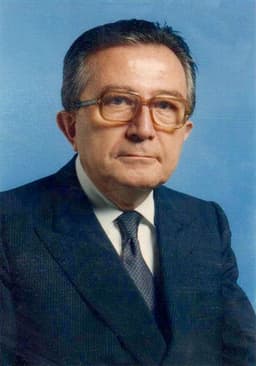
Giulio Andreotti
Politician · Modern
56.5Total

Ruhollah Khomeini
Politician · Modern
75.1Total
Basic Information
Born
1919
1902
Died
2013
1989
Era
Modern
Modern
Nationality
Italy
Iran
Occupation
Politician
Politician
Civilization
Western
Middle Eastern
Score Comparison
Military (10%)
50.0
41.6
Political (20%)
59.3
65.0
Influence (20%)
58.3
85.0
Legacy (20%)
52.0
90.0
Leadership (15%)
72.0
80.0
Strategy (15%)
42.7
54.3
TOTAL
56.5
75.1
Giulio Andreotti — Complete Timeline
1972 AD
Seven Terms as Prime MinisterPolitical Action◆ Major
Giulio Andreotti served as Prime Minister of Italy seven times between 1972 and 1992, a record in the post-war republic. His long tenure made him a dominant figure in Italian politics, known for his political maneuvering and ability to form coalitions across the fragmented party system.
Political CareerItalyLongevity
Impact: national
1976 AD
Involvement in the Lockheed ScandalPolitical Action
Andreotti was implicated in the Lockheed bribery scandal, which involved payments to Italian politicians to secure aircraft contracts. He was investigated but never convicted, though the scandal contributed to a climate of political corruption that would later lead to the Tangentopoli investigations.
ScandalCorruptionItaly
Impact: nationaldestructive
1980 AD
Support for European IntegrationPolitical Action
Throughout his career, Andreotti was a strong advocate for European integration, supporting Italy's participation in the European Monetary System and the Maastricht Treaty. He served as Foreign Minister and was involved in key EU decisions, helping to shape Italy's role in the European Community.
European UnionForeign PolicyItaly
Impact: regionalconstructive
1995 AD
Trial for Mafia AssociationPolitical Action◆ Major
Andreotti was put on trial in Palermo for alleged association with the Mafia, accused of having ties to Cosa Nostra during his political career. The trial lasted years and resulted in a conviction in 2002, which was later overturned on appeal in 2003 due to statute of limitations. The case deeply tarnished his legacy.
TrialMafiaCorruption
Impact: nationaldestructive
Ruhollah Khomeini — Complete Timeline
1964 AD
Exile to Iraq and FrancePolitical Action◆ Major
Khomeini was exiled from Iran after criticizing the Shah's White Revolution and granting of diplomatic immunity to US personnel. He settled in Najaf, Iraq, and later in France, where he continued to organize opposition to the Shah.
ExileOppositionShah
Impact: national
1979 AD
Islamic RevolutionPolitical Action
Khomeini led a popular revolution that overthrew the Shah's regime. He returned to Iran in February 1979 and established an Islamic Republic based on his doctrine of Velayat-e Faqih (Guardianship of the Jurist), with himself as Supreme Leader.
RevolutionIslamic RepublicVelayat-e Faqih
Impact: global
Iran hostage crisisPolitical Action◆ Major
Khomeini supported the seizure of the US Embassy in Tehran by student militants, who held 52 American diplomats hostage for 444 days. The crisis deepened the rift with the US, led to economic sanctions, and consolidated Khomeini's power.
Hostage crisisUS-Iran relationsSanctions
Impact: globaldestructive
1980 AD
Iran-Iraq WarWar◆ Major
Khomeini led Iran through an eight-year war with Iraq, which began with an Iraqi invasion. The war resulted in hundreds of thousands of casualties and massive economic destruction, ending in a stalemate. Khomeini accepted a UN ceasefire in 1988.
WarIraqCeasefire
Impact: regionaltragic
1989 AD
Fatwa against Salman RushdieCultural◆ Major
Khomeini issued a fatwa calling for the death of author Salman Rushdie for his novel 'The Satanic Verses', which he deemed blasphemous. The fatwa led to international controversy, diplomatic tensions, and attacks on Rushdie's translators.
FatwaBlasphemyInternational controversy
Impact: globaldestructive
Expert Analysis
Origins
Giulio Andreotti was born on January 14, 1919, in Rome, Italy, into a middle-class family. His father was a schoolteacher, and his mother was a homemaker. He studied law at the University of Rome La Sapienza, graduating in 1941. During World War II, he was involved in Catholic student organizations and later became a member of the Christian Democracy party. His early career was shaped by the post-war political landscape, where he served as an undersecretary and minister under Alcide De Gasperi.
Ruhollah Khomeini was born on September 24, 1902, in Khomeyn, Iran, into a religious family of Shia scholars. His father, a cleric, was murdered when Khomeini was five months old. He was raised by his mother and aunt, and later by his older brother. He studied Islamic theology in Qom, becoming a high-ranking ayatollah by the 1960s. His formative years were marked by opposition to the Pahlavi dynasty's secularization and Western influence, particularly the White Revolution of 1963.
Rise to Power
Andreotti's rise was gradual and institutional. He became a key figure in the Christian Democracy party, serving as Minister of the Interior (1954-1955) and Minister of Finance (1955-1958). His first term as Prime Minister began in 1972, and he held the office seven times until 1992. His longevity was due to his ability to form coalitions and navigate Italy's fractious political landscape. He was known as "Il Divo" (The Divine) for his political cunning.
Khomeini's rise was revolutionary. He was exiled in 1964 after denouncing the Shah's policies and granting of diplomatic immunity to US personnel. He settled in Najaf, Iraq, where he developed his theory of Islamic governance, "Velayat-e Faqih." From exile, he mobilized opposition through cassette tapes and pamphlets. The Iranian Revolution culminated in his return to Tehran on February 1, 1979, and the establishment of an Islamic Republic with him as Supreme Leader.
Leadership & Governance
Andreotti's leadership was characterized by pragmatism and consensus-building. He governed through shifting alliances, often with the Socialists and Communists. His approach was to maintain stability through backroom deals and patronage. He supported European integration and NATO alignment. However, his governance was marked by corruption scandals and alleged Mafia ties. He scored 72.0 in leadership but only 42.7 in strategy, reflecting his reactive rather than visionary style.
Khomeini's leadership was ideological and authoritarian. He centralized power as Supreme Leader, with authority over the military, judiciary, and media. He implemented Islamic law and suppressed dissent. His leadership score of 80.0 reflects his ability to command loyalty, but his strategy score of 54.3 indicates a less systematic approach. He prioritized revolutionary purity over economic development, leading to the Iran-Iraq War's devastation.
Triumph & Tragedy
Andreotti's greatest success was his political longevity, serving seven terms and influencing Italian politics for decades. He was instrumental in Italy's integration into the European Community. However, his greatest failure was his association with organized crime. In 2002, he was convicted of Mafia association (later overturned on appeal), and his reputation was tarnished by the Lockheed scandal. His political score of 59.3 reflects mixed achievements.
Khomeini's triumph was leading the Islamic Revolution and establishing a theocratic state that endures. He also successfully navigated the Iran-Iraq War, though at a massive cost. His failures include the hostage crisis, which isolated Iran internationally, and his fatwa against Salman Rushdie, which damaged Iran's global standing. His legacy score of 90.0 is the highest, but his military score of 41.6 reflects the war's toll.
Character & Destiny
Andreotti was enigmatic, secretive, and pragmatic. He was known for his aphorisms, such as "Power wears out those who don't have it." His character allowed him to survive political storms but also led to ethical compromises. Historians often view him as a symbol of Italy's post-war political corruption.
Khomeini was ascetic, uncompromising, and charismatic. He believed in his divine mission and was willing to sacrifice everything for his vision. His character inspired millions but also led to purges and human rights abuses. He is revered by supporters as a spiritual leader and reviled by critics as a despot.
Legacy
Andreotti's legacy is mixed. He left no major institutional reforms; his impact was more on the political process. Italy's political system remained unstable, and the Christian Democracy party collapsed after his era. His influence score of 58.3 reflects limited global impact.
Khomeini's legacy is profound. He transformed Iran from a monarchy to a theocracy, inspired Shia movements worldwide, and established a model of Islamic governance. His ideas continue to shape Iranian politics and foreign policy. His influence score of 85.0 and legacy score of 90.0 underscore his enduring impact.
Conclusion
While Andreotti was a master of Italian politics, his impact was largely domestic and transient. Khomeini, despite lower military and strategy scores, reshaped the Middle East and global Islam. With a total score of 75.1 against Andreotti's 56.5, Khomeini had greater historical impact. His revolution created a lasting system, while Andreotti's career ended in scandal and irrelevance. Khomeini's legacy endures; Andreotti's is fading.
Rankings
🥇
Ruhollah KhomeiniLeader
Mil: 41.6Pol: 65.0Inf: 85.0
75.1
🥈
Giulio Andreotti
Mil: 50.0Pol: 59.3Inf: 58.3
56.5
+18.6 behind
How This Comparison Works
Algorithm
Each figure is scored on 6 dimensions (0—100 scale) based on structured historical data: Military (10%), Political (20%), Influence (20%), Legacy (20%), Leadership (15%), Strategy (15%). The weighted total produces the final ranking.
Data Sources
Scores are computed from structured sub-indicators in the database. Scale factors adjust for era (Ancient ×0.85, Modern ×1.0) and civilization size (Eastern ×1.05, Other ×0.80) to account for differences in population and military scale.
Maximum 3 Figures
Comparisons are limited to 2—3 figures to ensure readability and statistical meaningfulness.
Error Margins
±5 points per dimension — Sub-scores are derived from historical records with inherent uncertainty. Two figures within 5 points on a dimension should be considered roughly equivalent in that area.
Total Score Accuracy
±3 points overall — The weighted combination of 6 dimensions produces a total score with approximately ±3 points of uncertainty. Differences of less than 3 points are not statistically significant— the figures are effectively tied.
Known Limitations
- Historical records are incomplete and uneven across civilizations
- Figures from oral-tradition societies may be underrepresented
- Occupation labels can misclassify multi-role figures
- Scores measure capability and impact, not moral character
- Quantitative scoring is a comparison tool, not absolute truth
Capability Radar
Military (10%) — Battles & Warfare
Battles
27
10
Win Rate
30
10
Expansion
35
10
Political (20%) — Governance & Reform
Reform
60
90
Diplomacy
80
75
Economy
55
40
Influence (20%) — Cultural & Global Reach
Cultural
50
85
Global
60
85
Legacy (20%) — Historical Impact
Historical
65
90
Longevity
60
80
Leadership (15%) — Power & Stability
Tenure
85
85
Stability
40
50
Strategy (15%) — Tactics & Innovation
Strategy
39
15
Tactics
42
10
Reform
42
20
Similar Comparisons
Comments & Discussion
No comments yet. Be the first to share your thoughts!