Loading...
Bassirou Diomaye Faye vs Julius Caesar
Julius Caesar leads by 47.4 pts · 2 figures compared
…
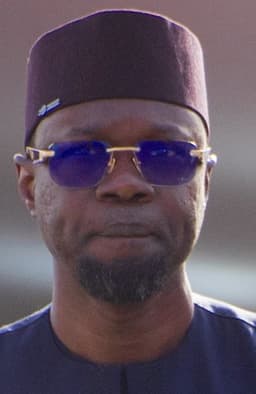
Bassirou Diomaye Faye
Politician · Modern
35.4Total

Julius Caesar
General · Ancient
82.8Total
Basic Information
Born
1980
-100
Died
—
-44
Era
Modern
Ancient
Nationality
Senegal
Roman Republic
Occupation
Politician
General
Civilization
Other
Western
Score Comparison
Military (10%)
16.7
88.0
Political (20%)
27.9
78.0
Influence (20%)
47.1
85.0
Legacy (20%)
35.0
82.0
Leadership (15%)
31.2
80.0
Strategy (15%)
43.2
85.0
TOTAL
35.4
82.8
Bassirou Diomaye Faye — Complete Timeline
2024 AD
Election as President of SenegalPolitical Action◆ Major
Bassirou Diomaye Faye won the 2024 Senegalese presidential election in the first round, defeating the ruling coalition candidate. At 44, he became the youngest elected president in Senegal's history. Faye, a former tax inspector, ran on an anti-corruption platform.
ElectionSenegalYouth
Impact: nationalconstructive
Release from prison before electionPolitical Action◆ Major
Faye was released from prison in March 2024 after being detained on charges of defamation and incitement. His release, part of a political amnesty, allowed him to campaign for the presidency, which he won weeks later.
PrisonAmnestyElection
Impact: national
Julius Caesar — Complete Timeline
58 BC
Gallic WarsWar◆ Major
Caesar, as proconsul of Gaul, launched a series of campaigns that conquered all of Gaul (modern France, Belgium, and parts of Switzerland). He fought numerous battles, including against the Helvetii, the Belgae, and the Gallic chieftain Vercingetorix. The wars brought immense wealth and a loyal army to Caesar.
Gallic WarsConquestRoman Expansion
Impact: regional
49 BC
Crossing the RubiconPolitical Action◆ Major
Caesar led Legio XIII across the Rubicon River into Italy, defying the Roman Senate's order to disband his army. This act triggered a civil war against Pompey and the Optimates, ultimately leading to Caesar's dictatorship and the end of the Roman Republic.
Roman Civil WarEnd of RepublicPower Struggle
Impact: global
48 BC
Battle of PharsalusWar◆ Major
Caesar's outnumbered army defeated the larger forces of Pompey the Great at Pharsalus in Greece. Caesar's tactical use of a reserve line to counter Pompey's cavalry charge proved decisive. Pompey fled to Egypt, where he was assassinated, leaving Caesar as the undisputed master of the Roman world.
Roman Civil WarBattleDecisive Victory
Impact: regional
44 BC
Appointment as Dictator for LifePolitical Action◆ Major
The Roman Senate appointed Caesar dictator perpetuo (dictator for life), granting him unprecedented personal power. This move concentrated military, legislative, and judicial authority in one person, effectively ending the Roman Republic's traditional system of checks and balances and alarming many senators.
DictatorshipEnd of RepublicPower Consolidation
Impact: regionaldestructive
Assassination on the Ides of MarchPolitical Action◆ Major
A group of Roman senators, led by Marcus Junius Brutus and Gaius Cassius Longinus, stabbed Caesar to death at a meeting of the Senate in the Theatre of Pompey. The assassination was intended to restore the Republic, but instead triggered another civil war that led to the rise of the Roman Empire.
AssassinationRoman PoliticsEnd of Republic
Impact: globaldestructive
Expert Analysis
bassirou-diomaye-faye-vs-julius-caesar
# The Crossing of Two Rubicons
On a March morning in 2024, Bassirou Diomaye Faye walked out of a Senegalese prison cell into the blinding light of a political miracle. Just weeks earlier, he had been an obscure tax collector, detained on charges of defamation and incitement. Now, he was about to become the youngest elected president in his nation’s history. Two thousand years earlier, on another March day, Julius Caesar stood on the banks of the Rubicon River in northern Italy, knowing that crossing it would mean civil war—and either supreme power or death. One man crossed into empire; the other crossed into democracy. Both understood that history pivots on a single step.
Origins
Caesar was born into the chaos of the late Roman Republic, a world of senatorial intrigue, slave revolts, and crumbling aristocratic norms. His family, the Julii, claimed descent from the goddess Venus, but they were politically marginal. His father died when Caesar was sixteen, leaving him to navigate a cutthroat world where a man’s worth was measured in military commands and provincial plunder. He learned early that survival meant alliance, audacity, and a willingness to break rules.
Faye emerged from a different kind of chaos: postcolonial Senegal, a nation that had known peaceful transitions of power since independence in 1960 but was increasingly gripped by corruption, youth unemployment, and a political class that seemed immune to accountability. Born in 1980 in the small town of Ndiaganiao, Faye grew up in a family of modest means. He studied law, became a tax inspector—a bureaucrat in a system he would later challenge. His world was not the Senate floor or the battlefield, but the dusty corridors of government offices where paperwork could either liberate or imprison.
Rise to Power
Caesar’s ascent was a masterpiece of calculated risk. At thirty-one, he was captured by pirates and, after his release, raised a fleet to crucify them. He climbed the political ladder—quaestor, aedile, praetor—each step financed by debt and the patronage of the wealthy Crassus. The real turning point came in 58 BCE, when he secured command of Gaul. For eight years, he fought more than thirty battles, conquered a territory larger than Italy, and built an army that worshipped him. When the Senate ordered him to disband, he chose war instead. The Rubicon, crossed in 49 BCE, was not a river but a line between the old order and a new one.
Faye’s rise was quieter but no less improbable. He had been a protégé of Ousmane Sonko, the fiery opposition leader whose own presidential candidacy was blocked by legal challenges. When Sonko was disqualified, he threw his support behind Faye—an unknown tax collector with no political base. The government, sensing a threat, arrested Faye in April 2023. The move backfired. His detention turned him into a martyr. From prison, he campaigned on a platform of anti-corruption, economic sovereignty, and a break with the French colonial legacy. When the Constitutional Council cleared his candidacy and he was released, Senegal’s youth saw in him a mirror of their own frustrations. In March 2024, he won the presidency outright in the first round, defeating the ruling coalition.
Leadership & Governance
Caesar governed as a conqueror who understood that power needed legitimacy. As dictator, he reformed the calendar, extended citizenship to provincials, initiated public works, and centralized tax collection. He was ruthless—his enemies were proscribed, their property seized—but he also pardoned former opponents, most famously Brutus. His military genius lay in speed and logistics: at the Battle of Alesia in 52 BCE, he built a double ring of fortifications to trap both a Gallic army and its relief force, a feat of engineering and strategy that still stuns military historians.
Faye governs as a reformer who knows that power is fragile. His first acts as president were symbolic: he reduced presidential salaries, sold off official cars, and declared his own assets. He has promised to renegotiate mining and oil contracts, to invest in agriculture, and to create jobs for a population where sixty percent are under twenty-five. His military score of 30.2 reflects a nation that has never fought a war under his command—but his strategy score of 56.4 suggests a man who understands that in modern politics, patience is a weapon. Where Caesar built walls, Faye builds coalitions.
Triumph & Tragedy
Caesar’s greatest triumph was his conquest of Gaul, which brought him wealth, glory, and a loyal army. His greatest tragedy was the civil war that followed: hundreds of thousands died, the Republic was gutted, and he himself fell on the Ides of March in 44 BCE, stabbed twenty-three times by senators he had spared. His last words, according to tradition, were “*Et tu, Brute?*”—a recognition that betrayal cuts deepest when it comes from a friend.
Faye’s triumph is his election itself, a peaceful transfer of power that defied predictions of violence. His tragedy is yet unwritten. He inherits a nation with high debt, a restless youth, and expectations that may be impossible to meet. The danger for him is not assassination but disillusionment—the slow erosion of hope that turns reformers into cautionary tales.
Character & Destiny
Caesar was driven by an insatiable ambition. He believed he was destined for greatness, and he shaped events to match that belief. His clemency was strategic, his cruelty calculated. He wrote his own commentary on the Gallic Wars in the third person, crafting his legacy even as he lived it. His character was his destiny: he could not stop reaching for more, and that reaching destroyed him.
Faye is driven by a vision of justice. He speaks of “systemic rupture” and “sovereignty” with the earnestness of a man who has seen corruption from the inside. He is less a warrior than a technician of reform. His character—patient, deliberate, unflashy—may save him from Caesar’s fate. But it may also limit his ability to inspire.
Legacy
Caesar left a world transformed. The Republic became an empire. His name became a title: Kaiser, Tsar. His reforms lasted centuries. But his legacy is double-edged: he showed how easily liberty can be traded for order, and how quickly a champion of the people can become a tyrant.
Faye’s legacy is a question mark. If he succeeds, he will be remembered as the young tax collector who broke the mold of African strongman politics. If he fails, he will be another proof that hope is not enough. His total score of 47.7 against Caesar’s 83.3 is not a judgment of worth but a measure of distance: one man conquered continents, the other conquered a system.
Conclusion
Two men, two rivers. Caesar crossed his Rubicon with legions, knowing that the world would never be the same. Faye crossed his prison threshold with nothing but a voter’s card, knowing that Senegal’s future hung on a ballot. One sought power for its own sake; the other seeks power to give it away. History does not always prefer the gentle path, but it rarely forgets those who try. The Ides of March still echo, but so does the morning a tax collector walked free and became a president.
Rankings
🥇
Julius CaesarLeader
Mil: 88.0Pol: 78.0Inf: 85.0
82.8
🥈
Bassirou Diomaye Faye
Mil: 16.7Pol: 27.9Inf: 47.1
35.4
+47.4 behind
How This Comparison Works
Algorithm
Each figure is scored on 6 dimensions (0—100 scale) based on structured historical data: Military (10%), Political (20%), Influence (20%), Legacy (20%), Leadership (15%), Strategy (15%). The weighted total produces the final ranking.
Data Sources
Scores are computed from structured sub-indicators in the database. Scale factors adjust for era (Ancient ×0.85, Modern ×1.0) and civilization size (Eastern ×1.05, Other ×0.80) to account for differences in population and military scale.
Maximum 3 Figures
Comparisons are limited to 2—3 figures to ensure readability and statistical meaningfulness.
Error Margins
±5 points per dimension — Sub-scores are derived from historical records with inherent uncertainty. Two figures within 5 points on a dimension should be considered roughly equivalent in that area.
Total Score Accuracy
±3 points overall — The weighted combination of 6 dimensions produces a total score with approximately ±3 points of uncertainty. Differences of less than 3 points are not statistically significant— the figures are effectively tied.
Known Limitations
- Historical records are incomplete and uneven across civilizations
- Figures from oral-tradition societies may be underrepresented
- Occupation labels can misclassify multi-role figures
- Scores measure capability and impact, not moral character
- Quantitative scoring is a comparison tool, not absolute truth
Capability Radar
Military (10%) — Battles & Warfare
Battles
20
95
Win Rate
22
92
Expansion
26
97
Political (20%) — Governance & Reform
Reform
10
90
Diplomacy
10
85
Economy
10
82
Influence (20%) — Cultural & Global Reach
Cultural
5
88
Global
5
94
Legacy (20%) — Historical Impact
Historical
5
95
Longevity
5
96
Leadership (15%) — Power & Stability
Tenure
5
75
Stability
10
60
Strategy (15%) — Tactics & Innovation
Strategy
31
94
Tactics
35
96
Reform
34
88
Similar Comparisons
Comments & Discussion
RUBICON-HOPPER6/17/2026
Faye’s walkout is inspiring, but let’s pump the brakes. Caesar crossed the Rubicon with legions, not hope. Faye walked free because of a political amnesty, not a military coup. One seized power; the other was handed a chance. Comparing a tax collector’s release to a general’s rebellion cheapens the brutal reality of Caesar’s gamble. History loves symmetry, but this is a stretch. Faye’s story is remarkable—let it stand on its own without Roman sandals.
千里靴督军6/17/2026
你拿一个刚出狱的税务员跟盖世枭雄比?凯撒渡河前已在高卢屠了百万蛮族,军权在手,元老院发抖。法耶?他连监狱都没逃过,是反对派谈判放出来的。这叫转折点?这叫政治交易。凯撒要是生在达喀尔,早把对手扔进大西洋喂鱼了。这类比较就是给非洲政客镀金,别拿罗马的剑去量西非的沙。