Loading...
Bayanchur Khan vs Michael VIII Palaiologos
Bayanchur Khan leads by 8.6 pts · 2 figures compared
…

Bayanchur Khan
Emperor · Medieval
61.4Total
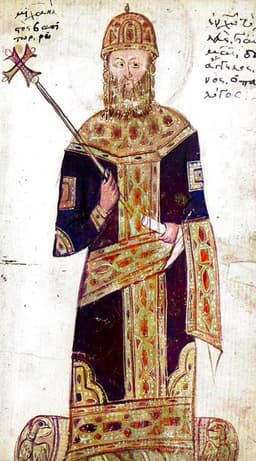
Michael VIII Palaiologos
Emperor · Medieval
52.8Total
Basic Information
Born
713
1223
Died
759
1282
Era
Medieval
Medieval
Nationality
Uyghur Khaganate
Byzantine Empire
Occupation
Emperor
Emperor
Civilization
Eastern
Western
Score Comparison
Military (10%)
61.7
70.0
Political (20%)
72.0
45.0
Influence (20%)
58.3
55.0
Legacy (20%)
52.0
55.0
Leadership (15%)
72.0
40.0
Strategy (15%)
60.7
55.0
TOTAL
61.4
52.8
Bayanchur Khan — Complete Timeline
747 AD
Establishment of the Uyghur Khaganate as a Major PowerPolitical Action◆ Major
Bayanchur Khan consolidated Uyghur control over the former Gokturk territories, establishing the Uyghur Khaganate as the dominant steppe power. He built a capital at Ordu-Baliq and organized the Uyghur state on a model combining steppe traditions with Chinese administrative practices.
State BuildingCapitalUyghur Empire
Impact: regionalconstructive
750 AD
Military Campaigns against the Kyrgyz and KarluksWar
Bayanchur Khan led campaigns against the Kyrgyz and Karluk tribes to secure the northern and western borders of the Uyghur Khaganate. He defeated these groups and incorporated them into the Uyghur confederation, expanding Uyghur territory.
ExpansionMilitary CampaignSteppe Tribes
Impact: regional
756 AD
Alliance with Tang China against the An Lushan RebellionPolitical Action◆ Major
Bayanchur Khan sent Uyghur cavalry to aid the Tang dynasty in suppressing the An Lushan Rebellion. The Uyghur forces helped recapture the Tang capital Chang'an and Luoyang, cementing the Uyghur-Tang alliance.
AllianceAn Lushan RebellionTang Dynasty
Impact: regionalconstructive
Michael VIII Palaiologos — Complete Timeline
1261 AD
Recapture of Constantinople from the Latin EmpireWar
Michael VIII Palaiologos's general Alexios Strategopoulos led a surprise attack that recaptured Constantinople from the Latin Empire without a major battle. The city was restored as the Byzantine capital, ending 57 years of Latin rule and re-establishing the Byzantine Empire.
ReconquestFourth CrusadeConstantinople
Impact: globalconstructive
Coronation as Byzantine emperor in Hagia SophiaPolitical Action◆ Major
Michael VIII was crowned emperor in Hagia Sophia in Constantinople, legitimizing his rule as the restorer of the Byzantine Empire. The coronation was a major symbolic event, reaffirming the continuity of the Roman imperial tradition in the East.
CoronationRestorationHagia Sophia
Impact: nationalconstructive
1262 AD
Restoration of the Byzantine navy and fortificationsReform
Michael VIII rebuilt the Byzantine navy, which had been neglected under the Nicaean emperors, and strengthened the fortifications of Constantinople. These measures improved the empire's defensive capabilities and allowed for limited naval campaigns in the Aegean.
Military ReformNavyFortifications
Impact: nationalconstructive
1274 AD
Union of the Churches at the Second Council of LyonPolitical Action◆ Major
Michael VIII agreed to the Union of the Churches at the Second Council of Lyon, recognizing papal supremacy in exchange for Western support against the Angevin threat. The union was deeply unpopular in Byzantium and caused religious strife, but it temporarily prevented a crusade against Constantinople.
Church UnionPapacyReligious Controversy
Impact: regional
1281 AD
Defeat of the Angevin invasion at the Siege of BeratWar◆ Major
Michael VIII's forces defeated an Angevin army besieging Berat in Albania, capturing the Angevin commander. The victory ended Charles of Anjou's plans to invade Constantinople and restored Byzantine control over parts of the Balkans.
Angevin WarsMilitary VictoryBalkans
Impact: regional
Expert Analysis
Origins
Bayanchur Khan (born c. 710) emerged from the Uyghur tribal confederation, which had been a vassal of the Gokturk Khaganate. His early life is obscure, but he rose within the Uyghur nobility, inheriting a position of leadership after the Uyghurs overthrew the Gokturks in 744. He was literate in the Old Turkic script and familiar with Chinese court culture through diplomatic exchanges. Michael VIII Palaiologos (born 1224) was a scion of the Byzantine aristocratic Palaiologos family, which had produced emperors before. His early career was shaped by the Latin occupation of Constantinople (1204-1261) and the exile Byzantine court in Nicaea. He received a traditional Greek education and military training, serving as a governor and general under the Nicaean emperor John III Vatatzes.
Rise to Power
Bayanchur Khan became khagan around 747, after his father, the first Uyghur khagan, died. He quickly consolidated power by defeating rival tribes and securing recognition from Tang China. His major turning point came in 757 when he answered the Tang call for help against the An Lushan Rebellion. By sending 4,000 elite Uyghur cavalry, he helped recapture Chang'an and Luoyang, earning the Tang emperor's gratitude and massive silk tributes. This alliance elevated the Uyghur Khaganate to a dominant steppe power. Michael VIII rose through a combination of military success and political maneuvering. He became regent for the young Nicaean emperor John IV Laskaris in 1258, then had John blinded and imprisoned, seizing the throne himself in 1259. His great triumph came in 1261 when his general Alexios Strategopoulos recaptured Constantinople from the Latin Empire with a small force, restoring the Byzantine Empire after 57 years of exile.
Leadership & Governance
Bayanchur Khan ruled with a blend of steppe traditions and Chinese-influenced bureaucracy. He established a dual administration: a traditional tribal council for military affairs and a Chinese-style chancellery for diplomacy and taxation. He adopted Manichaeism as the state religion around 763, making the Uyghur Khaganate the only Manichaean state in history. This move alienated some Buddhist and Nestorian subjects but strengthened ties with Sogdian merchants. Michael VIII governed a restored but weakened empire. He focused on rebuilding Constantinople's fortifications and navy, which had been neglected. His political score of 45.0 reflects his controversial decision to accept the Union of the Churches at the Second Council of Lyon in 1274, recognizing papal supremacy to gain Western support against Charles of Anjou. This caused deep division among Orthodox clergy and laity, undermining his domestic support.
Triumph & Tragedy
Bayanchur Khan's greatest success was the Tang alliance, which brought immense wealth and prestige. He also expanded Uyghur control over the Silk Road, securing trade routes that enriched the khaganate. However, his conversion to Manichaeism proved a strategic error: it isolated the Uyghurs from other steppe peoples who remained shamanist or Buddhist, and later Uyghur rulers struggled to maintain religious unity. His military score of 61.7 reflects competent but not exceptional campaigns. Michael VIII's crowning achievement was the recapture of Constantinople, a feat that earned him the title "New Constantine." He also defeated the Angevin invasion at the Siege of Berat in 1281, crushing Charles of Anjou's ambitions. But his legacy was marred by the Union of Lyon, which poisoned relations with the Orthodox world and weakened the empire internally. His leadership score of 40.0 indicates that his divisive policies undermined his effectiveness.
Character & Destiny
Bayanchur Khan emerges from records as a pragmatic diplomat who understood the value of Chinese alliances. His decision to adopt Manichaeism suggests a ruler open to foreign ideas, but also one who misjudged the cultural impact. He was decisive in battle but cautious in expansion, preferring tribute to conquest. Michael VIII was a master of realpolitik, willing to sacrifice religious principle for political gain. His blinding of John IV Laskaris stained his reputation, as did his unionist policies. He was a skilled diplomat but a poor judge of internal sentiment. Historians note that his focus on Western threats left the eastern frontiers vulnerable to Turkish expansion, a problem that would plague his successors.
Legacy
Bayanchur Khan's Uyghur Khaganate fell to the Kyrgyz in 840, but his cultural legacy endured. The Uyghurs adopted the Sogdian script, which evolved into the Old Uyghur alphabet and later influenced the Mongolian script. Manichaeism, though short-lived as a state religion, left traces in Uyghur art and manuscripts. His political score of 72.0 reflects his successful state-building, but his legacy score of 52.0 is lowered by the khaganate's collapse. Michael VIII restored the Byzantine Empire, but it was a shadow of its former self. His rebuilding of the navy and fortifications provided temporary security, but the unionist controversy weakened the empire's moral authority. His legacy score of 55.0 acknowledges his role as a restorer, but the empire he revived lasted only until 1453, a mere 192 years. His influence score of 55.0 is modest because his policies did not prevent the empire's eventual decline.
Conclusion
Bayanchur Khan scored 61.4 overall, compared to Michael VIII's 52.8, a gap of 8.6 points. While Michael VIII achieved the dramatic feat of recapturing Constantinople, his divisive policies and the fragility of his restored empire limit his long-term impact. Bayanchur Khan, though less famous, built a stable state that controlled the Silk Road, influenced Central Asian culture, and established a diplomatic model that later steppe empires would follow. His adoption of a foreign religion and script had lasting cultural consequences, whereas Michael VIII's unionism was quickly reversed. Therefore, Bayanchur Khan had a greater and more enduring impact on world history.
Rankings
🥇
Bayanchur KhanLeader
Mil: 61.7Pol: 72.0Inf: 58.3
61.4
🥈
Michael VIII Palaiologos
Mil: 70.0Pol: 45.0Inf: 55.0
52.8
+8.6 behind
How This Comparison Works
Algorithm
Each figure is scored on 6 dimensions (0—100 scale) based on structured historical data: Military (10%), Political (20%), Influence (20%), Legacy (20%), Leadership (15%), Strategy (15%). The weighted total produces the final ranking.
Data Sources
Scores are computed from structured sub-indicators in the database. Scale factors adjust for era (Ancient ×0.85, Modern ×1.0) and civilization size (Eastern ×1.05, Other ×0.80) to account for differences in population and military scale.
Maximum 3 Figures
Comparisons are limited to 2—3 figures to ensure readability and statistical meaningfulness.
Error Margins
±5 points per dimension — Sub-scores are derived from historical records with inherent uncertainty. Two figures within 5 points on a dimension should be considered roughly equivalent in that area.
Total Score Accuracy
±3 points overall — The weighted combination of 6 dimensions produces a total score with approximately ±3 points of uncertainty. Differences of less than 3 points are not statistically significant— the figures are effectively tied.
Known Limitations
- Historical records are incomplete and uneven across civilizations
- Figures from oral-tradition societies may be underrepresented
- Occupation labels can misclassify multi-role figures
- Scores measure capability and impact, not moral character
- Quantitative scoring is a comparison tool, not absolute truth
Capability Radar
Military (10%) — Battles & Warfare
Battles
65
65
Win Rate
70
60
Expansion
70
50
Political (20%) — Governance & Reform
Reform
60
60
Diplomacy
80
80
Economy
65
55
Influence (20%) — Cultural & Global Reach
Cultural
55
60
Global
55
55
Legacy (20%) — Historical Impact
Historical
60
75
Longevity
50
65
Leadership (15%) — Power & Stability
Tenure
75
70
Stability
70
45
Strategy (15%) — Tactics & Innovation
Strategy
65
75
Tactics
60
70
Reform
55
55
Similar Comparisons
Comments & Discussion
No comments yet. Be the first to share your thoughts!