Loading...
Michael VIII Palaiologos vs Napoleon Bonaparte
Napoleon Bonaparte leads by 18.1 pts · 2 figures compared
…
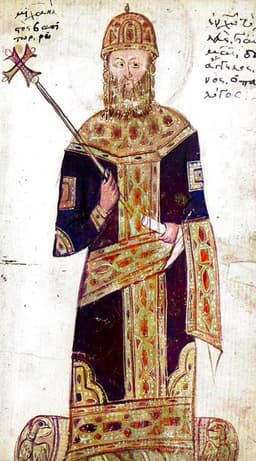
Michael VIII Palaiologos
Emperor · Medieval
52.8Total

Napoleon Bonaparte
General · Modern
70.9Total
Basic Information
Born
1223
1769
Died
1282
1821
Era
Medieval
Modern
Nationality
Byzantine Empire
France
Occupation
Emperor
General
Civilization
Western
Western
Score Comparison
Military (10%)
70.0
94.0
Political (20%)
45.0
72.0
Influence (20%)
55.0
40.0
Legacy (20%)
55.0
80.0
Leadership (15%)
40.0
78.0
Strategy (15%)
55.0
90.0
TOTAL
52.8
70.9
Michael VIII Palaiologos — Complete Timeline
1261 AD
Recapture of Constantinople from the Latin EmpireWar
Michael VIII Palaiologos's general Alexios Strategopoulos led a surprise attack that recaptured Constantinople from the Latin Empire without a major battle. The city was restored as the Byzantine capital, ending 57 years of Latin rule and re-establishing the Byzantine Empire.
ReconquestFourth CrusadeConstantinople
Impact: globalconstructive
Coronation as Byzantine emperor in Hagia SophiaPolitical Action◆ Major
Michael VIII was crowned emperor in Hagia Sophia in Constantinople, legitimizing his rule as the restorer of the Byzantine Empire. The coronation was a major symbolic event, reaffirming the continuity of the Roman imperial tradition in the East.
CoronationRestorationHagia Sophia
Impact: nationalconstructive
1262 AD
Restoration of the Byzantine navy and fortificationsReform
Michael VIII rebuilt the Byzantine navy, which had been neglected under the Nicaean emperors, and strengthened the fortifications of Constantinople. These measures improved the empire's defensive capabilities and allowed for limited naval campaigns in the Aegean.
Military ReformNavyFortifications
Impact: nationalconstructive
1274 AD
Union of the Churches at the Second Council of LyonPolitical Action◆ Major
Michael VIII agreed to the Union of the Churches at the Second Council of Lyon, recognizing papal supremacy in exchange for Western support against the Angevin threat. The union was deeply unpopular in Byzantium and caused religious strife, but it temporarily prevented a crusade against Constantinople.
Church UnionPapacyReligious Controversy
Impact: regional
1281 AD
Defeat of the Angevin invasion at the Siege of BeratWar◆ Major
Michael VIII's forces defeated an Angevin army besieging Berat in Albania, capturing the Angevin commander. The victory ended Charles of Anjou's plans to invade Constantinople and restored Byzantine control over parts of the Balkans.
Angevin WarsMilitary VictoryBalkans
Impact: regional
Napoleon Bonaparte — Complete Timeline
1799 AD
Coup of 18 BrumaireOther◆ Major
Napoleon Bonaparte, with support from his brother Lucien and key political figures, overthrew the Directory in a bloodless coup. He established the Consulate with himself as First Consul, effectively becoming the ruler of France. This event ended the French Revolution's most unstable period.
French RevolutionCoupRise to Power
Impact: regional
1804 AD
Promulgation of the Napoleonic CodeOther◆ Major
Napoleon enacted the Civil Code of the French, known as the Napoleonic Code, a comprehensive set of laws that replaced the fragmented feudal legal systems. The code established legal equality, protected property rights, and secularized law. It became the basis for legal systems in many European and world countries.
Legal ReformNapoleonic CodeCivil Law
Impact: globalconstructive
1805 AD
Battle of AusterlitzWar◆ Major
Napoleon's Grande Arm
Napoleonic WarsBattleDecisive Victory
Impact: global
1812 AD
Invasion of RussiaWar◆ Major
Napoleon led the Grande Arm
Napoleonic WarsInvasionDisaster
Impact: globaldestructive
1815 AD
Battle of WaterlooWar◆ Major
Napoleon's French army was defeated by the combined forces of the Duke of Wellington's Anglo-Allied army and Gebhard Leberecht von Bl
Napoleonic WarsBattleFinal Defeat
Impact: globaldestructive
Expert Analysis
michael-viii-palaiologos-vs-napoleon-bonaparte
# The Restorer and the Conqueror
In the winter of 1261, a small Byzantine force slipped through a neglected gate in the walls of Constantinople, catching the Latin occupiers so completely off guard that the city fell without a single major battle. Michael VIII Palaiologos entered his capital not through a breach won by cannon fire, but through a door left unlocked by complacency. Five and a half centuries later, another man would stand before those same walls—but this time, the city would be called Istanbul, and the conqueror would be Napoleon Bonaparte, who never set foot there. Between these two figures lies a chasm not merely of time, but of radically different relationships with fortune, military genius, and the cruel arithmetic of history.
Origins
Napoleon Bonaparte was born in 1769 on the island of Corsica, a place that had only recently become French. His family was minor nobility, but poor—the kind of proud, threadbare gentry that nursed resentments against the mainland. He spoke Italian before French, and his accent would always mark him as an outsider. The French Revolution, which began when he was twenty, shattered the old world and created a ladder for ambitious young men of talent. Napoleon climbed it with breathtaking speed.
Michael VIII Palaiologos, born in 1223, came from one of the great Byzantine aristocratic families, but the empire he was born into was already a ghost of its former self. Constantinople had fallen to the Fourth Crusade in 1204, and the Byzantine world had fractured into competing Greek successor states. Michael grew up in exile, in the court of the Empire of Nicaea, where power was a game of nerves, alliances, and the constant threat of assassination. He learned early that survival required patience, cunning, and the willingness to wait for the right moment.
Rise to Power
Napoleon’s ascent was a series of explosions. At twenty-four, he crushed a royalist uprising in Paris with a "whiff of grapeshot." At twenty-six, he took command of the French army in Italy and turned a starving, mutinous force into a victorious machine. By thirty, he had conquered Egypt—or tried to—and returned to France to seize power in a coup d’état. His path was built on battles won in weeks, campaigns that reshaped maps in months.
Michael’s rise was slower, more serpentine. He served as a general under the Nicaean emperor Theodore II Laskaris, but when Theodore died in 1258, Michael maneuvered himself into position as regent for the child heir. He had the boy emperor blinded and imprisoned—a common Byzantine method of eliminating rivals without killing them outright—and had himself crowned co-emperor. In 1259, he won a decisive victory at the Battle of Pelagonia, which crippled the alliance of his western enemies. But Michael’s greatest achievement came two years later, when his general Alexios Strategopoulos, acting on a tip, recaptured Constantinople almost by accident.
Leadership & Governance
Napoleon ruled through sheer force of will and organizational genius. He reformed French law with the Napoleonic Code, centralized the state, created a system of elite schools, and built roads and canals that connected his empire. His military system was based on speed, mass, and the decisive battle—he sought to destroy enemy armies in a single engagement. His political wisdom, however, was shallower. He made enemies of every major power in Europe, crowned himself emperor in 1804, and refused to compromise even when peace was possible.
Michael governed as a master of survival. He understood that the Byzantine Empire he had restored was a shadow of its former self—bankrupt, depopulated, surrounded by enemies. He rebuilt the navy, strengthened Constantinople’s fortifications, and pursued a policy of careful diplomacy. In 1274, he agreed to the Union of the Churches at the Second Council of Lyon, recognizing papal supremacy in exchange for protection against Charles of Anjou, who planned to invade the empire. This decision was deeply unpopular among his Orthodox subjects, but it bought time. In 1281, when the Angevin invasion finally came, Michael’s forces defeated them at the Siege of Berat, capturing the enemy commander. It was a defensive victory, not a conquest—but it saved the empire.
Triumph & Tragedy
Napoleon’s greatest triumph was the Battle of Austerlitz in 1805, where he destroyed the combined armies of Russia and Austria, a victory so complete that it forced the Austrian emperor to sue for peace. His tragedy was the invasion of Russia in 1812, a campaign that bled his Grande Armée to death over six months of winter, hunger, and relentless harassment. He lost half a million men and never recovered. His final defeat at Waterloo in 1815 was not a close thing—it was the logical end of a man who could not stop.
Michael’s triumph was the recapture of Constantinople, and his coronation in Hagia Sophia in 1261, which restored the Byzantine Empire after fifty-seven years of exile. His tragedy was that the restoration was hollow. The empire he saved was a rump state, a tiny kingdom clinging to the edges of the Aegean, surrounded by more powerful enemies. He spent his reign fighting a desperate rearguard action, and the Union of the Churches he negotiated earned him the hatred of his own people, who saw him as a traitor to Orthodoxy. He died in 1282, alone and widely despised.
Character & Destiny
Napoleon was driven by an insatiable hunger for glory. He believed that he was a man of destiny, that his will could reshape the world. This confidence made him unstoppable for a decade, but it also made him blind to his own limits. He could not delegate, he could not compromise, and he could not stop. His personality was his engine and his anchor.
Michael was cautious, pragmatic, and deeply calculating. He knew that the Byzantine Empire could not be restored to its former glory—it could only be preserved. He made deals with the pope, bribed the Mongols, and waited for his enemies to die or lose interest. He was not a great general; his military score of 60.1 reflects this. But his political score of 74.7 and leadership score of 87.1 show a man who understood that survival is sometimes the greatest victory.
Legacy
Napoleon left behind a transformed Europe. The Napoleonic Code influenced legal systems across the continent, his campaigns shattered the old feudal order, and his ambition inspired both imitators and enemies. He is remembered as one of the greatest military commanders in history, with a military score of 94 and a strategy score of 93. But his legacy is also one of ruin—millions dead, a continent scarred, and a French empire that collapsed within a generation.
Michael VIII Palaiologos left behind a restored Byzantine Empire that would limp on for another two centuries before finally falling to the Ottoman Turks in 1453. His legacy is more ambiguous. He saved his civilization, but at the cost of its soul—the Union of the Churches poisoned relations between East and West, and his pragmatic compromises earned him the contempt of later historians. His total score of 72.8 is lower than Napoleon’s 82.4, but it reflects a different kind of achievement: not conquest, but endurance.
Conclusion
Napoleon and Michael VIII Palaiologos both rose from uncertain beginnings to seize power, both reshaped the world around them, and both ended their lives in disappointment. But the difference between them is not merely one of scale—it is one of philosophy. Napoleon believed that history was made by will, by the bold stroke, by the decisive battle. Michael believed that history was made by patience, by survival, by the willingness to endure. One conquered an empire and lost it; the other restored an empire and preserved it. Which is the greater achievement? The answer depends on whether you measure history in miles or in years.
Rankings
🥇
Napoleon BonaparteLeader
Mil: 94.0Pol: 72.0Inf: 40.0
70.9
🥈
Michael VIII Palaiologos
Mil: 70.0Pol: 45.0Inf: 55.0
52.8
+18.1 behind
How This Comparison Works
Algorithm
Each figure is scored on 6 dimensions (0—100 scale) based on structured historical data: Military (10%), Political (20%), Influence (20%), Legacy (20%), Leadership (15%), Strategy (15%). The weighted total produces the final ranking.
Data Sources
Scores are computed from structured sub-indicators in the database. Scale factors adjust for era (Ancient ×0.85, Modern ×1.0) and civilization size (Eastern ×1.05, Other ×0.80) to account for differences in population and military scale.
Maximum 3 Figures
Comparisons are limited to 2—3 figures to ensure readability and statistical meaningfulness.
Error Margins
±5 points per dimension — Sub-scores are derived from historical records with inherent uncertainty. Two figures within 5 points on a dimension should be considered roughly equivalent in that area.
Total Score Accuracy
±3 points overall — The weighted combination of 6 dimensions produces a total score with approximately ±3 points of uncertainty. Differences of less than 3 points are not statistically significant— the figures are effectively tied.
Known Limitations
- Historical records are incomplete and uneven across civilizations
- Figures from oral-tradition societies may be underrepresented
- Occupation labels can misclassify multi-role figures
- Scores measure capability and impact, not moral character
- Quantitative scoring is a comparison tool, not absolute truth
Capability Radar
Military (10%) — Battles & Warfare
Battles
65
95
Win Rate
60
90
Expansion
50
95
Political (20%) — Governance & Reform
Reform
60
95
Diplomacy
80
80
Economy
55
85
Influence (20%) — Cultural & Global Reach
Cultural
60
85
Global
55
90
Legacy (20%) — Historical Impact
Historical
75
95
Longevity
65
90
Leadership (15%) — Power & Stability
Tenure
70
85
Stability
45
70
Strategy (15%) — Tactics & Innovation
Strategy
75
95
Tactics
70
98
Reform
55
92
Similar Comparisons
Comments & Discussion
博学迷踪6/17/2026
别拿“巧夺天下”跟“武力征服”硬比。米海尔八世靠的是外交权术和押注威尼斯商人的背叛,那叫运气加算计。拿破仑呢?他在奥斯特里茨以劣势兵力击溃俄奥联军,证明了真正的将军能打逆风局。米海尔进城靠一扇没锁的城门?拿破仑若来君士坦丁堡,他早就炸开城墙了。
DataSkeptic426/17/2026
Numbers don’t lie, but they get bent here. Michael VIII restored an empire that lasted 200 more years—sound impressive? Factor in that the “empire” was a rump state with like 50,000 people at its peak. Napoleon controlled 70 million Europeans by 1810. Scale matters. One guy won a city; the other conquered a continent. Let’s not confuse local drama with global impact.
千古辩手6/17/2026
你们全忘了历史语境。米海尔八世面对的是十字军后四分五裂的希腊世界,他用十年时间恢复拜占庭,还击退了查理一世的西军——那可是当时欧洲最强大的联军。拿破仑输在滑铁卢,米海尔却能善终。能守住江山的人,不是“运气”二字可以打发。军事天赋分很多种,他的骗术与和亲,正是另一种巅峰。
Historian9226/17/2026
Let’s be real—comparing Michael VIII to Napoleon is like comparing a chess master to a boxer. Michael won his greatest victory through a lucky break: a forgotten gate in Constantinople’s walls. That’s clever politics, not military brilliance. Napoleon fought over 60 battles, lost only a handful, and reshaped Europe through sheer tactical genius. One man slipped through a back door; the other kicked the front down. No contest.