Loading...
This comparison has not been analyzed yet.
One-time AI generation (~1 minute). Scores and timeline are already available below.
Benjamin Constant vs Romeo Lucas Garcia
Benjamin Constant leads by 9.6 pts · 2 figures compared
…

Benjamin Constant
General · Modern
47.0Total
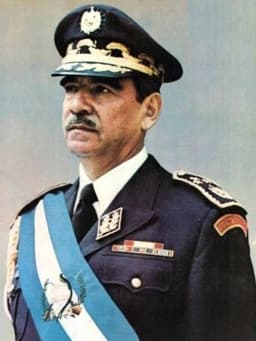
Romeo Lucas Garcia
General · Modern
37.4Total
Basic Information
Born
1836
1924
Died
1891
—
Era
Modern
Modern
Nationality
Brazil
Guatemala
Occupation
General
General
Civilization
Western
Western
Score Comparison
Military (10%)
25.9
22.6
Political (20%)
48.0
27.9
Influence (20%)
53.3
47.1
Legacy (20%)
46.7
37.5
Leadership (15%)
64.5
45.0
Strategy (15%)
25.0
30.3
TOTAL
47.0
37.4
Benjamin Constant — Complete Timeline
1880 AD
Published 'O Positivismo no Brasil'Cultural
Benjamin Constant published 'O Positivismo no Brasil', a work that promoted the ideas of Auguste Comte. This publication helped spread Positivism among Brazilian intellectuals and military officers, influencing the republican movement.
PublicationPositivismIdeology
Impact: nationalconstructive
1889 AD
Founded the Military School of RealengoReform◆ Major
As Minister of War, Constant founded the Military School of Realengo, which became a center for Positivist education. The school trained a generation of officers who were influenced by Positivist ideas, shaping the Brazilian military's political role.
EducationMilitaryPositivism
Impact: nationalconstructive
Proclamation of the Brazilian RepublicPolitical Action
Benjamin Constant was a key leader in the military coup that overthrew the Brazilian Empire. He commanded the troops that surrounded the Imperial Palace and convinced Emperor Pedro II to abdicate. This established the First Brazilian Republic.
RepublicCoupEnd of Empire
Impact: national
Appointed Minister of WarPolitical Action◆ Major
Benjamin Constant was appointed Minister of War in the provisional government of the newly proclaimed Republic. He implemented reforms based on Positivist principles, including the separation of church and state and the reorganization of the military.
GovernmentReformPositivism
Impact: nationalconstructive
Romeo Lucas Garcia — Complete Timeline
1978 AD
Became President of GuatemalaPolitical Action◆ Major
Romeo Lucas Garc
PresidencyGuatemalaMilitary Rule
Impact: national
1979 AD
Oversaw Escalation of State TerrorPolitical Action◆ Major
Lucas García's regime intensified the use of death squads, forced disappearances, and massacres against political opponents and indigenous communities. The violence peaked during his tenure, with thousands killed or 'disappeared'.
State TerrorHuman RightsCivil War
Impact: nationaldestructive
1982 AD
Overthrown by Coup and ExiledPolitical Action◆ Major
Lucas García was overthrown in a military coup led by General Efraín Ríos Montt. He went into exile, and his ouster marked the end of the last military ruler before Ríos Montt's brief but brutal regime.
CoupExileGuatemala
Impact: nationaldestructive
This comparison has not been analyzed yet.
One-time AI generation (~1 minute). Scores and timeline are already available below.
Rankings
🥇
Benjamin ConstantLeader
Mil: 25.9Pol: 48.0Inf: 53.3
47.0
🥈
Romeo Lucas Garcia
Mil: 22.6Pol: 27.9Inf: 47.1
37.4
+9.6 behind
How This Comparison Works
Algorithm
Each figure is scored on 6 dimensions (0—100 scale) based on structured historical data: Military (10%), Political (20%), Influence (20%), Legacy (20%), Leadership (15%), Strategy (15%). The weighted total produces the final ranking.
Data Sources
Scores are computed from structured sub-indicators in the database. Scale factors adjust for era (Ancient ×0.85, Modern ×1.0) and civilization size (Eastern ×1.05, Other ×0.80) to account for differences in population and military scale.
Maximum 3 Figures
Comparisons are limited to 2—3 figures to ensure readability and statistical meaningfulness.
Error Margins
±5 points per dimension — Sub-scores are derived from historical records with inherent uncertainty. Two figures within 5 points on a dimension should be considered roughly equivalent in that area.
Total Score Accuracy
±3 points overall — The weighted combination of 6 dimensions produces a total score with approximately ±3 points of uncertainty. Differences of less than 3 points are not statistically significant— the figures are effectively tied.
Known Limitations
- Historical records are incomplete and uneven across civilizations
- Figures from oral-tradition societies may be underrepresented
- Occupation labels can misclassify multi-role figures
- Scores measure capability and impact, not moral character
- Quantitative scoring is a comparison tool, not absolute truth
Capability Radar
Military (10%) — Battles & Warfare
Battles
10
10
Win Rate
10
10
Expansion
10
5
Political (20%) — Governance & Reform
Reform
40
10
Diplomacy
30
15
Economy
20
10
Influence (20%) — Cultural & Global Reach
Cultural
30
5
Global
20
5
Legacy (20%) — Historical Impact
Historical
40
10
Longevity
30
5
Leadership (15%) — Power & Stability
Tenure
30
30
Stability
20
5
Strategy (15%) — Tactics & Innovation
Strategy
10
15
Tactics
10
15
Reform
15
10
Similar Comparisons
Comments & Discussion
No comments yet. Be the first to share your thoughts!