Loading...
Bertrand du Guesclin vs Guo Ziyi
Guo Ziyi leads by 3.1 pts · 2 figures compared
…
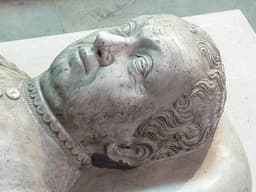
Bertrand du Guesclin
General · Medieval
60.0Total

Guo Ziyi
General · Medieval
63.1Total
Basic Information
Born
1320
697
Died
1380
781
Era
Medieval
Medieval
Nationality
France
China
Occupation
General
General
Civilization
Western
Eastern
Score Comparison
Military (10%)
67.3
78.5
Political (20%)
54.7
45.0
Influence (20%)
56.4
61.0
Legacy (20%)
48.3
58.0
Leadership (15%)
80.0
77.2
Strategy (15%)
69.1
72.0
TOTAL
60.0
63.1
Bertrand du Guesclin — Complete Timeline
1364 AD
Battle of CocherelWar◆ Major
Bertrand du Guesclin led French forces to victory at the Battle of Cocherel against the forces of Charles II of Navarre. The victory secured the French throne for Charles V and established du Guesclin as a leading commander.
Hundred Years' WarBattle
Impact: regional
Battle of AurayWar◆ Major
Du Guesclin was defeated and captured at the Battle of Auray while fighting for the French in the Breton War of Succession. The defeat was a setback for French ambitions in Brittany.
Hundred Years' WarBattleDefeat
Impact: regionaltragic
1370 AD
Campaign in AquitaineWar◆ Major
Du Guesclin led a successful campaign in Aquitaine, using Fabian tactics to avoid pitched battles and recapture castles and towns from the English. His strategy weakened English control in the region.
Hundred Years' WarCampaign
Impact: regional
Appointment as Constable of FrancePolitical Action◆ Major
King Charles V appointed Bertrand du Guesclin as Constable of France, the highest military office. Du Guesclin was tasked with leading the French campaign to recover territory from the English.
FranceAppointment
Impact: nationalconstructive
1380 AD
Death at the Siege of Châteauneuf-de-RandonWar◆ Major
Bertrand du Guesclin died during the siege of Ch
Hundred Years' WarSiegeDeath
Impact: nationaltragic
Guo Ziyi — Complete Timeline
756 AD
Appointment as Commander-in-ChiefPolitical Action◆ Major
Emperor Suzong appointed Guo Ziyi as commander-in-chief of Tang forces to suppress the An Lushan Rebellion. This appointment gave him authority over all imperial armies and marked the start of his decisive role in the war.
AppointmentTang DynastyMilitary Command
Impact: nationalconstructive
757 AD
Suppression of the An Lushan RebellionWar
Guo Ziyi, as commander of Tang forces, recaptured Chang'an and Luoyang from rebel forces. This campaign restored the Tang emperor to the throne and preserved the dynasty's rule over China.
An Lushan RebellionTang DynastyMilitary Campaign
Impact: nationalconstructive
Battle of XiangzhouWar◆ Major
Guo Ziyi led Tang and allied Uyghur forces to victory against the rebel army of An Qingxu at Xiangzhou. This battle broke the back of the rebellion and led to the recapture of the eastern capital Luoyang.
An Lushan RebellionBattleTang Dynasty
Impact: nationalconstructive
765 AD
Defense against Tibetan incursionsWar◆ Major
Guo Ziyi, with a small force, faced a Tibetan army that had captured Chang'an. Through diplomacy and a show of force, he persuaded the Tibetans to withdraw without a major battle, restoring order.
Tibetan IncursionTang DynastyDefense
Impact: nationalconstructive
Expert Analysis
Origins
Bertrand du Guesclin was born around 1320 in Brittany, France, into a minor noble family. His early life was marked by a lack of formal education; he was reportedly more interested in physical pursuits. He began his military career as a mercenary, fighting in local conflicts. In contrast, Guo Ziyi was born in 697 in Huazhou, Tang China, into a military family. His father was a prefect, and Guo Ziyi received a classical education and passed the military examination system, becoming an officer. Both men rose from modest beginnings, but their paths diverged: du Guesclin through freelance warfare, Guo through the imperial bureaucracy.
Rise to Power
Du Guesclin first gained attention during the Breton War of Succession (1341–1364), where he fought for Charles of Blois. His victory at the Battle of Cocherel in 1364 against the forces of Charles II of Navarre secured his reputation. However, he was defeated and captured at the Battle of Auray later that year, a setback that led to his ransom. King Charles V of France recognized his potential and appointed him Constable of France in 1370, the highest military office. Guo Ziyi's rise was tied to the An Lushan Rebellion (755–763). Emperor Suzong appointed him commander-in-chief in 756, tasked with suppressing the rebellion. Guo recaptured the capitals Chang'an and Luoyang in 757, restoring the emperor's authority. His victory at the Battle of Xiangzhou in 758 broke the rebel back. Both men rose through decisive victories, but Guo's appointment came during a national crisis, while du Guesclin's came after years of service.
Leadership & Governance
Du Guesclin's leadership style emphasized Fabian tactics: avoiding pitched battles, harassing supply lines, and recapturing fortresses. His campaign in Aquitaine (1370–1374) systematically reduced English-held territories through sieges and skirmishes. He scored 80.0 in leadership, reflecting his ability to inspire loyalty among his men, though his political score was only 54.7. Guo Ziyi, with a leadership score of 77.2, commanded through strategic acumen and diplomacy. He integrated allied Uyghur forces effectively at Xiangzhou. His governance approach included showing mercy to defeated rebels, which helped stabilize the empire. Guo's political score was 45.0, lower than du Guesclin's, but he demonstrated diplomatic skill in persuading Tibetan forces to withdraw from Chang'an without battle. Both were effective commanders, but du Guesclin focused on attrition, while Guo combined military force with negotiation.
Triumph & Tragedy
Du Guesclin's greatest success was the reconquest of much of Aquitaine, using his strategy of avoiding major battles. His appointment as Constable was a triumph, as he restored French morale. His tragedy was his death at the Siege of Châteauneuf-de-Randon in 1380, during a minor siege. He also suffered capture at Auray. Guo Ziyi's triumph was suppressing the An Lushan Rebellion, saving the Tang dynasty. His defense against Tibetan incursions in 763, where he forced their withdrawal through a show of force, was a diplomatic victory. His tragedy was the political intrigue after the rebellion; he was repeatedly sidelined by court eunuchs, though he remained loyal. Guo's military score of 78.5 reflects his effectiveness, while du Guesclin's 67.3 indicates more limited scope.
Character & Destiny
Du Guesclin was known for his physical prowess, courage, and loyalty to the French crown. He was pragmatic, often using deception and avoiding direct confrontation. His character led to a steady rise, but his death in a minor siege shows his willingness to engage in risky situations. Guo Ziyi was characterized by humility, loyalty, and strategic patience. He accepted dismissal without complaint, and his reputation for integrity helped him regain command when needed. His destiny was to be the savior of the Tang, but he never sought supreme power. Historical assessments note that du Guesclin's tactics were innovative for his time, while Guo's were conventional but effective. Both were shaped by their cultures: du Guesclin by feudal chivalry, Guo by Confucian duty.
Legacy
Du Guesclin is remembered as a national hero in France, a symbol of resistance against the English. His Fabian tactics influenced later French strategy. However, his legacy score is 48.3, limited by his death before the end of the Hundred Years' War. Guo Ziyi's legacy is more enduring in China. He is revered as a loyal general who saved the dynasty, with temples dedicated to him. His legacy score of 58.0 reflects his lasting impact. The Tang dynasty survived for another century partly due to his efforts. Du Guesclin's military reforms were temporary, while Guo's example of loyalty became a model for Chinese officials.
Conclusion
Guo Ziyi had greater impact than Bertrand du Guesclin. With a total score of 63.1 vs 60.0, Guo's military achievements (78.5) and strategic success (72.0) surpassed du Guesclin's (67.3 and 69.1). Guo saved a major dynasty from collapse, reconquered capitals, and stabilized the empire, while du Guesclin's victories were part of a longer war that ended after his death. Guo's legacy endures in Chinese culture, while du Guesclin is a lesser-known figure outside France. Although du Guesclin's leadership (80.0) slightly edges Guo's (77.2), Guo's overall effectiveness and historical significance make him the superior general.
Rankings
🥇
Guo ZiyiLeader
Mil: 78.5Pol: 45.0Inf: 61.0
63.1
🥈
Bertrand du Guesclin
Mil: 67.3Pol: 54.7Inf: 56.4
60.0
+3.1 behind
How This Comparison Works
Algorithm
Each figure is scored on 6 dimensions (0—100 scale) based on structured historical data: Military (10%), Political (20%), Influence (20%), Legacy (20%), Leadership (15%), Strategy (15%). The weighted total produces the final ranking.
Data Sources
Scores are computed from structured sub-indicators in the database. Scale factors adjust for era (Ancient ×0.85, Modern ×1.0) and civilization size (Eastern ×1.05, Other ×0.80) to account for differences in population and military scale.
Maximum 3 Figures
Comparisons are limited to 2—3 figures to ensure readability and statistical meaningfulness.
Error Margins
±5 points per dimension — Sub-scores are derived from historical records with inherent uncertainty. Two figures within 5 points on a dimension should be considered roughly equivalent in that area.
Total Score Accuracy
±3 points overall — The weighted combination of 6 dimensions produces a total score with approximately ±3 points of uncertainty. Differences of less than 3 points are not statistically significant— the figures are effectively tied.
Known Limitations
- Historical records are incomplete and uneven across civilizations
- Figures from oral-tradition societies may be underrepresented
- Occupation labels can misclassify multi-role figures
- Scores measure capability and impact, not moral character
- Quantitative scoring is a comparison tool, not absolute truth
Capability Radar
Military (10%) — Battles & Warfare
Battles
65
85
Win Rate
60
80
Expansion
60
70
Political (20%) — Governance & Reform
Reform
45
60
Diplomacy
70
85
Economy
40
65
Influence (20%) — Cultural & Global Reach
Cultural
55
70
Global
45
65
Legacy (20%) — Historical Impact
Historical
60
80
Longevity
50
75
Leadership (15%) — Power & Stability
Tenure
60
75
Stability
55
80
Strategy (15%) — Tactics & Innovation
Strategy
75
85
Tactics
70
75
Reform
55
60
Similar Comparisons
Comments & Discussion
No comments yet. Be the first to share your thoughts!