Loading...
Bertrand du Guesclin vs Bohemond I of Antioch
Bertrand du Guesclin leads by 4.8 pts · 2 figures compared
…
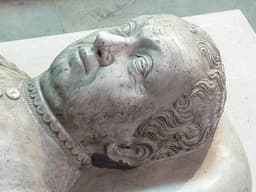
Bertrand du Guesclin
General · Medieval
60.0Total
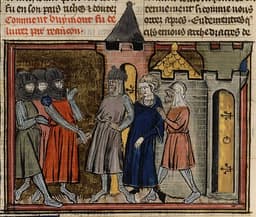
Bohemond I of Antioch
General · Medieval
55.2Total
Basic Information
Born
1320
1054
Died
1380
1111
Era
Medieval
Medieval
Nationality
France
Italy
Occupation
General
General
Civilization
Western
Western
Score Comparison
Military (10%)
67.3
76.0
Political (20%)
54.7
45.1
Influence (20%)
56.4
53.3
Legacy (20%)
48.3
46.7
Leadership (15%)
80.0
61.1
Strategy (15%)
69.1
66.3
TOTAL
60.0
55.2
Bertrand du Guesclin — Complete Timeline
1364 AD
Battle of CocherelWar◆ Major
Bertrand du Guesclin led French forces to victory at the Battle of Cocherel against the forces of Charles II of Navarre. The victory secured the French throne for Charles V and established du Guesclin as a leading commander.
Hundred Years' WarBattle
Impact: regional
Battle of AurayWar◆ Major
Du Guesclin was defeated and captured at the Battle of Auray while fighting for the French in the Breton War of Succession. The defeat was a setback for French ambitions in Brittany.
Hundred Years' WarBattleDefeat
Impact: regionaltragic
1370 AD
Campaign in AquitaineWar◆ Major
Du Guesclin led a successful campaign in Aquitaine, using Fabian tactics to avoid pitched battles and recapture castles and towns from the English. His strategy weakened English control in the region.
Hundred Years' WarCampaign
Impact: regional
Appointment as Constable of FrancePolitical Action◆ Major
King Charles V appointed Bertrand du Guesclin as Constable of France, the highest military office. Du Guesclin was tasked with leading the French campaign to recover territory from the English.
FranceAppointment
Impact: nationalconstructive
1380 AD
Death at the Siege of Châteauneuf-de-RandonWar◆ Major
Bertrand du Guesclin died during the siege of Ch
Hundred Years' WarSiegeDeath
Impact: nationaltragic
Bohemond I of Antioch — Complete Timeline
1098 AD
Capture of AntiochWar
Bohemond led the capture of Antioch during the First Crusade. He negotiated with a traitor inside the city to open a gate, allowing the crusaders to enter. He then claimed the city for himself, becoming Prince of Antioch.
CrusadeSiegeCrusader States
Impact: regional
1104 AD
Battle of HarranWar◆ Major
Bohemond and Baldwin of Edessa were defeated by a combined Seljuk force at the Battle of Harran. Bohemond was captured and held for ransom, weakening the Principality of Antioch.
Crusader StatesBattleDefeat
Impact: regionaltragic
1107 AD
Campaign against the Byzantine EmpireWar◆ Major
After his release, Bohemond launched a campaign against the Byzantine Empire, besieging Dyrrhachium. He was forced to surrender in 1108 and sign the Treaty of Devol, which made Antioch a vassal of Byzantium.
Byzantine EmpireWarTreaty
Impact: regional
1108 AD
Treaty of DevolPolitical Action◆ Major
Bohemond signed the Treaty of Devol with Byzantine Emperor Alexios I Komnenos. The treaty recognized Bohemond as Prince of Antioch but made him a vassal of the Byzantine Empire, a humiliation that ended his ambitions.
TreatyByzantine EmpireCrusader States
Impact: regional
Expert Analysis
Origins
Bertrand du Guesclin was born around 1320 in the Duchy of Brittany, France, into a minor noble family. His early life was marked by a lack of formal education; he was described as rough and unkempt. However, he excelled in martial training, participating in local tournaments and skirmishes. His family's modest status meant he had to earn his reputation through military prowess.
Bohemond I of Antioch was born around 1054 in southern Italy to Robert Guiscard, the Norman Duke of Apulia and Calabria. As the eldest son, Bohemond was groomed for leadership but was later disinherited in favor of his half-brother. This drove him to seek his own fortune, leading him to join the First Crusade in 1096.
Rise to Power
Du Guesclin rose to prominence during the Breton War of Succession (1341–1364). His first major success was the Battle of Cocherel in 1364, where he defeated the forces of Charles II of Navarre, securing the French crown's position. However, he suffered a setback at the Battle of Auray later that year, being defeated and captured by the English-backed claimant. After his release, he served under King Charles V of France. In 1370, he was appointed Constable of France, the highest military office, tasked with leading the reconquest of lands lost to the English.
Bohemond's rise came during the First Crusade. He was a key commander in the Siege of Antioch (1097–1098). Through a combination of military skill and treachery, he negotiated with a tower guard to open the gates, allowing the crusaders to capture the city. He then claimed the principality of Antioch for himself, establishing a Norman state in the Levant. His capture of Antioch made him one of the most powerful crusader lords.
Leadership & Governance
Du Guesclin's leadership style was characterized by caution and strategic patience. He favored Fabian tactics—avoiding major pitched battles and instead conducting sieges, raids, and attrition warfare. This approach was suited to the French strategy of gradually recovering territory from the English. He was known for his discipline and ability to maintain morale among troops, even during prolonged campaigns. His governance as Constable was focused on military reorganization and securing royal authority.
Bohemond was a bold and aggressive leader, often taking risks to achieve his goals. At Antioch, he used deception and negotiation to capture the city. As Prince of Antioch, he ruled with a firm hand, but his governance was marked by constant conflict with the Byzantine Empire and neighboring Muslim states. His leadership during the Battle of Harran in 1104 was a disaster: he was captured after a rash pursuit, leading to a period of captivity and ransom.
Triumph & Tragedy
Du Guesclin's greatest triumph was his campaign in Aquitaine (1370–1374), where he systematically recaptured castles and towns from the English using Fabian tactics. He avoided a major defeat and restored French control over much of the region. His tragedy was his death at the Siege of Châteauneuf-de-Randon in 1380, just as his strategy was succeeding. He died of illness, possibly exacerbated by harsh conditions, before seeing the full fruits of his efforts.
Bohemond's triumph was the capture of Antioch, a pivotal event of the First Crusade. His tragedy was the defeat at Harran and subsequent capture, which weakened his principality. Later, his campaign against the Byzantine Empire failed: he besieged Dyrrhachium but was forced to surrender in 1108 and sign the Treaty of Devol, making him a vassal of the Byzantine emperor. This marked the end of his ambitions.
Character & Destiny
Du Guesclin was pragmatic and resilient. He accepted defeats and adapted, learning from setbacks like Auray. His character was that of a loyal servant to the French crown, never seeking personal glory over the king's cause. This loyalty earned him the trust of Charles V, who gave him the resources to implement his strategy. His destiny was to be a key figure in the Hundred Years' War, remembered as a national hero.
Bohemond was ambitious and opportunistic, driven by a desire to carve out his own kingdom. His charisma and military skill enabled him to achieve great success, but his overconfidence and aggression led to his downfall. He was a cunning negotiator but also a man of his time, willing to betray allies (such as the Byzantine emperor) to gain advantage. His destiny was to be a legendary crusader, but his legacy was limited by his ultimate failure.
Legacy
Du Guesclin's legacy is that of a master of Fabian tactics. He is credited with reviving French military fortunes during the Hundred Years' War, providing a strategy that later commanders like Joan of Arc would build upon. He is remembered as a national hero in France, with a burial site in the Basilica of Saint-Denis. His methods influenced French military doctrine for generations.
Bohemond's legacy is tied to the First Crusade and the establishment of the Crusader states. His capture of Antioch was a crucial moment in crusader history. However, his principality was short-lived, and his treaty with Byzantium limited its independence. He is remembered as a symbol of Norman ambition and crusader zeal, but his political achievements were fragile.
Conclusion
Bertrand du Guesclin had a greater overall impact. His military score of 67.3 and leadership score of 80.0 reflect his effectiveness, while Bohemond's military score of 76.0 is offset by lower political and leadership scores. Du Guesclin's strategy directly contributed to the recovery of French territory, altering the course of the Hundred Years' War. Bohemond's victories were dramatic but ultimately unsustainable. Du Guesclin's total score of 60.0 against Bohemond's 55.2 supports the conclusion that du Guesclin's influence was more lasting. Therefore, Bertrand du Guesclin stands as the more significant figure.
Rankings
🥇
Bertrand du GuesclinLeader
Mil: 67.3Pol: 54.7Inf: 56.4
60.0
🥈
Bohemond I of Antioch
Mil: 76.0Pol: 45.1Inf: 53.3
55.2
+4.8 behind
How This Comparison Works
Algorithm
Each figure is scored on 6 dimensions (0—100 scale) based on structured historical data: Military (10%), Political (20%), Influence (20%), Legacy (20%), Leadership (15%), Strategy (15%). The weighted total produces the final ranking.
Data Sources
Scores are computed from structured sub-indicators in the database. Scale factors adjust for era (Ancient ×0.85, Modern ×1.0) and civilization size (Eastern ×1.05, Other ×0.80) to account for differences in population and military scale.
Maximum 3 Figures
Comparisons are limited to 2—3 figures to ensure readability and statistical meaningfulness.
Error Margins
±5 points per dimension — Sub-scores are derived from historical records with inherent uncertainty. Two figures within 5 points on a dimension should be considered roughly equivalent in that area.
Total Score Accuracy
±3 points overall — The weighted combination of 6 dimensions produces a total score with approximately ±3 points of uncertainty. Differences of less than 3 points are not statistically significant— the figures are effectively tied.
Known Limitations
- Historical records are incomplete and uneven across civilizations
- Figures from oral-tradition societies may be underrepresented
- Occupation labels can misclassify multi-role figures
- Scores measure capability and impact, not moral character
- Quantitative scoring is a comparison tool, not absolute truth
Capability Radar
Military (10%) — Battles & Warfare
Battles
65
75
Win Rate
60
70
Expansion
60
65
Political (20%) — Governance & Reform
Reform
45
40
Diplomacy
70
65
Economy
40
35
Influence (20%) — Cultural & Global Reach
Cultural
55
45
Global
45
45
Legacy (20%) — Historical Impact
Historical
60
60
Longevity
50
50
Leadership (15%) — Power & Stability
Tenure
60
55
Stability
55
30
Strategy (15%) — Tactics & Innovation
Strategy
75
75
Tactics
70
80
Reform
55
30
Similar Comparisons
Comments & Discussion
No comments yet. Be the first to share your thoughts!