Loading...
Bhim Singh II of Kota vs Julius Caesar
Julius Caesar leads by 38.3 pts · 2 figures compared
…
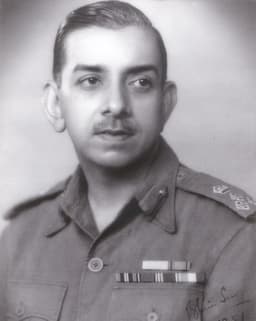
Bhim Singh II of Kota
Emperor · Modern
44.5Total

Julius Caesar
General · Ancient
82.8Total
Basic Information
Born
1909
-100
Died
1991
-44
Era
Modern
Ancient
Nationality
India
Roman Republic
Occupation
Emperor
General
Civilization
Indian
Western
Score Comparison
Military (10%)
45.3
88.0
Political (20%)
36.5
78.0
Influence (20%)
47.1
85.0
Legacy (20%)
35.0
82.0
Leadership (15%)
58.8
80.0
Strategy (15%)
51.3
85.0
TOTAL
44.5
82.8
Bhim Singh II of Kota — Complete Timeline
1940 AD
Accession as Maharao of KotaPolitical Action◆ Major
Bhim Singh II became the Maharao of Kota at age 31, succeeding his father. His reign spanned the end of British colonial rule and the integration of princely states into independent India, requiring him to navigate political transitions.
SuccessionPrincely StateTransition
Impact: regional
1949 AD
Integration of Kota into the Indian UnionPolitical Action
Bhim Singh II signed the Instrument of Accession, merging Kota into the Dominion of India. He later served as a member of the Rajasthan Legislative Assembly and as a Rajya Sabha member, participating in democratic governance after the end of princely rule.
Indian IndependenceIntegrationDemocracy
Impact: national
1960 AD
Establishment of the Kota Barrage and irrigation projectsReform◆ Major
Bhim Singh II championed the construction of the Kota Barrage on the Chambal River, a major irrigation project that transformed agriculture in the region. The project provided water for farming and helped mitigate droughts, benefiting thousands of farmers.
IrrigationAgricultureDevelopment
Impact: regionalconstructive
1970 AD
Environmental conservation efforts in KotaReform
Bhim Singh II initiated environmental conservation programs, including the protection of the Chambal River ecosystem and the establishment of wildlife sanctuaries. His efforts contributed to the preservation of the region's biodiversity, including the gharial crocodile.
EnvironmentConservationWildlife
Impact: regionalconstructive
Julius Caesar — Complete Timeline
58 BC
Gallic WarsWar◆ Major
Caesar, as proconsul of Gaul, launched a series of campaigns that conquered all of Gaul (modern France, Belgium, and parts of Switzerland). He fought numerous battles, including against the Helvetii, the Belgae, and the Gallic chieftain Vercingetorix. The wars brought immense wealth and a loyal army to Caesar.
Gallic WarsConquestRoman Expansion
Impact: regional
49 BC
Crossing the RubiconPolitical Action◆ Major
Caesar led Legio XIII across the Rubicon River into Italy, defying the Roman Senate's order to disband his army. This act triggered a civil war against Pompey and the Optimates, ultimately leading to Caesar's dictatorship and the end of the Roman Republic.
Roman Civil WarEnd of RepublicPower Struggle
Impact: global
48 BC
Battle of PharsalusWar◆ Major
Caesar's outnumbered army defeated the larger forces of Pompey the Great at Pharsalus in Greece. Caesar's tactical use of a reserve line to counter Pompey's cavalry charge proved decisive. Pompey fled to Egypt, where he was assassinated, leaving Caesar as the undisputed master of the Roman world.
Roman Civil WarBattleDecisive Victory
Impact: regional
44 BC
Appointment as Dictator for LifePolitical Action◆ Major
The Roman Senate appointed Caesar dictator perpetuo (dictator for life), granting him unprecedented personal power. This move concentrated military, legislative, and judicial authority in one person, effectively ending the Roman Republic's traditional system of checks and balances and alarming many senators.
DictatorshipEnd of RepublicPower Consolidation
Impact: regionaldestructive
Assassination on the Ides of MarchPolitical Action◆ Major
A group of Roman senators, led by Marcus Junius Brutus and Gaius Cassius Longinus, stabbed Caesar to death at a meeting of the Senate in the Theatre of Pompey. The assassination was intended to restore the Republic, but instead triggered another civil war that led to the rise of the Roman Empire.
AssassinationRoman PoliticsEnd of Republic
Impact: globaldestructive
Expert Analysis
bhim-singh-ii-of-kota-vs-julius-caesar
# The Conqueror and the Conservator: Two Paths to Power
On a March morning in 44 BCE, Julius Caesar fell beneath twenty-three dagger blows in the Roman Senate, his blood pooling on the marble floor as his assassins declared themselves liberators. Two thousand years later, in the dusty heat of Rajasthan, another ruler—Maharao Bhim Singh II of Kota—signed away his ancestral throne with a stroke of a pen, choosing preservation over defiance. What possible connection could bind a Roman dictator who remade the ancient world and an Indian prince who traded his crown for irrigation canals and crocodile sanctuaries? The answer lies not in their achievements, but in the starkly different worlds they inhabited—and the very different meanings of power each understood.
Origins
Julius Caesar was born into the chaos of a dying republic, a world where ambition was measured in legions and provinces. His family, the Julii, claimed descent from the goddess Venus, but their political fortunes had faded. Rome in the first century BCE was a cauldron of civil wars, slave revolts, and senatorial corruption—a system straining under the weight of its own conquests. Caesar grew up watching his uncle Marius and his rival Sulla turn Roman armies against each other, learning early that in a state without stable institutions, the man with the most loyal soldiers ruled.
Bhim Singh II entered a very different world in 1909, the twilight of the British Raj. The princely state of Kota was a feudal remnant, its power circumscribed by colonial overlords. His family had ruled for centuries, but their authority now depended on British approval. Born into a gilded cage, Bhim Singh inherited not a republic to conquer, but a tradition to manage. Where Caesar learned that glory came from breaking the old order, Bhim Singh learned that survival came from accommodating it.
Rise to Power
Caesar’s path was forged in blood and debt. He fled Rome to avoid Sulla's proscriptions, served as a military tribune in Asia, and was captured by pirates—whom he famously promised to crucify, and then did. He climbed the political ladder through the *cursus honorum*, but his true springboard was the governorship of Gaul. Between 58 and 50 BCE, he conquered a territory larger than Italy itself, fighting over a million men and enslaving another million. The Gallic Wars made him Rome’s richest general and its most feared. When the Senate ordered him to disband his army, he instead crossed the Rubicon River in 49 BCE, igniting a civil war that would end the Republic.
Bhim Singh II’s rise was quieter but no less significant. He became Maharao of Kota in 1940, at age 31, inheriting a state that was already a client of the British Empire. His key turning point came in 1949, when he signed the Instrument of Accession, merging Kota into the newly independent Dominion of India. Where Caesar seized power by defying the state, Bhim Singh secured his legacy by surrendering it. The contrast is not one of courage, but of context: Caesar faced a republic that could be toppled; Bhim Singh faced a nation-state that could not be resisted.
Leadership & Governance
Caesar ruled as a military autocrat. As dictator for life, he reformed the calendar, granted citizenship to provincials, initiated public works, and centralized taxation. But his genius was strategic, not administrative. He understood that in Rome, power flowed from the army, and he kept his legions loyal by sharing plunder and granting land. His reforms were real, but they were also instruments of control. The Senate became a rubber stamp, and the people cheered as long as bread and circuses flowed. Caesar’s governance was brilliant, but brittle—it depended entirely on his person.
Bhim Singh II governed in an age of bureaucracy and democracy. His greatest achievement was the Kota Barrage, completed around 1960, which transformed the arid Chambal River basin into fertile farmland. He also launched environmental conservation programs, protecting the Chambal ecosystem and its endangered species—including the gharial crocodile and the Ganges river dolphin. These were not grand conquests, but they were sustainable. While Caesar built an empire that collapsed within decades, Bhim Singh built irrigation canals that still water fields today.
Triumph & Tragedy
Caesar’s greatest triumph was his swift victory in the civil war—defeating Pompey at Pharsalus in 48 BCE, then mopping up resistance in Egypt, Asia, and Africa. His tragedy was his own success: by concentrating power in himself, he made assassination the only check against him. The Ides of March was not a failure of intelligence (he was warned) but of imagination—he could not conceive that men he had pardoned would kill him.
Bhim Singh II’s triumph was the peaceful integration of Kota into India, a transition that avoided the bloodshed that scarred other princely states. His tragedy was more subtle: he became a constitutional figurehead, his power reduced to ceremonial duties. Where Caesar died violently at the height of his power, Bhim Singh lived into old age as a retired monarch—a fate that would have seemed pitiful to a Roman general, but which reflected a different kind of wisdom.
Character & Destiny
Caesar was reckless, generous, and calculating. He pardoned his enemies, slept with his allies’ wives, and gambled everything on single battles. His personality was the engine of his destiny: his ambition was insatiable, his confidence absolute. He once said, “It is easier to find men who will volunteer to die, than to find those who are willing to endure pain with patience.” He was built for conquest, not for peace.
Bhim Singh II was patient, pragmatic, and environmentally conscious—traits that would have mystified Caesar. He understood that the age of kings was ending, and that true leadership meant adapting to change. Where Caesar saw the world as something to be conquered, Bhim Singh saw it as something to be conserved. Their characters reflect their eras: Caesar the product of a world where power was personal and violent; Bhim Singh the product of a world where power was institutional and negotiated.
Legacy
Caesar’s legacy is monumental. His name became synonymous with imperial rule—*Kaiser* and *Tsar* derive from it. His conquests laid the foundation for the Roman Empire, which shaped Western law, language, and culture for two millennia. But his methods also set a precedent for military dictatorship, and his assassination plunged Rome into another century of civil war.
Bhim Singh II’s legacy is quieter but enduring. The Kota Barrage still irrigates Rajasthan. The Chambal sanctuary still protects endangered species. He is remembered not as a conqueror, but as a steward—a man who used his last shreds of power to build, not to destroy. In India’s democratic framework, he represents the princely class that chose integration over resistance.
Conclusion
Standing at the edge of the Chambal River, watching a gharial slide into the brown water, one might recall the Forum where Caesar fell. Both men faced a choice between glory and survival. Caesar chose glory and died young, remaking the world in his image. Bhim Singh chose survival and lived old, preserving a small piece of it. The difference is not one of greatness, but of what greatness meant in their time. Caesar’s Rome rewarded the man who broke the Republic; Bhim Singh’s India rewarded the man who accepted its end. History, in the end, is a mirror that reflects not just the figures who stand before it, but the age that watches them.
Rankings
🥇
Julius CaesarLeader
Mil: 88.0Pol: 78.0Inf: 85.0
82.8
🥈
Bhim Singh II of Kota
Mil: 45.3Pol: 36.5Inf: 47.1
44.5
+38.3 behind
How This Comparison Works
Algorithm
Each figure is scored on 6 dimensions (0—100 scale) based on structured historical data: Military (10%), Political (20%), Influence (20%), Legacy (20%), Leadership (15%), Strategy (15%). The weighted total produces the final ranking.
Data Sources
Scores are computed from structured sub-indicators in the database. Scale factors adjust for era (Ancient ×0.85, Modern ×1.0) and civilization size (Eastern ×1.05, Other ×0.80) to account for differences in population and military scale.
Maximum 3 Figures
Comparisons are limited to 2—3 figures to ensure readability and statistical meaningfulness.
Error Margins
±5 points per dimension — Sub-scores are derived from historical records with inherent uncertainty. Two figures within 5 points on a dimension should be considered roughly equivalent in that area.
Total Score Accuracy
±3 points overall — The weighted combination of 6 dimensions produces a total score with approximately ±3 points of uncertainty. Differences of less than 3 points are not statistically significant— the figures are effectively tied.
Known Limitations
- Historical records are incomplete and uneven across civilizations
- Figures from oral-tradition societies may be underrepresented
- Occupation labels can misclassify multi-role figures
- Scores measure capability and impact, not moral character
- Quantitative scoring is a comparison tool, not absolute truth
Capability Radar
Military (10%) — Battles & Warfare
Battles
30
95
Win Rate
32
92
Expansion
33
97
Political (20%) — Governance & Reform
Reform
20
90
Diplomacy
25
85
Economy
20
82
Influence (20%) — Cultural & Global Reach
Cultural
15
88
Global
5
94
Legacy (20%) — Historical Impact
Historical
10
95
Longevity
10
96
Leadership (15%) — Power & Stability
Tenure
30
75
Stability
25
60
Strategy (15%) — Tactics & Innovation
Strategy
36
94
Tactics
44
96
Reform
45
88
Similar Comparisons
Comments & Discussion
The Centurion's Shadow6/17/2026
Bhim Singh II knew what Caesar never grasped: survival trumps glory. Sure, Caesar conquered Gaul, crossed the Rubicon, and remade Rome—but he got stabbed 23 times for his hubris. Bhim Singh, meanwhile, read the room in 1948 and chose a pen over a sword. He got to keep his ghariyal sanctuary and irrigation legacy. Caesar's corpse was defiled in public; Bhim Singh died in his own bed. Who's the better strategist? The one who lives to see his crocodiles hatch.
数据骑士6/17/2026
拿恺撒比Bhim Singh二世?这根本是拿罗马战车比骆驼商队。恺撒在公元前50年指挥的军团多达5万人,控制了整个高卢和部分不列颠;Bhim Singh最牛的时候管的不过是个2万平方公里的土邦,1948年签合并协议时连警察都指挥不动。你把爱尔兰巨斧和水果刀放在一起比锋利度?数据纬度差几个量级,强行对比就是历史版关公战秦琼。
Classicus Scepticus6/17/2026
This comparison reeks of presentism dressed as insight. Caesar reshaped Mediterranean governance from Hispania to Syria, conquered 800 cities in Gaul alone, and authored military texts still studied at West Point. Bhim Singh II was a colonial-era prince who, after the Raj's collapse, managed a peaceful handover of a mid-sized principality. One built an empire; the other preserved a legacy. That's like comparing the eruption of Vesuvius with a campfire. Scale matters, and here it's laughably mism
落日藩王6/17/2026
说得好听是"保守者",说白了就是跪着活。恺撒死前喊的是"Et tu, Brute?",最后还反击了一下;Bhim Singh二世1948年签字时连个象征性反抗都没有。拉贾斯坦当时多少土邦王公搞武装讨价还价?斋浦尔、焦特布尔都谈判拿到特权,他倒好,直接交权换鳄鱼塘。历史需要豪杰,不是温顺的签字机器。你敬他是聪明人,我敬他辜负了"辛格"这个姓氏。
The Gadfly of Antiquity6/17/2026
What strikes me isn't their power but their deaths. Caesar's assassination birthed an empire—Octavian himself built on Caesar's martyrdom. Bhim Singh's 1949 accession to India guaranteed his irrelevance: he became a footnote in Rajasthan's tourism pamphlets. Two deaths: one that sparked civil war and shaped a continent; another that ended with a modest obituary in the Times of India. The comparison isn't wrong; it's brutally instructive. Power isn't just what you wield in life, but what detonate