Loading...
Bhim Singh of Mewar vs Julius Caesar
Julius Caesar leads by 40.4 pts · 2 figures compared
…
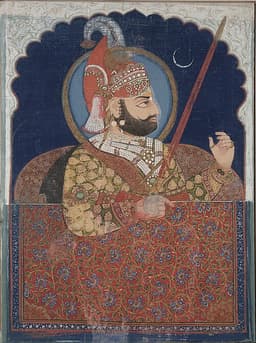
Bhim Singh of Mewar
Emperor · Modern
42.4Total

Julius Caesar
General · Ancient
82.8Total
Basic Information
Born
1761
-100
Died
1828
-44
Era
Modern
Ancient
Nationality
India
Roman Republic
Occupation
Emperor
General
Civilization
Indian
Western
Score Comparison
Military (10%)
14.9
88.0
Political (20%)
32.2
78.0
Influence (20%)
51.0
85.0
Legacy (20%)
40.0
82.0
Leadership (15%)
62.2
80.0
Strategy (15%)
39.6
85.0
TOTAL
42.4
82.8
Bhim Singh of Mewar — Complete Timeline
1778 AD
Last Coronation at ChittorCultural
Bhim Singh was crowned Maharana at Chittor, the traditional capital of Mewar. This was the last coronation held at Chittor before the fort was abandoned due to Maratha threats.
CoronationChittorMewar
Impact: regional
1800 AD
Resisted Maratha InvasionsWar◆ Major
Bhim Singh led Mewar's resistance against Maratha raids under Holkar and Scindia. Despite limited resources, he defended Chittor and Udaipur, but the kingdom was weakened by constant warfare.
Maratha WarsDefenseMewar
Impact: regional
1818 AD
Treaty of 1818 with the BritishPolitical Action◆ Major
Bhim Singh signed a subsidiary alliance with the British East India Company, making Mewar a princely state under British suzerainty. This ended Mewar's independence and brought it under colonial control.
TreatyBritish RajPrincely State
Impact: regional
Julius Caesar — Complete Timeline
58 BC
Gallic WarsWar◆ Major
Caesar, as proconsul of Gaul, launched a series of campaigns that conquered all of Gaul (modern France, Belgium, and parts of Switzerland). He fought numerous battles, including against the Helvetii, the Belgae, and the Gallic chieftain Vercingetorix. The wars brought immense wealth and a loyal army to Caesar.
Gallic WarsConquestRoman Expansion
Impact: regional
49 BC
Crossing the RubiconPolitical Action◆ Major
Caesar led Legio XIII across the Rubicon River into Italy, defying the Roman Senate's order to disband his army. This act triggered a civil war against Pompey and the Optimates, ultimately leading to Caesar's dictatorship and the end of the Roman Republic.
Roman Civil WarEnd of RepublicPower Struggle
Impact: global
48 BC
Battle of PharsalusWar◆ Major
Caesar's outnumbered army defeated the larger forces of Pompey the Great at Pharsalus in Greece. Caesar's tactical use of a reserve line to counter Pompey's cavalry charge proved decisive. Pompey fled to Egypt, where he was assassinated, leaving Caesar as the undisputed master of the Roman world.
Roman Civil WarBattleDecisive Victory
Impact: regional
44 BC
Appointment as Dictator for LifePolitical Action◆ Major
The Roman Senate appointed Caesar dictator perpetuo (dictator for life), granting him unprecedented personal power. This move concentrated military, legislative, and judicial authority in one person, effectively ending the Roman Republic's traditional system of checks and balances and alarming many senators.
DictatorshipEnd of RepublicPower Consolidation
Impact: regionaldestructive
Assassination on the Ides of MarchPolitical Action◆ Major
A group of Roman senators, led by Marcus Junius Brutus and Gaius Cassius Longinus, stabbed Caesar to death at a meeting of the Senate in the Theatre of Pompey. The assassination was intended to restore the Republic, but instead triggered another civil war that led to the rise of the Roman Empire.
AssassinationRoman PoliticsEnd of Republic
Impact: globaldestructive
Expert Analysis
bhim-singh-of-mewar-vs-julius-caesar
### The Last Coronation at Chittor: Two Men, Two Fates
On a winter morning in 1778, Bhim Singh stood in the ancient halls of Chittor, the once-mighty fortress of the Sisodia Rajputs. He was about to be crowned Maharana of Mewar, a dynasty that had defied the Mughal Empire at its zenith. The ceremony was steeped in ritual, a proud echo of a glorious past. Yet, as the crown was placed upon his head, a shadow hung over the celebration. This would be the last coronation ever held at Chittor. Half a world away, and nearly two thousand years earlier, another man stood on the banks of a small, muddy river in northern Italy. Gaius Julius Caesar, a Roman general of patrician birth but populist ambition, hesitated for a moment before crossing the Rubicon. “The die is cast,” he reportedly said. With that single act, he set in motion a chain of events that would shatter the Roman Republic and forge an empire. One man was born into a world of fading glory; the other, into a world of limitless ambition. Their fates were sealed not just by their times, but by the very different fires that forged their souls.
### Origins
Julius Caesar was born into the chaos of the late Roman Republic, a world of ruthless political competition. His family, the Julii, claimed descent from the goddess Venus, but their political influence had waned. Young Caesar grew up in a Rome riven by civil wars between populists and the senatorial aristocracy. He learned early that survival meant maneuvering, borrowing, and forging alliances. His education was that of a Roman aristocrat: rhetoric, law, and military command. But his true classroom was the Forum, where he watched men like Marius and Sulla wield power with terrifying finality. He was a product of a republic that was already dying, a system that rewarded audacity.
Bhim Singh’s origins were starkly different. He was born into a world of siege. By 1761, the once-mighty Mewar kingdom, a bastion of Rajput pride that had held out against Akbar, was a shadow of itself. The Maratha Confederacy, a rising Hindu power, was now the dominant force in North India. The Mughal Empire was a corpse. Bhim Singh inherited a throne that was more a burden than a prize. His ancestors had fought epic wars; he would fight a war of attrition against time and tide. His upbringing was steeped in the Rajput code of honor—*izzat* and *dharma*—but the world that honored those codes was vanishing. While Caesar’s Rome was a cauldron of opportunity, Bhim Singh’s Mewar was a fortress under a slow, relentless flood.
### Rise to Power
Caesar’s path to power was a masterclass in calculated risk. He began as a military tribune, then a quaestor in Spain, where he reportedly wept before a statue of Alexander the Great, lamenting that he had done nothing at an age when Alexander had conquered the world. He climbed the political ladder—aedile, pontifex maximus, praetor—spending borrowed fortunes on games and bribes. His true springboard was the governorship of Gaul. From 58 to 50 BCE, he launched a brutal, brilliant campaign that conquered modern France and Belgium, forging a loyal army and amassing staggering wealth. When the Senate ordered him to disband his legions, he chose war. The crossing of the Rubicon was the ultimate gamble of a man who had spent his life betting on himself.
Bhim Singh’s rise was not a climb but a holding action. He became Maharana in 1778, but his coronation at Chittor was a symbolic act; the fortress itself was long since lost to Maratha control. His power was nominal. The real rulers of the region were the Maratha chieftains—Holkar and Scindia—who raided Mewar’s territories with impunity. In 1800, Bhim Singh led a desperate resistance against these invasions. With a small, underfunded army, he managed to defend his core territories, but he could not drive the Marathas out. His “rise” was not a conquest but a struggle to keep a candle lit in a storm. Where Caesar saw an empire to build, Bhim Singh saw a kingdom to preserve.
### Leadership & Governance
Caesar governed as a revolutionary reformer. As dictator, he overhauled the calendar, granted citizenship to provincials, initiated massive public works, and reformed debt laws. His rule was efficient, ruthless, and deeply unpopular with the old aristocracy. He was a military genius, not just a tactician but a logistical master who understood that morale and speed were weapons. He led from the front, sharing his soldiers’ rations and hardships. Yet his political wisdom was flawed: he pardoned his enemies, believing they would be grateful, only to be stabbed by them. His style was one of absolute control, tempered by a strange magnanimity that his rivals mistook for weakness.
Bhim Singh’s governance was the art of survival. He had no legions, no treasury for grand reforms. His leadership was defined by *raj dharma*—the duty of a king to protect his people. In 1818, facing the inevitable rise of British power, he signed the Treaty of 1818, accepting a subsidiary alliance with the East India Company. This was not a defeat but a calculated surrender. Mewar became a princely state, losing its independence but preserving its dynasty and its cultural identity. Bhim Singh’s “reform” was a graceful, if painful, retreat. He ensured that Mewar would not be annexed, that its temples and traditions would survive under British suzerainty. Where Caesar broke the world to remake it, Bhim Singh bent to keep it from breaking.
### Triumph & Tragedy
Caesar’s greatest triumph was his conquest of Gaul, a feat that doubled Rome’s territory and made him the richest man in the Republic. His greatest tragedy was his assassination on the Ides of March, 44 BCE, at the foot of the Senate curia. He died believing he was saving Rome; in truth, he had already destroyed the Republic. His tragedy was that he succeeded too well.
Bhim Singh’s triumph was his defense of Mewar in 1800, a last stand that kept his kingdom alive against overwhelming odds. His tragedy was the Treaty of 1818. He became a king in name only, a subordinate prince. The last coronation at Chittor was not a beginning but an end. His tragedy was that his greatest act of leadership—preserving his dynasty—was also an admission of defeat.
### Character & Destiny
Caesar was an actor on the world stage. He was charming, calculating, and utterly without scruple when it came to power. He believed in his own destiny, a man who saw himself as the solution to Rome’s chaos. His character was his destiny: his ambition was so vast that it could not be contained by the old laws. He had to be king or die.
Bhim Singh was a stoic in a crumbling palace. He was a realist who understood that honor sometimes means knowing when to bend. His character was shaped by *karma*—the acceptance of a role in a larger cycle. He did not seek to conquer the world; he sought to save his corner of it. His destiny was to be the last of something great, not the first of something new.
### Legacy
Caesar’s legacy is the Roman Empire. His name became a title—*Kaiser* and *Tsar*. He changed the course of Western history. He is remembered as a genius, a tyrant, and a martyr, his life a cautionary tale about the price of absolute power. His legacy is a question: can one man save a republic by destroying it?
Bhim Singh’s legacy is more modest but no less profound. He is remembered in Rajasthan as a king who kept the flame of Mewar alive. The Treaty of 1818 ensured that the House of Sisodia would rule, however nominally, until Indian independence in 1947. His legacy is survival, not conquest. He is a footnote in world history, but a cherished chapter in the history of his people.
### Conclusion
Standing at the Rubicon, Caesar saw a river that, once crossed, could never be uncrossed. Standing at Chittor, Bhim Singh saw a fortress that, once lost, could never be fully reclaimed. One man chose to break the world, and was broken by it. The other chose to bend, and in bending, saved what he could. Both were kings in their own right, but they ruled different universes. Caesar’s universe was one of infinite possibility, where ambition could reshape reality. Bhim Singh’s universe was one of immutable cycles, where duty meant holding the line. History remembers the man who crosses the river; it often forgets the man who guards the gate. But both are necessary. For every empire builder, there must be a kingdom keeper. And sometimes, keeping is the harder art.
Rankings
🥇
Julius CaesarLeader
Mil: 88.0Pol: 78.0Inf: 85.0
82.8
🥈
Bhim Singh of Mewar
Mil: 14.9Pol: 32.2Inf: 51.0
42.4
+40.4 behind
How This Comparison Works
Algorithm
Each figure is scored on 6 dimensions (0—100 scale) based on structured historical data: Military (10%), Political (20%), Influence (20%), Legacy (20%), Leadership (15%), Strategy (15%). The weighted total produces the final ranking.
Data Sources
Scores are computed from structured sub-indicators in the database. Scale factors adjust for era (Ancient ×0.85, Modern ×1.0) and civilization size (Eastern ×1.05, Other ×0.80) to account for differences in population and military scale.
Maximum 3 Figures
Comparisons are limited to 2—3 figures to ensure readability and statistical meaningfulness.
Error Margins
±5 points per dimension — Sub-scores are derived from historical records with inherent uncertainty. Two figures within 5 points on a dimension should be considered roughly equivalent in that area.
Total Score Accuracy
±3 points overall — The weighted combination of 6 dimensions produces a total score with approximately ±3 points of uncertainty. Differences of less than 3 points are not statistically significant— the figures are effectively tied.
Known Limitations
- Historical records are incomplete and uneven across civilizations
- Figures from oral-tradition societies may be underrepresented
- Occupation labels can misclassify multi-role figures
- Scores measure capability and impact, not moral character
- Quantitative scoring is a comparison tool, not absolute truth
Capability Radar
Military (10%) — Battles & Warfare
Battles
15
95
Win Rate
10
92
Expansion
5
97
Political (20%) — Governance & Reform
Reform
20
90
Diplomacy
30
85
Economy
15
82
Influence (20%) — Cultural & Global Reach
Cultural
35
88
Global
10
94
Legacy (20%) — Historical Impact
Historical
30
95
Longevity
20
96
Leadership (15%) — Power & Stability
Tenure
40
75
Stability
20
60
Strategy (15%) — Tactics & Innovation
Strategy
15
94
Tactics
20
96
Reform
5
88
Similar Comparisons
Comments & Discussion
RUBICON-DENIER6/17/2026
Crossing the Rubicon is overhyped—Caesar was just one of many Roman generals who broke the rules. Bhim Singh’s coronation at Chittor in 1778 marked the end of a 1,000-year Sisodia lineage, while Caesar’s stunt started a civil war that killed hundreds of thousands. Singh preserved Rajput honor under Maratha pressure; Caesar butchered Gauls for glory. Give me a man who defends a crumbling fort over one who builds his myth on corpses.
CRUMBLING-CROWN6/17/2026
把布拉马·辛格比作恺撒?别逗了。1778年的奇托尔加赫加冕,是拉杰普特人最后的荣光,而恺撒跨过卢比孔河只是为了个人野心。辛格继承的是一个摇摇欲坠的王国,对面是马拉塔帝国的压力;恺撒却亲手摧毁了罗马共和制。事实是:辛格至少守住了梅瓦尔直至死亡,恺撒却在元老院被捅了23刀。一个象征衰亡,一个制造混乱。高下立判。
STATS-SCEPTIC6/17/2026
Comparing Bhim Singh’s 1778 coronation to Caesar’s 49 BCE Rubicon crossing is apples to oranges. Caesar commanded legions of 50,000 men and conquered Gaul with 1–2 million casualties; Bhim Singh ruled a small principality with a few thousand soldiers. The Mewar treasury in 1778 held about 5 million rupees—less than Caesar’s personal debt of 25 million sesterces. One changed world history; the other made a local footnote. Context matters, folks.
VERSE-AND-SWORD6/17/2026
作为古典学学者,我得说:恺撒不仅仅是征服者,他还是拉丁散文的大师。《高卢战记》让人至今捧读,而辛格留下了什么?几首拉杰普特民歌?恺撒的“骰子已掷”成了西方文明的口号,辛格的加冕只是印度史册的一行小字。不过,我承认:奇托尔加赫的黄昏比卢比孔河的黎明更有诗意——一个王朝的终结,总是比一个帝国的诞生更令人心碎。
REVISIONIST-ROAST6/17/2026
This comparison is ahistorical clickbait. Bhim Singh of Mewar (r. 1778–1819) was a puppet king under Maratha suzerainty, not a classical conqueror. Caesar crossed the Rubicon in 49 BCE at age 50, while Singh was crowned at 30 with zero military achievements recorded. One wrote his own history; the other faded into obscurity. The only die cast here is your algorithm’s attempt to score engagement from two mismatched eras.