Loading...
Bhutto Zulfikar Ali vs Julius Caesar
Julius Caesar leads by 30.4 pts · 2 figures compared
…
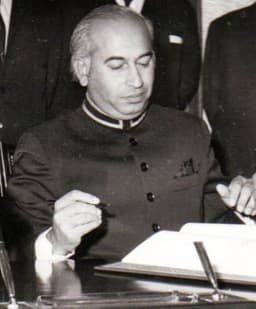
Bhutto Zulfikar Ali
Politician · Modern
52.4Total

Julius Caesar
General · Ancient
82.8Total
Basic Information
Born
1928
-100
Died
—
-44
Era
Modern
Ancient
Nationality
Pakistan
Roman Republic
Occupation
Politician
General
Civilization
Indian
Western
Score Comparison
Military (10%)
45.7
88.0
Political (20%)
55.0
78.0
Influence (20%)
58.3
85.0
Legacy (20%)
52.0
82.0
Leadership (15%)
40.0
80.0
Strategy (15%)
60.0
85.0
TOTAL
52.4
82.8
Bhutto Zulfikar Ali — Complete Timeline
1967 AD
Founding of the Pakistan People's PartyPolitical Action◆ Major
Bhutto founded the Pakistan People's Party (PPP) with a socialist and populist platform. The party quickly gained mass support, especially in West Pakistan, challenging the military regime of Ayub Khan.
PPPSocialismPolitical party
Impact: nationalconstructive
1970 AD
1970 general election victoryPolitical Action
Bhutto's PPP won a majority of seats in West Pakistan in the 1970 general election, while the Awami League won in East Pakistan. The refusal to transfer power to the Awami League led to the Bangladesh Liberation War.
ElectionBangladesh Liberation WarPolitical crisis
Impact: nationaldestructive
1972 AD
Nationalization of industriesReform◆ Major
Bhutto's government nationalized major industries, including steel, banking, and oil. This policy aimed to reduce economic inequality but led to inefficiencies, reduced foreign investment, and long-term economic challenges.
NationalizationEconomic reformSocialism
Impact: national
Simla AgreementPolitical Action◆ Major
Bhutto signed the Simla Agreement with Indian Prime Minister Indira Gandhi, normalizing relations after the 1971 war. The agreement established the Line of Control in Kashmir and committed both countries to bilateral resolution of disputes.
India-Pakistan relationsKashmirPeace treaty
Impact: regionalconstructive
1979 AD
Execution by Zia-ul-HaqPolitical Action
Bhutto was executed by hanging after a controversial murder trial under General Zia-ul-Haq's military regime. His death sparked international outrage and made him a martyr for the PPP, shaping Pakistani politics for decades.
ExecutionMartyrdomMilitary regime
Impact: nationaltragic
Julius Caesar — Complete Timeline
58 BC
Gallic WarsWar◆ Major
Caesar, as proconsul of Gaul, launched a series of campaigns that conquered all of Gaul (modern France, Belgium, and parts of Switzerland). He fought numerous battles, including against the Helvetii, the Belgae, and the Gallic chieftain Vercingetorix. The wars brought immense wealth and a loyal army to Caesar.
Gallic WarsConquestRoman Expansion
Impact: regional
49 BC
Crossing the RubiconPolitical Action◆ Major
Caesar led Legio XIII across the Rubicon River into Italy, defying the Roman Senate's order to disband his army. This act triggered a civil war against Pompey and the Optimates, ultimately leading to Caesar's dictatorship and the end of the Roman Republic.
Roman Civil WarEnd of RepublicPower Struggle
Impact: global
48 BC
Battle of PharsalusWar◆ Major
Caesar's outnumbered army defeated the larger forces of Pompey the Great at Pharsalus in Greece. Caesar's tactical use of a reserve line to counter Pompey's cavalry charge proved decisive. Pompey fled to Egypt, where he was assassinated, leaving Caesar as the undisputed master of the Roman world.
Roman Civil WarBattleDecisive Victory
Impact: regional
44 BC
Appointment as Dictator for LifePolitical Action◆ Major
The Roman Senate appointed Caesar dictator perpetuo (dictator for life), granting him unprecedented personal power. This move concentrated military, legislative, and judicial authority in one person, effectively ending the Roman Republic's traditional system of checks and balances and alarming many senators.
DictatorshipEnd of RepublicPower Consolidation
Impact: regionaldestructive
Assassination on the Ides of MarchPolitical Action◆ Major
A group of Roman senators, led by Marcus Junius Brutus and Gaius Cassius Longinus, stabbed Caesar to death at a meeting of the Senate in the Theatre of Pompey. The assassination was intended to restore the Republic, but instead triggered another civil war that led to the rise of the Roman Empire.
AssassinationRoman PoliticsEnd of Republic
Impact: globaldestructive
Expert Analysis
bhutto-zulfikar-ali-vs-julius-caesar
# The Dictator's Gambit
On a March morning in 44 BCE, Julius Caesar walked into the Senate chamber, dismissing a warning of danger with a wave of his hand. Less than an hour later, he lay bleeding at the foot of Pompey's statue, stabbed twenty-three times by men he had pardoned. Two thousand years later, in a prison cell in Rawalpindi, Zulfikar Ali Bhutto spent his final night writing letters to his daughter, awaiting a dawn execution ordered by a general he had appointed. Both men rose from privilege to absolute power, both wrote their names across history in blood and ink, and both died at the hands of those they trusted. But the worlds they shaped could not have been more different—one built an empire that lasted five centuries, the other left a nation still wrestling with his ghost.
Origins
Gaius Julius Caesar was born into the patrician Julian clan, one of Rome's oldest families, but his branch had fallen into obscurity. His father died when he was sixteen, leaving him as head of a household with little money but immense ambition. The Roman Republic was already rotting from within when Caesar came of age—senatorial corruption, slave revolts, and civil wars had made the old system unsustainable. He was shaped by a world where a man could rise by military glory alone, where the Senate's decrees meant less than the loyalty of legions.
Zulfikar Ali Bhutto was born in 1928 into the feudal aristocracy of Sindh, in what was then British India. His father was a wealthy landowner and politician who sent him to the University of Southern California and later Oxford. Bhutto came of age during the bloody birth of Pakistan, a nation carved from faith and chaos. He saw his country lose half its territory in 1971, saw millions die in civil war, and understood that in the subcontinent, power flowed through personal charisma and populist slogans, not ancient institutions.
Rise to Power
Caesar's ascent was a masterpiece of calculated risk. He borrowed fortunes to fund public games, bought his way into the priesthood, and survived proscription lists during Sulla's dictatorship by hiding in the Sabine hills. His breakthrough came when he secured the governorship of Gaul—a backwater that he turned into a conquest. Over eight years, he defeated hundreds of tribes, crossed the Rhine, and invaded Britain, building a veteran army that loved him more than Rome. When the Senate ordered him to disband his legions, he crossed the Rubicon River in 49 BCE, knowing it meant civil war. "The die is cast," he reportedly said, and the Republic fell.
Bhutto's rise was faster but built on weaker ground. He served as foreign minister under General Ayub Khan, then broke away to found the Pakistan People's Party in 1967 with the slogan "Roti, Kapra, aur Makaan"—bread, clothing, and shelter. His moment came after Pakistan's catastrophic defeat in the 1971 war, when Bangladesh seceded and the military's prestige lay in ruins. Bhutto stepped into the vacuum, becoming president and later prime minister, promising to rebuild the nation. Where Caesar had conquered tribes, Bhutto conquered hearts—he was the first Pakistani leader to speak directly to the masses in their own language.
Leadership & Governance
Caesar governed as a reformer who understood that the old Republic could not be saved, only replaced. He granted citizenship to Gauls and Spaniards, reformed the calendar to create the Julian system still used today, and launched massive public works to employ Rome's poor. His military genius lay in speed and logistics—he once marched his army forty miles in a single day to surprise a Gallic force. But his political wisdom was flawed: he pardoned his enemies, then mocked them, believing he could win loyalty through generosity alone. He centralized power so completely that the Senate became a rubber stamp, and when he accepted the title "dictator for life," he sealed his fate.
Bhutto's rule was a whirlwind of ambition and contradiction. He signed the Simla Agreement with India in 1972, normalizing relations after the war, but he also accelerated Pakistan's nuclear program. He nationalized steel, banking, and oil, breaking the power of the old industrial elite but alienating the business class. He gave Pakistan its first constitution and held elections, but he also crushed dissent with an iron fist. His military strategy was weak—he had no battlefield victories to match Caesar's—but his political instinct was sharp. He knew that in Pakistan, power meant balancing generals, mullahs, and the streets. He failed at all three.
Triumph & Tragedy
Caesar's greatest moment came in 52 BCE at the Siege of Alesia, where he surrounded a massive Gallic army while simultaneously building fortifications to repel a relief force. It was a double encirclement of staggering complexity, and it broke Gaul forever. His greatest failure was his inability to see that his own mercy was a weapon his enemies would turn against him. He believed that by forgiving the sons of his opponents, he could secure the future. Instead, Brutus and Cassius used his leniency to plot his murder.
Bhutto's triumph was the Simla Agreement, which returned 90,000 Pakistani prisoners of war and secured 5,000 square miles of territory from India. It was a diplomatic victory that restored some dignity after the 1971 disaster. His tragedy was the 1977 election, which he rigged so blatantly that it triggered mass protests. He called in the army to restore order, and General Zia-ul-Haq—whom Bhutto had promoted above more senior officers—seized power. The murder trial that followed was a farce, but Bhutto had given Zia the rope.
Character & Destiny
Caesar was a man of supreme self-confidence bordering on arrogance. He walked into the Senate unarmed because he could not imagine anyone daring to strike him. He believed his luck was infinite, his charm invincible. His character drove him to take risks that would have destroyed any other man—crossing the Rubicon, fighting in Gaul with inferior numbers, pardoning enemies who would later kill him. His destiny was to destroy an old world and build a new one, but he did not live to rule it.
Bhutto was a man of immense charisma and equally immense insecurity. He needed to be loved by the masses and feared by his rivals. He could charm foreign leaders and incite crowds with equal skill, but he could also be petty and vindictive. His character drove him to rig an election he would have probably won anyway, to humiliate rivals he could have co-opted. His destiny was to be the father of Pakistan's democracy and the man who taught its generals that they could kill a prime minister and get away with it.
Legacy
Caesar's legacy is the Roman Empire. His adopted son Octavian became Augustus, the first emperor, and the system Caesar created lasted until the fall of Constantinople in 1453. His name became a title—Kaiser, Tsar—and his writings on the Gallic Wars are still read by soldiers and students. He is remembered as the man who ended the Republic and began something greater, a figure of such magnitude that his assassins became footnotes.
Bhutto's legacy is more ambiguous. He founded the Pakistan People's Party, which remains a major force today. His daughter Benazir became the first female prime minister of a Muslim-majority nation. But he also broke the institutional fabric of Pakistan—he politicized the civil service, weakened the judiciary, and showed the military that a civilian leader could be hanged. Today, he is remembered as a martyr by his supporters and a warning by his critics. No one is neutral about Bhutto.
Conclusion
Caesar and Bhutto both believed that history belongs to the bold, that a single man could bend a nation to his will. Caesar was right—he bent Rome so thoroughly that it never straightened again. Bhutto was wrong—Pakistan bent back, and broke him in the process. The difference lies not in their ambition, which was equal, but in the worlds they inherited. Caesar ruled a civilization with two thousand years ahead of it, built on institutions that could absorb his ambition and reshape it into an empire. Bhutto ruled a nation barely twenty-five years old, fragile as glass, where one man's fall could shatter everything. In the end, the Ides of March gave Rome an emperor. The gallows of Rawalpindi gave Pakistan a ghost.
Rankings
🥇
Julius CaesarLeader
Mil: 88.0Pol: 78.0Inf: 85.0
82.8
🥈
Bhutto Zulfikar Ali
Mil: 45.7Pol: 55.0Inf: 58.3
52.4
+30.4 behind
How This Comparison Works
Algorithm
Each figure is scored on 6 dimensions (0—100 scale) based on structured historical data: Military (10%), Political (20%), Influence (20%), Legacy (20%), Leadership (15%), Strategy (15%). The weighted total produces the final ranking.
Data Sources
Scores are computed from structured sub-indicators in the database. Scale factors adjust for era (Ancient ×0.85, Modern ×1.0) and civilization size (Eastern ×1.05, Other ×0.80) to account for differences in population and military scale.
Maximum 3 Figures
Comparisons are limited to 2—3 figures to ensure readability and statistical meaningfulness.
Error Margins
±5 points per dimension — Sub-scores are derived from historical records with inherent uncertainty. Two figures within 5 points on a dimension should be considered roughly equivalent in that area.
Total Score Accuracy
±3 points overall — The weighted combination of 6 dimensions produces a total score with approximately ±3 points of uncertainty. Differences of less than 3 points are not statistically significant— the figures are effectively tied.
Known Limitations
- Historical records are incomplete and uneven across civilizations
- Figures from oral-tradition societies may be underrepresented
- Occupation labels can misclassify multi-role figures
- Scores measure capability and impact, not moral character
- Quantitative scoring is a comparison tool, not absolute truth
Capability Radar
Military (10%) — Battles & Warfare
Battles
42
95
Win Rate
45
92
Expansion
51
97
Political (20%) — Governance & Reform
Reform
70
90
Diplomacy
60
85
Economy
55
82
Influence (20%) — Cultural & Global Reach
Cultural
55
88
Global
55
94
Legacy (20%) — Historical Impact
Historical
60
95
Longevity
50
96
Leadership (15%) — Power & Stability
Tenure
65
75
Stability
30
60
Strategy (15%) — Tactics & Innovation
Strategy
52
94
Tactics
57
96
Reform
60
88
Similar Comparisons
Comments & Discussion
GildedDagger6/17/2026
Caesar's death was a political assassination rooted in Roman oligarchic tradition; Bhutto's was a judicial murder dressed in legal robes. Caesar was stabbed by equals who feared his ambition—Bhutto was hanged by a subordinate who exploited the very constitutional loopholes Bhutto himself created. Caesar fell with his boots on, dictating the narrative to history. Bhutto died as his own system turned on him. That's the difference between an emperor who never needed the law and a populist who thoug
铁血账房6/17/2026
历史总是在计算上耍花招。说两人死于信任者之手没错,但根本没有可比性:布鲁图斯是盟友,而齐亚·哈克是路人。更关键的是经济遗产——凯撒建立的是一个可持续的帝国财政体系,《尤利乌斯历法》至今还在用;布托则留下了百废待兴、外债爆表的巴基斯坦。拿一个终结了罗马共和国的人去比一个把巴基斯坦推向深渊的人,我觉得这场“对话”从一开始就没打算公平。
ClassicalContrarian6/17/2026
Both were masters of political theater, but Caesar understood the show had to outlast the actor. He adopted Octavian, centralized the cult of his own divinity, and made his name synonymous with imperial rule from London to Baghdad. Bhutto? He built a cult of personality around his own doomed charisma—and left no institutional legacy except his daughter's fractured party and a constitution he kept breaking. Caesar founded an empire of law and conquest. Bhutto bequeathed a chaos of slogans. One le
冷眼史官6/17/2026
非要比较的话,我站布托。凯撒出身贵族冷门,靠政变和征服上位,本质上是个罗马军阀;布托则是亚洲第一个真正用民粹之力挑战帝国主义和后殖民体制的领导人。凯撒杀了高卢一百万,布托的罪行是“授权行动”和军事干预俾路支。历史审判凯撒时给了他赞美,审判布托时给了他死刑。这不是谁更暴力的问题,而是谁更让殖民历史不舒服的问题——布托碰了不该碰的蛋糕。