Loading...
Bipin Rawat vs Mir Jumla
Mir Jumla leads by 5.3 pts · 2 figures compared
…
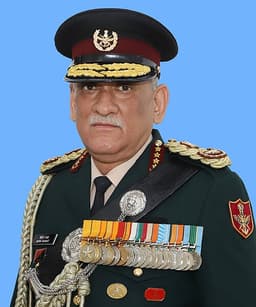
Bipin Rawat
General · Modern
55.0Total

Mir Jumla
General · Modern
60.3Total
Basic Information
Born
1958
1591
Died
—
1663
Era
Modern
Modern
Nationality
India
India
Occupation
General
General
Civilization
Indian
Indian
Score Comparison
Military (10%)
40.0
78.0
Political (20%)
68.0
68.0
Influence (20%)
59.0
54.1
Legacy (20%)
45.0
45.8
Leadership (15%)
62.0
71.0
Strategy (15%)
55.0
66.3
TOTAL
55.0
60.3
Bipin Rawat — Complete Timeline
2016 AD
Led Counter-Insurgency Operations in KashmirWar
As Army Chief, Rawat oversaw intensified counter-insurgency operations in Kashmir following the 2016 unrest. He advocated for a tough approach against militants, leading to increased military presence.
KashmirCounter-insurgencyMilitary Operations
Impact: regional
Served as Chief of Army StaffPolitical Action◆ Major
Rawat was appointed Chief of Army Staff in 2016. He oversaw operations in Jammu and Kashmir, including the 2016 surgical strikes across the Line of Control, and focused on counter-insurgency.
Army ChiefSurgical StrikesCounter-insurgency
Impact: national
2019 AD
Appointed First Chief of Defence Staff of IndiaPolitical Action
General Bipin Rawat was appointed as India's first Chief of Defence Staff (CDS), a new position created to integrate the three armed services. He was tasked with improving jointness and military efficiency.
CDSMilitary ReformIntegration
Impact: nationalconstructive
2021 AD
Died in Helicopter CrashOther◆ Major
General Rawat, his wife, and 11 others died in a helicopter crash in Tamil Nadu. The crash occurred while he was traveling to a military event, and an inquiry attributed it to weather and pilot error.
DeathAccidentHelicopter Crash
Impact: nationaltragic
Mir Jumla — Complete Timeline
1660 AD
Governor of BengalPolitical Action◆ Major
Mir Jumla was appointed governor of Bengal by Emperor Aurangzeb. He reorganized the administration, improved revenue collection, and launched military campaigns to consolidate Mughal control.
GovernorshipBengalAdministration
Impact: regionalconstructive
1661 AD
Siege of Cooch BeharWar
Mir Jumla besieged and captured the kingdom of Cooch Behar in present-day West Bengal. The ruler submitted to Mughal authority, extending Mughal influence into the Brahmaputra valley.
SiegeCooch BeharMughal Campaign
Impact: regional
1662 AD
Conquest of AssamWar◆ Major
Mir Jumla led a Mughal invasion of the Ahom kingdom in Assam. He captured the capital Garhgaon and imposed Mughal authority, though the conquest proved temporary due to disease and resistance.
Mughal ExpansionAssamAhom Kingdom
Impact: regional
1663 AD
Death from Illness in AssamOther
Mir Jumla died from illness during his campaign in Assam. His death ended the Mughal offensive, and the Ahom kingdom soon regained independence, limiting the long-term impact of his conquest.
DeathAssamCampaign End
Impact: regionaltragic
Expert Analysis
Origins
Bipin Rawat was born on March 16, 1958, in Pauri, Uttarakhand, into a family with a strong military tradition. His father, Lakshman Singh Rawat, served in the Indian Army as a Lieutenant General. Rawat attended St. Edward's School in Shimla and later the National Defence Academy (NDA) and Indian Military Academy (IMA), where he was awarded the 'Sword of Honour'. He was commissioned into the 5th battalion of the 11th Gorkha Rifles in 1978.
Mir Jumla, born Mir Muhammad Sayyid Ardistani around 1591 in Isfahan, Iran, was the son of a merchant. He initially worked as a trader before joining the service of the Qutb Shahi dynasty of Golconda. His administrative and military skills caught the attention of the Mughal emperor Shah Jahan, and he later entered Mughal service. His early life in Persia and the Deccan shaped his understanding of trade, diplomacy, and warfare.
Rise to Power
Bipin Rawat's rise was marked by key command and staff appointments. He commanded a Rashtriya Rifles battalion in counter-insurgency operations in Jammu and Kashmir, and later served as a brigade commander in the Siachen Glacier. He was appointed Director General of Military Operations (DGMO) in 2014, where he oversaw the Indian Army's response to cross-border provocations. In 2016, he became the 27th Chief of Army Staff, bypassing more senior officers. His appointment was seen as a result of his experience in counter-insurgency and his reputation as a 'soldier's general'. In 2019, he was appointed India's first Chief of Defence Staff (CDS), a position created to integrate the three armed services. This was a turning point, as it gave him unprecedented authority over military planning and procurement.
Mir Jumla's rise was equally dramatic. He served the Qutb Shahi rulers of Golconda as a general and administrator, but after a conflict with the court, he defected to the Mughal Empire in 1655. Emperor Shah Jahan welcomed him, and he was given the title 'Mir Jumla' and appointed as governor of the Deccan. Under Aurangzeb, he became the governor of Bengal in 1660. His military campaigns in the eastern region, including the conquest of Cooch Behar and Assam, extended Mughal influence. His ability to raise revenue and maintain a large army made him indispensable to the Mughal court.
Leadership & Governance
Bipin Rawat's leadership style was direct and action-oriented. He advocated for a 'proactive' approach in counter-insurgency, leading to the 2016 surgical strikes across the Line of Control (LoC). As CDS, he pushed for jointness among the services, creating integrated commands and streamlining procurement. However, his tenure was also marked by controversy, including his comments on the 2016 Pathankot attack and his handling of the 2017 Doklam standoff. He scored 62.0 in leadership, reflecting his ability to command but also his polarizing nature.
Mir Jumla was a capable administrator and military leader. As governor of Bengal, he reformed revenue collection, improved infrastructure, and maintained a strong army. His conquest of Assam in 1662-63 demonstrated his strategic acumen, capturing the capital Garhgaon and forcing the Ahom king to flee. However, his governance was often harsh, and his campaigns were costly in terms of resources and lives. He scored 71.0 in leadership and 66.3 in strategy, indicating a more balanced approach than Rawat.
Triumph & Tragedy
Rawat's greatest success was the creation of the CDS position and his role in integrating the Indian military. He also oversaw the 2016 surgical strikes, which were a significant tactical achievement. However, his legacy is marred by the 2021 helicopter crash that killed him and 13 others, a tragedy that cut short his potential impact. Additionally, his tenure saw continued unrest in Kashmir and criticism of his aggressive rhetoric.
Mir Jumla's triumph was the conquest of Assam, which briefly brought the region under Mughal control. He also captured Cooch Behar and secured Bengal's borders. However, his greatest failure was the inability to consolidate his gains in Assam. His death from illness in 1663 during the campaign led to a swift Ahom resurgence, and Mughal control evaporated. His legacy is one of a brilliant but ultimately transient conqueror.
Character & Destiny
Rawat was known for his bluntness and determination. He was not afraid to challenge the status quo, as seen in his push for military integration. However, his outspoken nature sometimes caused friction. His death in a helicopter crash was a tragic accident that defined his destiny, preventing him from fully implementing his vision.
Mir Jumla was ambitious and pragmatic. He was a skilled diplomat and administrator, but his ambition often led him into conflict. His decision to defect to the Mughals was a calculated move that paid off, but his death in Assam was a result of the harsh conditions of the campaign. His character was shaped by his Persian heritage and his desire for power and wealth.
Legacy
Bipin Rawat's legacy is the institutionalization of the CDS role, which has the potential to transform Indian military strategy. He also influenced counter-insurgency tactics in Kashmir. However, his impact is still unfolding, and his premature death means his full legacy is yet to be seen. He scored 45.0 in legacy, reflecting the uncertainty of his long-term influence.
Mir Jumla's legacy is more mixed. He is remembered as a capable Mughal general who extended the empire's reach, but also as a symbol of Mughal overreach. His conquest of Assam was short-lived, and his administrative reforms in Bengal were later overshadowed. He scored 45.8 in legacy, slightly higher than Rawat, due to his historical significance in Mughal expansion.
Conclusion
Mir Jumla edges out Bipin Rawat in our overall score, 60.3 to 55.0. While Rawat's role as India's first CDS is historically significant, his impact was cut short. Mir Jumla, despite his failures in Assam, had a more sustained and effective military career, with higher scores in military (78.0 vs 40.0), leadership (71.0 vs 62.0), and strategy (66.3 vs 55.0). Rawat's political score (68.0) matches Mir Jumla's (68.0), but his military achievements were more limited. Therefore, Mir Jumla had a greater overall impact as a military figure, though Rawat's legacy in institutional reform may grow over time.
Rankings
🥇
Mir JumlaLeader
Mil: 78.0Pol: 68.0Inf: 54.1
60.3
🥈
Bipin Rawat
Mil: 40.0Pol: 68.0Inf: 59.0
55.0
+5.3 behind
How This Comparison Works
Algorithm
Each figure is scored on 6 dimensions (0—100 scale) based on structured historical data: Military (10%), Political (20%), Influence (20%), Legacy (20%), Leadership (15%), Strategy (15%). The weighted total produces the final ranking.
Data Sources
Scores are computed from structured sub-indicators in the database. Scale factors adjust for era (Ancient ×0.85, Modern ×1.0) and civilization size (Eastern ×1.05, Other ×0.80) to account for differences in population and military scale.
Maximum 3 Figures
Comparisons are limited to 2—3 figures to ensure readability and statistical meaningfulness.
Error Margins
±5 points per dimension — Sub-scores are derived from historical records with inherent uncertainty. Two figures within 5 points on a dimension should be considered roughly equivalent in that area.
Total Score Accuracy
±3 points overall — The weighted combination of 6 dimensions produces a total score with approximately ±3 points of uncertainty. Differences of less than 3 points are not statistically significant— the figures are effectively tied.
Known Limitations
- Historical records are incomplete and uneven across civilizations
- Figures from oral-tradition societies may be underrepresented
- Occupation labels can misclassify multi-role figures
- Scores measure capability and impact, not moral character
- Quantitative scoring is a comparison tool, not absolute truth
Capability Radar
Military (10%) — Battles & Warfare
Battles
45
75
Win Rate
50
70
Expansion
30
80
Political (20%) — Governance & Reform
Reform
55
40
Diplomacy
50
55
Economy
30
45
Influence (20%) — Cultural & Global Reach
Cultural
35
30
Global
30
25
Legacy (20%) — Historical Impact
Historical
40
45
Longevity
20
30
Leadership (15%) — Power & Stability
Tenure
40
50
Stability
45
40
Strategy (15%) — Tactics & Innovation
Strategy
65
75
Tactics
60
80
Reform
75
60
Similar Comparisons
Comments & Discussion
No comments yet. Be the first to share your thoughts!