Loading...
Bipin Rawat vs Napoleon Bonaparte
Napoleon Bonaparte leads by 15.9 pts · 2 figures compared
…
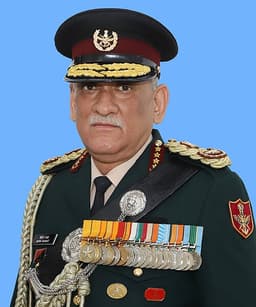
Bipin Rawat
General · Modern
55.0Total

Napoleon Bonaparte
General · Modern
70.9Total
Basic Information
Born
1958
1769
Died
—
1821
Era
Modern
Modern
Nationality
India
France
Occupation
General
General
Civilization
Indian
Western
Score Comparison
Military (10%)
40.0
94.0
Political (20%)
68.0
72.0
Influence (20%)
59.0
40.0
Legacy (20%)
45.0
80.0
Leadership (15%)
62.0
78.0
Strategy (15%)
55.0
90.0
TOTAL
55.0
70.9
Bipin Rawat — Complete Timeline
2016 AD
Led Counter-Insurgency Operations in KashmirWar
As Army Chief, Rawat oversaw intensified counter-insurgency operations in Kashmir following the 2016 unrest. He advocated for a tough approach against militants, leading to increased military presence.
KashmirCounter-insurgencyMilitary Operations
Impact: regional
Served as Chief of Army StaffPolitical Action◆ Major
Rawat was appointed Chief of Army Staff in 2016. He oversaw operations in Jammu and Kashmir, including the 2016 surgical strikes across the Line of Control, and focused on counter-insurgency.
Army ChiefSurgical StrikesCounter-insurgency
Impact: national
2019 AD
Appointed First Chief of Defence Staff of IndiaPolitical Action
General Bipin Rawat was appointed as India's first Chief of Defence Staff (CDS), a new position created to integrate the three armed services. He was tasked with improving jointness and military efficiency.
CDSMilitary ReformIntegration
Impact: nationalconstructive
2021 AD
Died in Helicopter CrashOther◆ Major
General Rawat, his wife, and 11 others died in a helicopter crash in Tamil Nadu. The crash occurred while he was traveling to a military event, and an inquiry attributed it to weather and pilot error.
DeathAccidentHelicopter Crash
Impact: nationaltragic
Napoleon Bonaparte — Complete Timeline
1799 AD
Coup of 18 BrumaireOther◆ Major
Napoleon Bonaparte, with support from his brother Lucien and key political figures, overthrew the Directory in a bloodless coup. He established the Consulate with himself as First Consul, effectively becoming the ruler of France. This event ended the French Revolution's most unstable period.
French RevolutionCoupRise to Power
Impact: regional
1804 AD
Promulgation of the Napoleonic CodeOther◆ Major
Napoleon enacted the Civil Code of the French, known as the Napoleonic Code, a comprehensive set of laws that replaced the fragmented feudal legal systems. The code established legal equality, protected property rights, and secularized law. It became the basis for legal systems in many European and world countries.
Legal ReformNapoleonic CodeCivil Law
Impact: globalconstructive
1805 AD
Battle of AusterlitzWar◆ Major
Napoleon's Grande Arm
Napoleonic WarsBattleDecisive Victory
Impact: global
1812 AD
Invasion of RussiaWar◆ Major
Napoleon led the Grande Arm
Napoleonic WarsInvasionDisaster
Impact: globaldestructive
1815 AD
Battle of WaterlooWar◆ Major
Napoleon's French army was defeated by the combined forces of the Duke of Wellington's Anglo-Allied army and Gebhard Leberecht von Bl
Napoleonic WarsBattleFinal Defeat
Impact: globaldestructive
Expert Analysis
bipin-rawat-vs-napoleon-bonaparte
# Two Generals, Two Worlds
On a misty December morning in 2021, a military helicopter carrying India’s highest-ranking officer plunged into the hills of Tamil Nadu, killing everyone on board. Half a world away and two centuries earlier, another general—exiled on a remote Atlantic island—dictated his memoirs as British warships patrolled the horizon. Napoleon Bonaparte and Bipin Rawat never shared a century, a continent, or a command. Yet both rose to the pinnacle of military power in their nations, and both met ends that seemed to mock their ambitions. What separates a legend from a footnote in the same profession?
Origins
Corsica in 1769 was a conquered land, and Napoleon Bonaparte was born a subject of France just months after the island fell to French rule. His family belonged to the minor nobility, scraping by on modest estates. The young Napoleon spoke Italian-accented French, was mocked at military school for his short stature and provincial manners, and carried a burning resentment that would later fuel his ambition. He devoured history and military strategy, dreaming of Alexander and Caesar.
Bipin Rawat was born in 1958 in Pauri, a small town in the Himalayan state of Uttarakhand, into a military family. His father served as a lieutenant general in the Indian Army. From childhood, Rawat breathed the air of cantonments—parade grounds, mess halls, the quiet discipline of a soldier’s household. Where Napoleon had to claw his way into the officer corps through sheer intellect and will, Rawat walked a path already paved. He attended the National Defence Academy, then the Indian Military Academy, and was commissioned into the Sikh Regiment in 1978.
The difference in their starting points is not merely biographical. Napoleon came of age in revolutionary France, where the old aristocracy was guillotined and talent became the only currency. Rawat came of age in independent India, a democracy with a professional, apolitical army that had inherited British traditions. One era rewarded audacity; the other rewarded institutional loyalty.
Rise to Power
Napoleon’s ascent was a series of explosions. At 24, he drove the British out of Toulon and was promoted to brigadier general. At 26, he crushed a royalist uprising in Paris with a “whiff of grapeshot.” At 27, he took command of the Army of Italy and proceeded to shatter Austrian armies in a campaign that still dazzles military historians. By 30, he was First Consul of France. By 35, Emperor.
Each step was a gamble. He wrote to his brother Joseph in 1795: “I know how to risk, and I risk everything.” His Italian campaign of 1796-1797 was a masterpiece of speed, deception, and audacity—marching his hungry, shoeless army over the Alps to strike where the enemy least expected. He did not merely win battles; he reinvented warfare.
Rawat’s rise was methodical, like climbing a ladder one rung at a time. He commanded a battalion in counter-insurgency operations in Kashmir and the northeast. He served as a military observer in the Congo. He taught at the Defence Services Staff College. In 2016, he was appointed Chief of Army Staff—a position he reached after four decades of service. His defining moment came in September 2016, when he oversaw the surgical strikes across the Line of Control in Kashmir—a retaliatory operation against militant launch pads that was India’s most significant military action against Pakistan since the 1971 war.
Where Napoleon conquered nations, Rawat conducted punitive raids. The scale is incomparable, but so are the contexts. Napoleon operated in a Europe of shifting alliances and fragile states, where a bold general could redraw borders. Rawat operated in a nuclear-armed subcontinent, where escalation meant annihilation.
Leadership & Governance
As emperor, Napoleon was a hurricane of reform. The Napoleonic Code standardized French law, abolished feudal privileges, and enshrined meritocracy. He restructured education, established the Bank of France, and built roads and canals across the continent. On the battlefield, his military genius earned a Strategy score of 93—among the highest in history. He won 60 of his 70 major battles, from Austerlitz in 1805 (his masterpiece) to Borodino in 1812 (a pyrrhic victory that bled his army dry).
Yet his Political score of 75 reflects a darker truth. He could not stop conquering. He installed his brothers on European thrones, alienated potential allies, and provoked coalitions that eventually crushed him. His Leadership score of 80 suggests he inspired devotion but also bred resentment. “I love power as a musician loves his violin,” he once said. But he played that violin until it broke.
Rawat, with a Leadership score of 75.7 and Political score of 70.3, was a different creature. As Chief of Army Staff, he pushed for modernization and integration of India’s three armed services. His appointment as India’s first Chief of Defence Staff in 2019 was a historic reform—creating a single point of military advice for the civilian government, something the country had lacked since independence. He advocated for theater commands, joint operations, and breaking down inter-service rivalries.
His Military score of 45.8 and Strategy score of 71.7 reflect a career spent not in large-scale conventional warfare but in counter-insurgency, peacekeeping, and bureaucratic maneuvering. He was not a battlefield genius; he was an institutional reformer. Where Napoleon created an empire, Rawat tried to create a structure.
Triumph & Tragedy
Napoleon’s greatest triumph was Austerlitz, where he lured the combined Russian and Austrian armies into a trap and destroyed them, ending the War of the Third Coalition. His greatest tragedy was the invasion of Russia in 1812—half a million men marched east, fewer than 30,000 returned. Then came Leipzig in 1813, where he was overwhelmed by numbers, and Waterloo in 1815, where he was defeated by Wellington and Blücher. He died in exile on Saint Helena in 1821, aged 51.
Rawat’s greatest triumph was arguably the 2016 surgical strikes, which demonstrated India’s willingness to cross the Line of Control and changed the psychological calculus of the conflict. His greatest tragedy was his death—a helicopter crash in Tamil Nadu on December 8, 2021, while he was traveling to address a military college. He was 63. His wife and 11 others died with him. There was no battle, no enemy, no glory—just a mechanical failure in the hills.
Character & Destiny
Napoleon was restless, brilliant, and insatiable. He could dictate four letters simultaneously, work 20 hours a day, and remember every soldier’s face in his Imperial Guard. He was also arrogant, paranoid, and incapable of stopping. His personality drove him to conquer Europe, and his personality drove him to lose it. “Circumstances?” he once scoffed. “I make circumstances.”
Rawat was described by colleagues as blunt, decisive, and politically astute—a soldier who understood that in a democracy, the military serves the civilian leadership. He was not a visionary; he was a problem-solver. His helicopter crash was not a tragic flaw but a tragic accident. It ended a career that had not yet reached its peak.
Legacy
Napoleon’s Legacy score of 78 is modest for a man who reshaped Europe. His legal code, his administrative reforms, his influence on nationalism and warfare—these endure. But he also left a trail of devastated countries, millions of dead, and a reputation as a tyrant. He is remembered as both hero and villain, liberator and conqueror, genius and madman.
Rawat’s Legacy score of 60.4 reflects a career cut short. His reforms as Chief of Defence Staff are still being implemented. His impact on Indian military integration may take decades to assess. He is remembered as a patriot who died in service, but he did not change the world.
Conclusion
The comparison between Napoleon and Rawat is not about who was greater—it is about what greatness means in different contexts. Napoleon lived in an age of giants, where a single general could topple thrones and rewrite laws. Rawat lived in an age of institutions, where a general’s job was to serve, not to rule. One conquered; one reformed. One died in exile; one died in a crash. Both, in their own ways, did what their times demanded. The difference is not in their ambition but in the stage they were given. Napoleon built an empire that collapsed with him. Rawat built a structure that might outlast him. Perhaps, in the long run, that is the more lasting victory.
Rankings
🥇
Napoleon BonaparteLeader
Mil: 94.0Pol: 72.0Inf: 40.0
70.9
🥈
Bipin Rawat
Mil: 40.0Pol: 68.0Inf: 59.0
55.0
+15.9 behind
How This Comparison Works
Algorithm
Each figure is scored on 6 dimensions (0—100 scale) based on structured historical data: Military (10%), Political (20%), Influence (20%), Legacy (20%), Leadership (15%), Strategy (15%). The weighted total produces the final ranking.
Data Sources
Scores are computed from structured sub-indicators in the database. Scale factors adjust for era (Ancient ×0.85, Modern ×1.0) and civilization size (Eastern ×1.05, Other ×0.80) to account for differences in population and military scale.
Maximum 3 Figures
Comparisons are limited to 2—3 figures to ensure readability and statistical meaningfulness.
Error Margins
±5 points per dimension — Sub-scores are derived from historical records with inherent uncertainty. Two figures within 5 points on a dimension should be considered roughly equivalent in that area.
Total Score Accuracy
±3 points overall — The weighted combination of 6 dimensions produces a total score with approximately ±3 points of uncertainty. Differences of less than 3 points are not statistically significant— the figures are effectively tied.
Known Limitations
- Historical records are incomplete and uneven across civilizations
- Figures from oral-tradition societies may be underrepresented
- Occupation labels can misclassify multi-role figures
- Scores measure capability and impact, not moral character
- Quantitative scoring is a comparison tool, not absolute truth
Capability Radar
Military (10%) — Battles & Warfare
Battles
45
95
Win Rate
50
90
Expansion
30
95
Political (20%) — Governance & Reform
Reform
55
95
Diplomacy
50
80
Economy
30
85
Influence (20%) — Cultural & Global Reach
Cultural
35
85
Global
30
90
Legacy (20%) — Historical Impact
Historical
40
95
Longevity
20
90
Leadership (15%) — Power & Stability
Tenure
40
85
Stability
45
70
Strategy (15%) — Tactics & Innovation
Strategy
65
95
Tactics
60
98
Reform
75
92
Similar Comparisons
Comments & Discussion
MARCHINGMADMAN6/17/2026
"Comparing the Chief of Defense Staff who managed insurgencies in Kashmir to the Emperor of Europe is like comparing a postman to a conquistador. Rawat was a capable administrator in a subordinate role directing counterinsurgency operations, whereas Napoleon rewrote the rulebook of warfare itself. The only thing they share is a helicopter crash versus exile—both tragic, but not military parallels."
历史星芒6/17/2026
“以印度国防参谋长比肩拿破仑?法国皇帝27岁便横扫意大利、埃及,而拉瓦特将军57岁才成为首位CDS。两人虽然都死于非命(圣赫勒拿岛 vs. 直升机坠毁),但拉瓦特从未在同等战略层面指挥过大规模战役。这是将‘将才’与‘统帅’混为一谈的典型错误数据比较。”
STATSWARFARE6/17/2026
"Let’s run the numbers: Napoleon commanded campaigns with 600,000+ troops across continents; Rawat oversaw 1.3 million soldiers within one national border. But raw size doesn’t equal impact. Rawat’s legacy is doctrinal—he pushed for theater commands in India. Napoleon’s is transformational—he created the modern corps system. One built systems; the other was the system."
决断之刃6/17/2026
“我最反感这种虚假的平衡。拿破仑是在废墟中重建军队的天才,他打垮了五次反法同盟;拉瓦特只是政治正确上升的官僚(别忘了他与莫迪政府的关系)。拉瓦特的战术成就无非是‘成功的平定行动’,而拿破仑的成就包括《拿破仑法典》——这根本不是同一个维度的比较。”
REVISIONISTEYE6/17/2026
"Everyone ignores the endgame: both died failures. Napoleon outgeneraled himself in Russia and Waterloo; Rawat oversaw the 2020 Galwan Valley clash where India didn't come out ahead militarily (despite official narratives). The comparison holds if we see both as architects of overreach—one lost his empire, the other his reputation. Legend and footnote? More like mirror images."