Loading...
Bohdan Khmelnytsky vs Yi Sun-sin
Bohdan Khmelnytsky leads by 2.9 pts · 2 figures compared
…
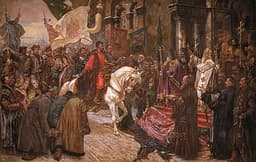
Bohdan Khmelnytsky
General · Modern
61.2Total

Yi Sun-sin
General · Modern
58.3Total
Basic Information
Born
1595
1545
Died
1657
1598
Era
Modern
Modern
Nationality
Ukraine
Korea
Occupation
General
General
Civilization
Western
Eastern
Score Comparison
Military (10%)
61.7
79.1
Political (20%)
62.7
42.3
Influence (20%)
58.3
65.0
Legacy (20%)
52.0
40.0
Leadership (15%)
80.0
68.0
Strategy (15%)
60.7
76.0
TOTAL
61.2
58.3
Bohdan Khmelnytsky — Complete Timeline
1648 AD
Battle of Zhovti VodyWar◆ Major
Khmelnytsky's Cossack forces, allied with Crimean Tatars, defeated a Polish army at Zhovti Vody. This victory marked the beginning of the Khmelnytsky Uprising, leading to widespread rebellion across Ukraine.
BattleUprisingPoland
Impact: regional
Election as Hetman of the Zaporozhian HostPolitical Action◆ Major
Bohdan Khmelnytsky was elected Hetman of the Zaporozhian Cossacks at a council on the Dnieper River. This election formalized his leadership of the Cossack uprising against the Polish-Lithuanian Commonwealth.
ElectionCossackHetman
Impact: regionalconstructive
1649 AD
Siege of ZbarazhWar◆ Major
Khmelnytsky besieged the Polish fortress of Zbarazh for over six weeks. The siege ended with the Treaty of Zboriv, which granted autonomy to the Cossack Hetmanate but failed to achieve full independence.
SiegePolandTreaty
Impact: regional
1651 AD
Battle of BerestechkoWar◆ Major
Khmelnytsky's forces suffered a major defeat at Berestechko against the Polish army, with heavy Cossack casualties. This battle forced him to sign the unfavorable Treaty of Bila Tserkva, reducing Cossack autonomy.
BattleDefeatPoland
Impact: regionaltragic
1654 AD
Treaty of PereiaslavPolitical Action
Khmelnytsky signed the Treaty of Pereiaslav with Tsar Alexis of Russia, placing the Cossack Hetmanate under Russian protection. This treaty shifted Ukraine's allegiance from Poland to Russia, with lasting geopolitical consequences.
TreatyRussiaUkraine
Impact: regional
Yi Sun-sin — Complete Timeline
1592 AD
Introduction of the Turtle Ship (Geobukseon)Invention◆ Major
Yi Sun-sin oversaw the deployment of the turtle ship, an ironclad warship with a spiked iron roof and cannons. These ships played a crucial role in early victories against the Japanese navy, breaking their supply lines and protecting Korean coastlines.
Naval InnovationWarshipImjin War
Impact: regional
1597 AD
Battle of MyeongnyangWar
Admiral Yi Sun-sin, with only 13 ships, defeated a Japanese fleet of over 130 vessels in the Myeongnyang Strait. Using the strong currents and his tactical skill, he inflicted heavy losses without losing a single ship, cutting off Japanese supply lines and turning the tide of the war.
Naval BattleTactical VictoryImjin War
Impact: regional
1598 AD
Death at the Battle of NoryangWar◆ Major
Yi Sun-sin was killed by a stray bullet during the Battle of Noryang, the final major naval engagement of the Imjin War. His death occurred as his fleet was defeating the Japanese, securing a decisive victory that ended the Japanese invasion of Korea.
Death in BattleFinal VictoryImjin War
Impact: regionaltragic
Expert Analysis
Origins
Bohdan Khmelnytsky was born in 1595 into a Ukrainian noble family within the Polish-Lithuanian Commonwealth. He was educated in Jesuit schools and served in the Polish military, gaining administrative experience as a Cossack officer. His personal grievances with a Polish nobleman who seized his estate, combined with widespread oppression of Orthodox Ukrainians, fueled his later rebellion. In contrast, Yi Sun-sin was born in 1545 in Seoul, Joseon Korea, into a modest yangban (scholar-official) family. He pursued a military career after failing civil service exams, passing the military examination in 1576 at age 31. His early career was marked by slow promotion due to factional politics, but he gained recognition for his strategic thinking and integrity.
Rise to Power
Khmelnytsky's rise began in 1647 when he fled to the Zaporozhian Sich, the Cossack stronghold, after his grievances were ignored. In early 1648, he was elected Hetman of the Zaporozhian Host, uniting Cossacks, Crimean Tatars, and discontented peasants. His early victories at the Battle of Zhovti Vody (May 1648) and the Battle of Korsun (May 1648) shattered Polish forces and propelled him to leadership of a massive uprising. Yi Sun-sin's rise was slower but steady. He was appointed to several naval commands, but his breakthrough came in 1591 when he was made Left Naval Commander of Jeolla Province. He prepared for war by strengthening the navy, developing the turtle ship (Geobukseon), and drilling his crews. The Japanese invasion began in 1592, and Yi's first major victory at the Battle of Okpo (May 1592) established his reputation.
Leadership & Governance
Khmelnytsky governed as Hetman, combining military command with political authority over the Cossack Hetmanate. He implemented a centralized administration, collected taxes, and maintained diplomatic relations with the Crimean Khanate, the Ottoman Empire, and Muscovy. His leadership style was pragmatic, often shifting alliances to secure Cossack autonomy. However, his reliance on the Crimean Tatars, who frequently betrayed him, weakened his position. Yi Sun-sin led the Korean navy with strict discipline and innovative tactics. He emphasized training, logistics, and intelligence, often personally inspecting ships and crews. His governance was limited to naval affairs, but he effectively coordinated with local officials and the royal court, despite political rivals who undermined him. Yi's leadership scored 68.0 in the military dimension, while Khmelnytsky's political score of 62.7 reflects his broader governance role.
Triumph & Tragedy
Khmelnytsky's greatest triumph was the Khmelnytsky Uprising (1648–1657), which liberated large parts of Ukraine from Polish rule and established the Cossack Hetmanate. He achieved major victories at Zhovti Vody, Korsun, and the Siege of Zbarazh (1649), forcing the Treaty of Zboriv that granted Cossack autonomy. However, his tragedy included the crushing defeat at the Battle of Berestechko (1651), where his army was destroyed by Polish forces. This forced the humiliating Treaty of Bila Tserkva, which reduced Cossack territory. Khmelnytsky's signing of the Treaty of Pereiaslav (1654) with Russia, intended to secure protection, ultimately led to the absorption of Ukraine into the Russian Empire. Yi Sun-sin's triumphs were numerous: he won every battle he commanded, including the spectacular Battle of Myeongnyang (1597), where with 13 ships he defeated over 130 Japanese vessels. His turtle ships and tactics crippled Japanese supply lines. His tragedy was his death at the Battle of Noryang (1598), killed by a stray bullet as his fleet achieved final victory. He died knowing Korea was saved, but his death deprived the nation of his leadership.
Character & Destiny
Khmelnytsky was charismatic, ambitious, and ruthless, capable of uniting diverse groups but also prone to shifting alliances. His personal grievance over his estate drove him, but his broader vision of an independent Ukraine was thwarted by his own decisions, particularly the alliance with Russia. Historians note his political acumen but also his inability to secure lasting autonomy. Yi Sun-sin was known for his integrity, perseverance, and tactical brilliance. He was falsely imprisoned in 1597 due to court intrigues, but when disaster struck the Korean navy, he was reinstated. His unwavering loyalty to Joseon and his refusal to surrender even against overwhelming odds defined his destiny. His character, scoring 68.0 in leadership, contrasts with Khmelnytsky's 80.0, but Yi's strategic score of 76.0 exceeds Khmelnytsky's 60.7.
Legacy
Khmelnytsky's legacy is complex: he is a national hero in Ukraine, celebrated as the founder of the Cossack state, but also criticized for allying with Russia, which led to centuries of domination. The Treaty of Pereiaslav is still debated. His uprising reshaped Eastern Europe, weakening Poland and enabling Russian expansion. Yi Sun-sin is revered in Korea as the greatest naval commander in history. His tactics, including the use of turtle ships and the Myeongnyang victory, are studied in military academies worldwide. He is memorialized in statues, films, and the Yi Sun-sin class destroyers of the South Korean navy. His legacy is more universally admired, while Khmelnytsky's is more contested.
Conclusion
While Bohdan Khmelnytsky scored higher overall (61.2 vs. 58.3), his impact was more ambiguous: he launched a successful rebellion but ultimately failed to secure independence, and his alliance with Russia had negative long-term consequences. Yi Sun-sin, despite a lower total score, achieved complete strategic success, defending Korea from invasion without a single naval defeat. His military score of 79.1 dwarfs Khmelnytsky's 61.7, and his legacy is one of unblemished triumph. Therefore, Yi Sun-sin had greater impact in terms of achieving his objectives and leaving a positive, enduring legacy. Khmelnytsky's political score of 62.7 reflects his role as a state-builder, but his flawed decisions undermine his long-term influence. Yi Sun-sin's strategic brilliance and flawless execution make him the superior commander.
Rankings
🥇
Bohdan KhmelnytskyLeader
Mil: 61.7Pol: 62.7Inf: 58.3
61.2
🥈
Yi Sun-sin
Mil: 79.1Pol: 42.3Inf: 65.0
58.3
+2.9 behind
How This Comparison Works
Algorithm
Each figure is scored on 6 dimensions (0—100 scale) based on structured historical data: Military (10%), Political (20%), Influence (20%), Legacy (20%), Leadership (15%), Strategy (15%). The weighted total produces the final ranking.
Data Sources
Scores are computed from structured sub-indicators in the database. Scale factors adjust for era (Ancient ×0.85, Modern ×1.0) and civilization size (Eastern ×1.05, Other ×0.80) to account for differences in population and military scale.
Maximum 3 Figures
Comparisons are limited to 2—3 figures to ensure readability and statistical meaningfulness.
Error Margins
±5 points per dimension — Sub-scores are derived from historical records with inherent uncertainty. Two figures within 5 points on a dimension should be considered roughly equivalent in that area.
Total Score Accuracy
±3 points overall — The weighted combination of 6 dimensions produces a total score with approximately ±3 points of uncertainty. Differences of less than 3 points are not statistically significant— the figures are effectively tied.
Known Limitations
- Historical records are incomplete and uneven across civilizations
- Figures from oral-tradition societies may be underrepresented
- Occupation labels can misclassify multi-role figures
- Scores measure capability and impact, not moral character
- Quantitative scoring is a comparison tool, not absolute truth
Capability Radar
Military (10%) — Battles & Warfare
Battles
65
85
Win Rate
70
98
Expansion
60
30
Political (20%) — Governance & Reform
Reform
50
30
Diplomacy
60
50
Economy
45
20
Influence (20%) — Cultural & Global Reach
Cultural
60
75
Global
50
65
Legacy (20%) — Historical Impact
Historical
65
80
Longevity
55
75
Leadership (15%) — Power & Stability
Tenure
55
40
Stability
40
35
Strategy (15%) — Tactics & Innovation
Strategy
65
90
Tactics
60
95
Reform
55
80
Similar Comparisons
Comments & Discussion
No comments yet. Be the first to share your thoughts!