Loading...
Bohdan Khmelnytsky vs Napoleon Bonaparte
Napoleon Bonaparte leads by 9.7 pts · 2 figures compared
…
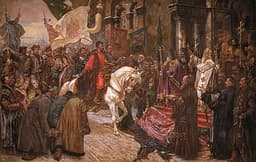
Bohdan Khmelnytsky
General · Modern
61.2Total

Napoleon Bonaparte
General · Modern
70.9Total
Basic Information
Born
1595
1769
Died
1657
1821
Era
Modern
Modern
Nationality
Ukraine
France
Occupation
General
General
Civilization
Western
Western
Score Comparison
Military (10%)
61.7
94.0
Political (20%)
62.7
72.0
Influence (20%)
58.3
40.0
Legacy (20%)
52.0
80.0
Leadership (15%)
80.0
78.0
Strategy (15%)
60.7
90.0
TOTAL
61.2
70.9
Bohdan Khmelnytsky — Complete Timeline
1648 AD
Battle of Zhovti VodyWar◆ Major
Khmelnytsky's Cossack forces, allied with Crimean Tatars, defeated a Polish army at Zhovti Vody. This victory marked the beginning of the Khmelnytsky Uprising, leading to widespread rebellion across Ukraine.
BattleUprisingPoland
Impact: regional
Election as Hetman of the Zaporozhian HostPolitical Action◆ Major
Bohdan Khmelnytsky was elected Hetman of the Zaporozhian Cossacks at a council on the Dnieper River. This election formalized his leadership of the Cossack uprising against the Polish-Lithuanian Commonwealth.
ElectionCossackHetman
Impact: regionalconstructive
1649 AD
Siege of ZbarazhWar◆ Major
Khmelnytsky besieged the Polish fortress of Zbarazh for over six weeks. The siege ended with the Treaty of Zboriv, which granted autonomy to the Cossack Hetmanate but failed to achieve full independence.
SiegePolandTreaty
Impact: regional
1651 AD
Battle of BerestechkoWar◆ Major
Khmelnytsky's forces suffered a major defeat at Berestechko against the Polish army, with heavy Cossack casualties. This battle forced him to sign the unfavorable Treaty of Bila Tserkva, reducing Cossack autonomy.
BattleDefeatPoland
Impact: regionaltragic
1654 AD
Treaty of PereiaslavPolitical Action
Khmelnytsky signed the Treaty of Pereiaslav with Tsar Alexis of Russia, placing the Cossack Hetmanate under Russian protection. This treaty shifted Ukraine's allegiance from Poland to Russia, with lasting geopolitical consequences.
TreatyRussiaUkraine
Impact: regional
Napoleon Bonaparte — Complete Timeline
1799 AD
Coup of 18 BrumaireOther◆ Major
Napoleon Bonaparte, with support from his brother Lucien and key political figures, overthrew the Directory in a bloodless coup. He established the Consulate with himself as First Consul, effectively becoming the ruler of France. This event ended the French Revolution's most unstable period.
French RevolutionCoupRise to Power
Impact: regional
1804 AD
Promulgation of the Napoleonic CodeOther◆ Major
Napoleon enacted the Civil Code of the French, known as the Napoleonic Code, a comprehensive set of laws that replaced the fragmented feudal legal systems. The code established legal equality, protected property rights, and secularized law. It became the basis for legal systems in many European and world countries.
Legal ReformNapoleonic CodeCivil Law
Impact: globalconstructive
1805 AD
Battle of AusterlitzWar◆ Major
Napoleon's Grande Arm
Napoleonic WarsBattleDecisive Victory
Impact: global
1812 AD
Invasion of RussiaWar◆ Major
Napoleon led the Grande Arm
Napoleonic WarsInvasionDisaster
Impact: globaldestructive
1815 AD
Battle of WaterlooWar◆ Major
Napoleon's French army was defeated by the combined forces of the Duke of Wellington's Anglo-Allied army and Gebhard Leberecht von Bl
Napoleonic WarsBattleFinal Defeat
Impact: globaldestructive
Expert Analysis
bohdan-khmelnytsky-vs-napoleon-bonaparte
# The Emperor and the Hetman: Two Paths to Power in an Age of Upheaval
On a June morning in 1815, Napoleon Bonaparte stood on a muddy ridge near Waterloo, watching his Imperial Guard march into the muzzles of British cannon. Across the Channel, few had heard of the Cossack hetman who had died 158 years earlier, yet Bohdan Khmelnytsky’s shadow stretched just as long over Eastern Europe. Both men rose from modest origins to command armies and reshape nations—but one built an empire that collapsed in his lifetime, while the other forged a national identity that outlasted his own defeat. What drove these two generals down such different paths?
Origins
Napoleon was born in 1769 on the island of Corsica, a recent French acquisition, to a minor noble family of Italian ancestry. His father’s death left him poor but ambitious, and the French Revolution of 1789 opened doors that would have remained closed under the old monarchy. He was a product of the Enlightenment, a reader of Rousseau and Voltaire, who saw the world as a chessboard of rational possibilities.
Bohdan Khmelnytsky, born in 1595 in what is now central Ukraine, came from a different world entirely. His father was a petty nobleman in the Polish-Lithuanian Commonwealth, a vast multi-ethnic state where Orthodox Ruthenians (Ukrainians) lived under Catholic Polish rule. Khmelnytsky was educated in Jesuit schools, spoke several languages, and fought for Poland against the Ottoman Empire. But in 1647, a Polish official seized his estate and killed his son. When Khmelnytsky appealed to the king for justice, he was ignored. The personal grievance became a national cause.
Rise to Power
Napoleon’s ascent was meteoric. In 1793, at age twenty-four, he drove the British out of Toulon and was promoted to brigadier general. By 1796, he commanded the Army of Italy, where his lightning campaigns humiliated the Austrians. In 1799, he seized power in a coup d’état, becoming First Consul. Five years later, he crowned himself Emperor of the French. His rise was a story of pure talent exploiting revolutionary chaos.
Khmelnytsky’s path was slower and more desperate. In 1648, at age fifty-three, he was elected Hetman of the Zaporozhian Cossacks—a warrior republic on the Dnieper River. His army, allied with Crimean Tatars, won a stunning victory at the Battle of Zhovti Vody in May 1648, routing a Polish force. This was not a coup but a rebellion, born from centuries of religious oppression, land seizures, and the refusal of the Polish nobility to treat Cossacks as equals. Where Napoleon climbed a ladder of merit, Khmelnytsky ignited a powder keg of grievances.
Leadership & Governance
Napoleon ruled with a blend of military brilliance and administrative genius. His 1805 victory at Austerlitz remains a masterpiece of strategy, crushing the combined armies of Austria and Russia. But his true legacy was the Napoleonic Code, a legal system that abolished feudal privileges, protected property rights, and established merit-based advancement. He reformed education, built roads, and centralized the state. Yet his governance grew increasingly autocratic: he censored the press, restored slavery in French colonies, and placed his brothers on European thrones.
Khmelnytsky’s leadership was more improvisational. He was a political strategist of high order, forging alliances with Tatars, negotiating with the Ottoman Sultan, and ultimately turning to Moscow. The Siege of Zbarazh in 1649 demonstrated his tactical patience: he starved the Polish garrison for six weeks, winning the Treaty of Zboriv that created an autonomous Cossack state. But his greatest defeat came in 1651 at Berestechko, where Polish cavalry smashed his army, killing perhaps 30,000 Cossacks. Khmelnytsky lacked Napoleon’s institutional machinery—he ruled through personal authority and shifting coalitions, not a codified bureaucracy.
Triumph & Tragedy
Napoleon’s greatest moment was arguably 1807, when he dictated peace to Tsar Alexander I on a raft in the Niemen River, at the height of his power. His empire stretched from Spain to Poland. His tragedy was the 1812 invasion of Russia: 600,000 men marched east; fewer than 100,000 returned. The Grande Armée was destroyed not by battle but by winter, distance, and Russian scorched-earth tactics. He was exiled to Elba in 1814, escaped in 1815, and met final defeat at Waterloo at age forty-six.
Khmelnytsky’s triumph was the Treaty of Pereiaslav in 1654, when he placed the Cossack Hetmanate under the protection of Tsar Alexis of Russia. For a moment, he had secured Ukrainian autonomy against Poland. But the treaty was a double-edged sword: Russia gradually absorbed the Hetmanate, erasing its independence within decades. Khmelnytsky died in 1657, probably poisoned by rivals, his dream of a free Ukraine incomplete. His tragedy was not a single battle but a slow betrayal by the ally he had trusted.
Character & Destiny
Napoleon was driven by an insatiable hunger for glory. “Impossible is a word to be found only in the dictionary of fools,” he once said. His arrogance blinded him: he refused to compromise, alienated potential allies, and overreached repeatedly. His personality—restless, brilliant, domineering—made him unstoppable in victory and incapable of consolidation in defeat.
Khmelnytsky was more pragmatic, a survivor who knew when to retreat and when to bargain. He was ruthless—his rebellion saw massacres of Polish nobles and Jewish communities—but he also understood the limits of Cossack power. His character was shaped by grievance and realism: he never dreamed of conquering Europe, only of freeing his people. That restraint allowed him to build something that outlasted him, even if it was eventually crushed.
Legacy
Napoleon’s legacy is written across Europe: the Napoleonic Code influences legal systems from France to Egypt, his military campaigns are studied in war colleges, and his name is synonymous with ambition and hubris. His score of 82.4 reflects a figure who reshaped an era but whose empire died with him.
Khmelnytsky’s legacy is more contested. In Ukraine, he is a national hero, the father of the Cossack state, celebrated on banknotes and monuments. In Poland and Jewish history, he is a figure of bloodshed. His score of 73.7 masks his deeper impact: he planted a seed of national consciousness that would flower three centuries later, in 1991, when Ukraine declared independence. Napoleon conquered for himself; Khmelnytsky fought for a nation that did not yet exist.
Conclusion
Standing at Waterloo, Napoleon saw his world end. Khmelnytsky, dying in his bed in 1657, saw a world beginning. One man’s tragedy was a personal fall from unimaginable heights; the other’s was a promise unfulfilled, passed to generations yet unborn. Their differences—in ambition, in scale, in the very nature of their causes—reflect the two faces of leadership: the conqueror who builds for himself, and the rebel who builds for others. In the end, the emperor’s empire crumbled, but the hetman’s idea endured.
Rankings
🥇
Napoleon BonaparteLeader
Mil: 94.0Pol: 72.0Inf: 40.0
70.9
🥈
Bohdan Khmelnytsky
Mil: 61.7Pol: 62.7Inf: 58.3
61.2
+9.7 behind
How This Comparison Works
Algorithm
Each figure is scored on 6 dimensions (0—100 scale) based on structured historical data: Military (10%), Political (20%), Influence (20%), Legacy (20%), Leadership (15%), Strategy (15%). The weighted total produces the final ranking.
Data Sources
Scores are computed from structured sub-indicators in the database. Scale factors adjust for era (Ancient ×0.85, Modern ×1.0) and civilization size (Eastern ×1.05, Other ×0.80) to account for differences in population and military scale.
Maximum 3 Figures
Comparisons are limited to 2—3 figures to ensure readability and statistical meaningfulness.
Error Margins
±5 points per dimension — Sub-scores are derived from historical records with inherent uncertainty. Two figures within 5 points on a dimension should be considered roughly equivalent in that area.
Total Score Accuracy
±3 points overall — The weighted combination of 6 dimensions produces a total score with approximately ±3 points of uncertainty. Differences of less than 3 points are not statistically significant— the figures are effectively tied.
Known Limitations
- Historical records are incomplete and uneven across civilizations
- Figures from oral-tradition societies may be underrepresented
- Occupation labels can misclassify multi-role figures
- Scores measure capability and impact, not moral character
- Quantitative scoring is a comparison tool, not absolute truth
Capability Radar
Military (10%) — Battles & Warfare
Battles
65
95
Win Rate
70
90
Expansion
60
95
Political (20%) — Governance & Reform
Reform
50
95
Diplomacy
60
80
Economy
45
85
Influence (20%) — Cultural & Global Reach
Cultural
60
85
Global
50
90
Legacy (20%) — Historical Impact
Historical
65
95
Longevity
55
90
Leadership (15%) — Power & Stability
Tenure
55
85
Stability
40
70
Strategy (15%) — Tactics & Innovation
Strategy
65
95
Tactics
60
98
Reform
55
92
Similar Comparisons
Comments & Discussion
CorsicaSniper6/17/2026
Bohdan was a pure product of the Cossack steppe—that muddy, Orthodox, anti-Polish rage. Napoleon? He’s Renaissance Italy in a French uniform. One mobilized religion and local grievance; the other mobilized Enlightenment bureaucracy. Khmelnytsky’s revolt was a tribal wildfire; Napoleon’s wars were a mechanical harvest. Different tools, different time.
银鞍塞壬6/17/2026
比较两人,就像拿哥萨克马刀去比拿破仑的燧发枪——都是兵器,但一个砍人,一个灭国。赫梅利尼茨基打波兰贵族,顶多算农民暴动升级版;拿破仑却改写了整个欧洲的政治密码。别拿守门员跟前锋比脚法。
CannonFodderStat6/17/2026
The data doesn't lie: Napoleon commanded over 600,000 men at his peak; Khmelnytsky might have mustered 100,000 Cossacks and peasants. Napoleon fought 60+ battles, winning most. Khmelnytsky’s major victories? Maybe 3 or 4 clear wins out of a dozen. Size matters. Napoleon reshaped a continent; Khmelnytsky couldn’t even secure independent Ukraine from Poland. Not the same league.
鹰扬小吏6/17/2026
拿破仑死后,法兰西帝国碎了一地;赫梅利尼茨基死后,乌克兰也回归了波兰。两人都未能建成不朽的王朝。但赫梅利尼茨基的存在本身,就成了后世乌克兰民族主义的图腾——拿破仑呢?他的失败催生了维也纳体系,欧洲都恨他。失败也分档次:一个成了传说,一个成了教训。