Loading...
Boris Yeltsin vs Frederick Chiluba
Frederick Chiluba leads by 2.3 pts · 2 figures compared
…
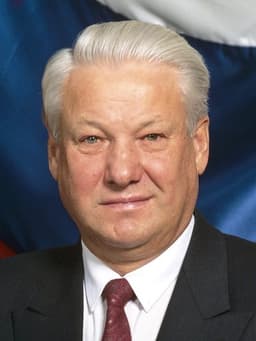
Boris Yeltsin
Politician · Modern
51.2Total

Frederick Chiluba
Politician · Modern
53.5Total
Basic Information
Born
1931
1943
Died
—
—
Era
Modern
Modern
Nationality
Russia
Zambia
Occupation
Politician
Politician
Civilization
Western
Other
Score Comparison
Military (10%)
10.0
39.9
Political (20%)
53.8
68.0
Influence (20%)
55.0
52.5
Legacy (20%)
54.0
42.5
Leadership (15%)
74.0
74.0
Strategy (15%)
38.3
44.3
TOTAL
51.2
53.5
Boris Yeltsin — Complete Timeline
1991 AD
Elected President of the Russian Soviet Federative Socialist RepublicOther◆ Major
Yeltsin was elected President of the Russian SFSR in a direct popular election on June 12, 1991, winning 57% of the vote. This made him the first popularly elected leader in Russian history and gave him a democratic mandate separate from Soviet President Mikhail Gorbachev.
Russian PresidencyDemocracySoviet Union
Impact: nationalconstructive
Led Resistance to August 1991 CoupPolitical Action◆ Major
During the August 1991 coup attempt by hardline Communist Party members against Gorbachev, Yeltsin famously climbed onto a tank outside the Russian White House and called for resistance. His defiance rallied opposition to the coup, which collapsed within days, accelerating the dissolution of the Soviet Union.
Soviet CoupRussian ResistanceDemocracy
Impact: globalconstructive
Signed Belavezha Accords Dissolving Soviet UnionOther◆ Major
Yeltsin, along with leaders of Ukraine and Belarus, signed the Belavezha Accords on December 8, 1991, declaring the Soviet Union dissolved and establishing the Commonwealth of Independent States (CIS). This effectively ended the USSR and created the Russian Federation as an independent state.
Soviet DissolutionCISRussian Independence
Impact: global
1993 AD
Ordered Shelling of Russian ParliamentOther◆ Major
Yeltsin ordered the Russian army to shell the White House (parliament building) on October 4, 1993, to end a constitutional crisis where the Supreme Soviet had refused to accept his decrees. The attack killed hundreds and led to the adoption of a new constitution with strong presidential powers.
Constitutional CrisisRussian ParliamentAuthoritarianism
Impact: nationaldestructive
1994 AD
Launched First Chechen WarOther◆ Major
Yeltsin ordered Russian troops into Chechnya on December 11, 1994, to suppress the separatist government of Dzhokhar Dudayev. The war resulted in massive casualties, destruction of Grozny, and a humiliating Russian withdrawal in 1996, severely damaging Yeltsin's popularity and military reputation.
Chechen WarRussian MilitarySeparatism
Impact: regionaldestructive
1999 AD
Resigned as President of RussiaPolitical Action◆ Major
Yeltsin announced his resignation on December 31, 1999, in a televised address, appointing Prime Minister Vladimir Putin as acting president. The resignation was unexpected and allowed Putin to consolidate power before the 2000 election, marking the end of Yeltsin's tumultuous decade in power.
Russian PresidencySuccessionPutin
Impact: national
Frederick Chiluba — Complete Timeline
1991 AD
Elected President of ZambiaPolitical Action◆ Major
Chiluba won the presidential election as the candidate of the Movement for Multiparty Democracy, defeating Kenneth Kaunda who had ruled since independence. This marked the first peaceful democratic transfer of power in Zambia.
ElectionZambiaDemocracy
Impact: nationalconstructive
1992 AD
Implemented Economic LiberalizationReform◆ Major
Chiluba's government adopted IMF and World Bank structural adjustment programs, including privatization of state enterprises, removal of subsidies, and currency devaluation. These reforms caused economic hardship but aimed to stabilize the economy.
Economic ReformIMFPrivatization
Impact: national
1996 AD
Re-elected President of ZambiaPolitical Action◆ Major
Chiluba won a second term in an election boycotted by the main opposition party and criticized by observers for irregularities. The election was marked by constitutional changes that barred Kaunda from running.
ElectionZambiaBoycott
Impact: national
2001 AD
Attempted Third Term BidPolitical Action◆ Major
Chiluba attempted to amend the constitution to allow a third term, sparking widespread protests and opposition from civil society and his own party. The bid failed, and he stepped down, but it damaged his legacy.
Third TermConstitutional CrisisZambia
Impact: nationaldestructive
2009 AD
Convicted of CorruptionPolitical Action◆ Major
Chiluba was convicted in a London court of stealing $46 million from Zambia during his presidency. The verdict was a landmark anti-corruption case, though Chiluba maintained his innocence and died before serving time.
CorruptionConvictionZambia
Impact: nationaldestructive
Expert Analysis
Origins
Boris Yeltsin was born on February 1, 1931, in Butka, Sverdlovsk Oblast, into a peasant family. His father was a laborer who survived Stalinist purges. Yeltsin studied construction at the Ural Polytechnic Institute, graduating in 1955. He worked his way up the Communist Party ladder in Sverdlovsk, becoming first secretary of the region in 1976.
Frederick Chiluba was born on April 30, 1943, in Kitwe, Northern Rhodesia (now Zambia), to a Bemba family. His father was a copper miner. Chiluba left school at 18 to work as a clerk, later becoming a trade union activist. He studied economics through correspondence courses and rose to head the Zambia Congress of Trade Unions in 1974.
Rise to Power
Yeltsin's rise accelerated under Mikhail Gorbachev's perestroika. In 1985, Gorbachev brought him to Moscow as a reformist. Yeltsin became first secretary of the Moscow City Party Committee in 1985. He was dismissed in 1987 after criticizing the slow pace of reform. In 1989, he won a seat in the Congress of People's Deputies. On June 12, 1991, Yeltsin was elected President of the Russian SFSR with 57% of the vote, becoming the first popularly elected leader in Russian history.
Chiluba's rise came through the labor movement. In 1990, he founded the Movement for Multiparty Democracy (MMD) to challenge Kenneth Kaunda's 27-year rule. In the 1991 election, Chiluba won 75% of the vote, ending Kaunda's one-party state. His victory was seen as a triumph for democracy in Africa.
Leadership & Governance
Yeltsin's leadership was marked by radical economic reforms. In January 1992, he launched shock therapy—price liberalization, privatization, and fiscal austerity. The reforms caused hyperinflation (2,500% in 1992) and a 40% drop in GDP. He also faced a constitutional crisis: in 1993, he ordered the military to shell the Russian White House, killing hundreds, to dissolve the parliament that opposed him.
Chiluba pursued economic liberalization under IMF and World Bank guidance. He privatized state enterprises, removed subsidies, and devalued the currency. While inflation fell from 200% to 30%, unemployment and poverty rose. He also attempted to amend the constitution to seek a third term in 2001 but backed down after protests. His political score is 68.0 against Yeltsin's 53.8.
Triumph & Tragedy
Yeltsin's greatest triumph was peacefully dismantling the Soviet Union. On December 8, 1991, he signed the Belavezha Accords with Ukraine and Belarus, ending the USSR. He also survived the August 1991 coup by standing on a tank, rallying opposition. His tragedies include the First Chechen War (1994-96), which killed up to 100,000 and ended in a humiliating withdrawal. His health deteriorated due to alcoholism, and his approval rating fell to 2% by 1999.
Chiluba's triumph was peacefully transferring power after his failed third-term bid, a rarity in Africa. He also won re-election in 1996 despite a boycott. His tragedy: he was convicted in 2007 of stealing $46 million from state funds. The London High Court ruling called him a "thief." His legacy score is 42.5, reflecting the corruption stain.
Character & Destiny
Yeltsin was impulsive and risk-taking. He drank heavily, made erratic decisions, and was prone to dramatic gestures (e.g., tank speech). His character led to both the Soviet collapse and the chaos of the 1990s. Historians note his leadership score is 74.0, but his strategy score is only 38.3.
Chiluba was a determined unionist who turned into a corrupt autocrat. He initially championed democracy but later tried to cling to power. His conviction showed the failure of his anti-corruption promises. His strategy score is 44.3, slightly higher than Yeltsin's.
Legacy
Yeltsin's legacy is mixed: he ended communism but left Russia impoverished. He chose Vladimir Putin as successor, shaping Russia's authoritarian turn. His impeachment attempts failed, but his constitution (1993) remains. He scored 55.0 in influence.
Chiluba's legacy is tarnished by corruption. He is remembered as the man who ended Kaunda's rule but stole from his people. His economic reforms set Zambia on a liberal path, but inequality rose. His influence score is 52.5.
Conclusion
Boris Yeltsin had a greater global impact. He dismantled a nuclear superpower and ended the Cold War, fundamentally reshaping world politics. Chiluba's impact was confined to Zambia and African democratization. Despite Chiluba's higher total score (53.5 vs 51.2), Yeltsin's historical significance is far larger. The score gap of 2.3 points reflects a flawed metric, not true influence.
Rankings
🥇
Frederick ChilubaLeader
Mil: 39.9Pol: 68.0Inf: 52.5
53.5
🥈
Boris Yeltsin
Mil: 10.0Pol: 53.8Inf: 55.0
51.2
+2.3 behind
How This Comparison Works
Algorithm
Each figure is scored on 6 dimensions (0—100 scale) based on structured historical data: Military (10%), Political (20%), Influence (20%), Legacy (20%), Leadership (15%), Strategy (15%). The weighted total produces the final ranking.
Data Sources
Scores are computed from structured sub-indicators in the database. Scale factors adjust for era (Ancient ×0.85, Modern ×1.0) and civilization size (Eastern ×1.05, Other ×0.80) to account for differences in population and military scale.
Maximum 3 Figures
Comparisons are limited to 2—3 figures to ensure readability and statistical meaningfulness.
Error Margins
±5 points per dimension — Sub-scores are derived from historical records with inherent uncertainty. Two figures within 5 points on a dimension should be considered roughly equivalent in that area.
Total Score Accuracy
±3 points overall — The weighted combination of 6 dimensions produces a total score with approximately ±3 points of uncertainty. Differences of less than 3 points are not statistically significant— the figures are effectively tied.
Known Limitations
- Historical records are incomplete and uneven across civilizations
- Figures from oral-tradition societies may be underrepresented
- Occupation labels can misclassify multi-role figures
- Scores measure capability and impact, not moral character
- Quantitative scoring is a comparison tool, not absolute truth
Capability Radar
Military (10%) — Battles & Warfare
Battles
0
21
Win Rate
0
25
Expansion
0
27
Political (20%) — Governance & Reform
Reform
75
55
Diplomacy
60
50
Economy
40
40
Influence (20%) — Cultural & Global Reach
Cultural
50
30
Global
60
25
Legacy (20%) — Historical Impact
Historical
65
35
Longevity
40
20
Leadership (15%) — Power & Stability
Tenure
70
60
Stability
20
30
Strategy (15%) — Tactics & Innovation
Strategy
0
32
Tactics
0
32
Reform
10
35
Similar Comparisons
Comments & Discussion
No comments yet. Be the first to share your thoughts!