Loading...
Borommakot vs Christian IV of Denmark
Borommakot leads by 2.3 pts · 2 figures compared
…
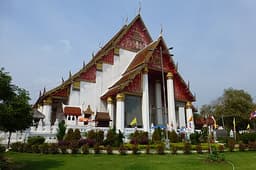
Borommakot
Emperor · Modern
57.2Total

Christian IV of Denmark
Emperor · Modern
54.9Total
Basic Information
Born
1680
1577
Died
1758
1648
Era
Modern
Modern
Nationality
Thailand
Denmark
Occupation
Emperor
Emperor
Civilization
Eastern
Western
Score Comparison
Military (10%)
55.0
55.0
Political (20%)
59.3
45.0
Influence (20%)
59.0
61.0
Legacy (20%)
47.5
49.2
Leadership (15%)
78.0
66.0
Strategy (15%)
45.0
51.7
TOTAL
57.2
54.9
Borommakot — Complete Timeline
1733 AD
Accession to the thronePolitical Action◆ Major
Borommakot became king of Ayutthaya after a civil war with his brother, Prince Aphai. His reign is considered the last golden age of the Ayutthaya Kingdom.
SuccessionCivil War
Impact: national
1740 AD
Construction of Wat PhutthaisawanCultural
Borommakot built Wat Phutthaisawan, a large Buddhist temple complex in Ayutthaya. The temple housed a famous Buddha image and became a major pilgrimage site.
Temple BuildingBuddhism
Impact: nationalconstructive
1745 AD
Restoration of Wat MahathatCultural
Borommakot ordered the restoration of Wat Mahathat, one of Ayutthaya's oldest temples. The restoration included rebuilding the main prang and adding new monastic quarters.
Temple RestorationBuddhism
Impact: nationalconstructive
1750 AD
Sending of Buddhist mission to Sri LankaCultural◆ Major
Borommakot dispatched a Siamese Buddhist mission to Sri Lanka to re-establish the higher ordination lineage. The mission successfully revived the Siam Nikaya order in Sri Lanka, which continues to this day.
BuddhismDiplomacySri Lanka
Impact: globalconstructive
1755 AD
Construction of Wat Na Phra MenCultural
Borommakot built Wat Na Phra Men, a temple located opposite the royal palace. The temple was used for royal ceremonies and housed a large bronze Buddha image.
Temple BuildingBuddhism
constructive
Christian IV of Denmark — Complete Timeline
1619 AD
Construction of the Stock Exchange (Børsen)Cultural
Christian IV commissioned the construction of the Copenhagen Stock Exchange, a Renaissance building with a distinctive spire. It became a center of commerce and one of the city's most iconic structures.
ArchitectureCommerceBørsen
Impact: nationalconstructive
1624 AD
Founding of Christiania (Oslo)Cultural◆ Major
After a fire destroyed Oslo, Christian IV ordered the city rebuilt on a new site and renamed it Christiania. The new city was designed with Renaissance planning and became the capital of Norway.
City PlanningOsloChristiania
Impact: regionalconstructive
1625 AD
Danish Intervention in the Thirty Years' WarWar◆ Major
Christian IV led Denmark into the Thirty Years' War as a Protestant champion. His campaign ended in defeat at the Battle of Lutter in 1626, leading to the Treaty of L
Thirty Years' WarBattle of LutterProtestant
Impact: globaltragic
1626 AD
Battle of LutterWar◆ Major
Christian IV's Danish army was decisively defeated by the Catholic League under Tilly at Lutter am Barenberge. The loss forced Denmark to retreat and eventually sign a peace treaty, ending its involvement in the war.
BattleDefeatThirty Years' War
Impact: regionaltragic
1637 AD
Construction of the Round TowerCultural◆ Major
Christian IV commissioned the Round Tower (Rundet
ArchitectureCopenhagenObservatory
Impact: nationalconstructive
Expert Analysis
Origins
Borommakot (1680–1758) was born as Prince Phon, son of King Sanphet VIII of Ayutthaya (modern Thailand). He grew up in a court riven by succession disputes, receiving a traditional Buddhist education in Pali scriptures and statecraft. His early life was marked by the execution of his father and the usurpation of the throne by his uncle, forcing him into monastic exile for safety.
Christian IV (1577–1648) was born at Frederiksborg Castle as the eldest son of King Frederick II of Denmark and Sophie of Mecklenburg. He received a rigorous Renaissance education in Latin, theology, and military science, and was groomed for rule from age 11. His father died when Christian was 11, leaving him under a regency council until his coronation at 19.
Rise to Power
Borommakot's path to power came through a civil war with his brother, Prince Aphai, in 1733. After their father's death, the two princes vied for the throne. Borommakot, with support from powerful noble families, defeated his brother's forces and had him executed. He was crowned in 1733, taking the regnal name Borommakot. His legitimacy was challenged early, but he consolidated power by purging rivals and appointing loyalists.
Christian IV ascended the throne in 1596 at age 19, ending a regency that had left the treasury depleted. He immediately asserted his authority by dismissing regency council members and launching a series of reforms. His early popularity stemmed from his dynamic personality and ambitious building projects, but his real power came from controlling the nobility through patronage and marriage alliances.
Leadership & Governance
Borommakot's leadership focused on restoring Buddhist orthodoxy and cultural revival. He enacted sumptuary laws to regulate monastic behavior, reformed temple administration, and personally supervised the construction of Wat Phutthaisawan (1733–1745) and the restoration of Wat Mahathat (1740s). His governance was centralized and theocratic, with the king as both political and religious head. He scored 78.0 in leadership, reflecting his effective management of the Buddhist sangha and court stability.
Christian IV was a hands-on ruler who personally oversaw Denmark's administration. He established new industries (ironworks, shipbuilding), reformed the navy, and founded trading companies. His governance was mercantilist, aiming to make Denmark self-sufficient. However, his political score of 45.0 reflects his inability to manage the nobility effectively, leading to conflicts. He is best known for his building projects: the Round Tower (1642), Stock Exchange (1625), and Christiania (now Oslo, 1624).
Triumph & Tragedy
Borommakot's greatest triumph was the dispatch of a Siamese Buddhist mission to Sri Lanka in 1753, which re-established the higher ordination lineage (Siam Nikaya) that continues today. This act cemented his legacy as a protector of Buddhism. His greatest failure was neglecting military modernization; he scored only 55.0 in military. His reign saw no major wars, but he failed to prepare Ayutthaya for future threats, leading to the kingdom's fall just 9 years after his death.
Christian IV's triumph was his ambitious building program that transformed Copenhagen into a Renaissance capital. His founding of Christiania (Oslo) created a planned city that became Norway's capital. His tragedy was the disastrous intervention in the Thirty Years' War (1625–1629). His defeat at the Battle of Lutter (1626) forced Denmark to sign the Treaty of Lübeck, losing territory and influence. He died in 1648, his kingdom weakened by war and debt.
Character & Destiny
Borommakot was pious, meticulous, and inward-looking. His character was shaped by his monastic background and desire for religious purity. He prioritized stability and cultural preservation over expansion, which led to peace but also vulnerability. His destiny was to be the last great king of Ayutthaya, his achievements overshadowed by the kingdom's collapse.
Christian IV was energetic, ambitious, and impulsive. He was known for his drinking and womanizing, fathering many illegitimate children. His character drove him to take risks, like entering the Thirty Years' War, but also led to poor strategic decisions. His destiny was to be remembered as a builder king, but his military failures tarnished his reputation.
Legacy
Borommakot's legacy endures through the Siam Nikaya in Sri Lanka, which remains the largest Buddhist monastic order there. His temple constructions, like Wat Phutthaisawan, are major tourist sites. However, his political score of 59.3 and legacy score of 47.5 reflect that his impact was largely religious and cultural, not structural. The Ayutthaya kingdom he left was fragile.
Christian IV's legacy is visible in Copenhagen's architecture: the Round Tower, Stock Exchange, Rosenborg Castle, and the district of Christianshavn. His founding of Oslo (then Christiania) shaped Norway's capital. His influence score of 61.0 reflects this tangible heritage. However, his total score of 54.9 is dragged down by political (45.0) and legacy (49.2) scores, as Denmark's decline in his later years limited his long-term impact.
Conclusion
Borommakot scored 57.2 total, slightly higher than Christian IV's 54.9, but the comparison is not merely numerical. Borommakot's impact was more focused and enduring in the religious sphere: his Buddhist mission continues to affect millions. Christian IV left more visible physical monuments but his political failures weakened Denmark. Borommakot had greater lasting influence on a specific institution (Buddhist ordination), while Christian IV's legacy is more diffuse. Therefore, Borommakot had a greater impact in terms of depth and longevity, scoring higher in leadership (78.0 vs 66.0) and political (59.3 vs 45.0). Christian IV's legacy is impressive but ultimately less transformative.
Rankings
🥇
BorommakotLeader
Mil: 55.0Pol: 59.3Inf: 59.0
57.2
🥈
Christian IV of Denmark
Mil: 55.0Pol: 45.0Inf: 61.0
54.9
+2.3 behind
How This Comparison Works
Algorithm
Each figure is scored on 6 dimensions (0—100 scale) based on structured historical data: Military (10%), Political (20%), Influence (20%), Legacy (20%), Leadership (15%), Strategy (15%). The weighted total produces the final ranking.
Data Sources
Scores are computed from structured sub-indicators in the database. Scale factors adjust for era (Ancient ×0.85, Modern ×1.0) and civilization size (Eastern ×1.05, Other ×0.80) to account for differences in population and military scale.
Maximum 3 Figures
Comparisons are limited to 2—3 figures to ensure readability and statistical meaningfulness.
Error Margins
±5 points per dimension — Sub-scores are derived from historical records with inherent uncertainty. Two figures within 5 points on a dimension should be considered roughly equivalent in that area.
Total Score Accuracy
±3 points overall — The weighted combination of 6 dimensions produces a total score with approximately ±3 points of uncertainty. Differences of less than 3 points are not statistically significant— the figures are effectively tied.
Known Limitations
- Historical records are incomplete and uneven across civilizations
- Figures from oral-tradition societies may be underrepresented
- Occupation labels can misclassify multi-role figures
- Scores measure capability and impact, not moral character
- Quantitative scoring is a comparison tool, not absolute truth
Capability Radar
Military (10%) — Battles & Warfare
Battles
30
45
Win Rate
40
30
Expansion
20
30
Political (20%) — Governance & Reform
Reform
65
65
Diplomacy
60
40
Economy
70
60
Influence (20%) — Cultural & Global Reach
Cultural
65
65
Global
30
40
Legacy (20%) — Historical Impact
Historical
55
55
Longevity
40
50
Leadership (15%) — Power & Stability
Tenure
70
70
Stability
75
45
Strategy (15%) — Tactics & Innovation
Strategy
30
35
Tactics
35
40
Reform
20
50
Similar Comparisons
Comments & Discussion
No comments yet. Be the first to share your thoughts!