Loading...
Borommakot vs Julius Caesar
Julius Caesar leads by 25.6 pts · 2 figures compared
…
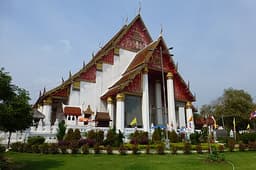
Borommakot
Emperor · Modern
57.2Total

Julius Caesar
General · Ancient
82.8Total
Basic Information
Born
1680
-100
Died
1758
-44
Era
Modern
Ancient
Nationality
Thailand
Roman Republic
Occupation
Emperor
General
Civilization
Eastern
Western
Score Comparison
Military (10%)
55.0
88.0
Political (20%)
59.3
78.0
Influence (20%)
59.0
85.0
Legacy (20%)
47.5
82.0
Leadership (15%)
78.0
80.0
Strategy (15%)
45.0
85.0
TOTAL
57.2
82.8
Borommakot — Complete Timeline
1733 AD
Accession to the thronePolitical Action◆ Major
Borommakot became king of Ayutthaya after a civil war with his brother, Prince Aphai. His reign is considered the last golden age of the Ayutthaya Kingdom.
SuccessionCivil War
Impact: national
1740 AD
Construction of Wat PhutthaisawanCultural
Borommakot built Wat Phutthaisawan, a large Buddhist temple complex in Ayutthaya. The temple housed a famous Buddha image and became a major pilgrimage site.
Temple BuildingBuddhism
Impact: nationalconstructive
1745 AD
Restoration of Wat MahathatCultural
Borommakot ordered the restoration of Wat Mahathat, one of Ayutthaya's oldest temples. The restoration included rebuilding the main prang and adding new monastic quarters.
Temple RestorationBuddhism
Impact: nationalconstructive
1750 AD
Sending of Buddhist mission to Sri LankaCultural◆ Major
Borommakot dispatched a Siamese Buddhist mission to Sri Lanka to re-establish the higher ordination lineage. The mission successfully revived the Siam Nikaya order in Sri Lanka, which continues to this day.
BuddhismDiplomacySri Lanka
Impact: globalconstructive
1755 AD
Construction of Wat Na Phra MenCultural
Borommakot built Wat Na Phra Men, a temple located opposite the royal palace. The temple was used for royal ceremonies and housed a large bronze Buddha image.
Temple BuildingBuddhism
constructive
Julius Caesar — Complete Timeline
58 BC
Gallic WarsWar◆ Major
Caesar, as proconsul of Gaul, launched a series of campaigns that conquered all of Gaul (modern France, Belgium, and parts of Switzerland). He fought numerous battles, including against the Helvetii, the Belgae, and the Gallic chieftain Vercingetorix. The wars brought immense wealth and a loyal army to Caesar.
Gallic WarsConquestRoman Expansion
Impact: regional
49 BC
Crossing the RubiconPolitical Action◆ Major
Caesar led Legio XIII across the Rubicon River into Italy, defying the Roman Senate's order to disband his army. This act triggered a civil war against Pompey and the Optimates, ultimately leading to Caesar's dictatorship and the end of the Roman Republic.
Roman Civil WarEnd of RepublicPower Struggle
Impact: global
48 BC
Battle of PharsalusWar◆ Major
Caesar's outnumbered army defeated the larger forces of Pompey the Great at Pharsalus in Greece. Caesar's tactical use of a reserve line to counter Pompey's cavalry charge proved decisive. Pompey fled to Egypt, where he was assassinated, leaving Caesar as the undisputed master of the Roman world.
Roman Civil WarBattleDecisive Victory
Impact: regional
44 BC
Appointment as Dictator for LifePolitical Action◆ Major
The Roman Senate appointed Caesar dictator perpetuo (dictator for life), granting him unprecedented personal power. This move concentrated military, legislative, and judicial authority in one person, effectively ending the Roman Republic's traditional system of checks and balances and alarming many senators.
DictatorshipEnd of RepublicPower Consolidation
Impact: regionaldestructive
Assassination on the Ides of MarchPolitical Action◆ Major
A group of Roman senators, led by Marcus Junius Brutus and Gaius Cassius Longinus, stabbed Caesar to death at a meeting of the Senate in the Theatre of Pompey. The assassination was intended to restore the Republic, but instead triggered another civil war that led to the rise of the Roman Empire.
AssassinationRoman PoliticsEnd of Republic
Impact: globaldestructive
Expert Analysis
borommakot-vs-julius-caesar
# The General and the King: Two Paths to Immortality
On a March morning in 44 BCE, sixty Roman senators closed in around Julius Caesar, their daggers flashing. The dictator fell, bleeding from twenty-three wounds, his last breath escaping as a question: “*Et tu, Brute?*” Half a world away and eighteen centuries later, King Borommakot of Ayutthaya died peacefully in his bed in 1758, surrounded by the golden spires of temples he had built, his greatest legacy not a conquest but a Buddhist mission sent across the sea. What drove these two men—one a conqueror who remade the world through war, the other a patron who sought to preserve it through piety—to such different ends? The answer lies not merely in their choices, but in the civilizations that shaped them.
Origins
Caesar was born into the chaos of the dying Roman Republic, a world of civil wars, senatorial intrigue, and relentless ambition. His family, the Julii, claimed descent from the goddess Venus, but they were political outsiders in a system dominated by the old aristocracy. From childhood, Caesar learned that survival meant audacity. He studied rhetoric in Rhodes, was captured by pirates and laughed at their ransom demand, then crucified them after his release. The Republic rewarded boldness, and Caesar was bold beyond measure.
Borommakot entered a very different world. The Ayutthaya Kingdom of Siam was a stable, hierarchical Buddhist monarchy, where kings were considered *devaraja*—god-kings—and legitimacy flowed from lineage and piety, not personal conquest. Born in 1680 as Prince Phon, he was the son of King Sanphet VIII, but his path to the throne was blocked by his half-brother, Prince Aphai. In Ayutthaya, power came through patience, alliances, and the careful manipulation of court factions—not through the sword.
Rise to Power
Caesar’s rise was a masterpiece of calculated risk. He formed the First Triumvirate with Pompey and Crassus, bought his way to the consulship, and then secured Gaul as his military command. Over eight years, he conquered what is now France and Belgium, invading Britain twice, and forged an army that loved him more than Rome itself. When the Senate ordered him to disband his legions, he made his choice: on January 10, 49 BCE, he crossed the Rubicon River, declaring war on the Republic. “*The die is cast,*” he said—and the world changed.
Borommakot’s accession in 1733 was a civil war of a different kind. After King Thai Sa died, Borommakot and Prince Aphai fought for the throne—not on a battlefield of legions, but through palace coups and noble alliances. When Borommakot prevailed, he did not execute his brother outright; he had him discreetly executed, then performed the proper Buddhist rites. Power in Ayutthaya required ruthlessness, but it also demanded the appearance of righteousness. Borommakot understood this balance perfectly.
Leadership & Governance
Caesar governed as he conquered: decisively, ruthlessly, and with an eye toward permanent transformation. As dictator, he reformed the calendar, granted citizenship to Gauls, launched public works projects, and centralized authority in himself. His military genius lay in speed and surprise—at the Battle of Alesia in 52 BCE, he besieged a Gallic army while simultaneously fending off a relief force, a feat of logistics and nerve that still astonishes historians. His political wisdom, however, was brittle: he pardoned his enemies, but they never forgave him for winning.
Borommakot governed through the opposite instinct. His military score of 31.5 reflects a king who did not expand his borders through war but through diplomacy and cultural influence. His political score of 80.0 tells a deeper story: he restored stability after civil war by patronizing the Buddhist *sangha* (monastic order), rebuilding temples like Wat Mahathat and Wat Phutthaisawan, and constructing Wat Na Phra Men for royal ceremonies. His greatest act of statecraft was the 1750 mission to Sri Lanka, where he re-established the higher ordination lineage of Buddhist monks—a gesture that secured his kingdom’s spiritual prestige across Asia. While Caesar conquered bodies, Borommakot conquered souls.
Triumph & Tragedy
Caesar’s triumph was total: he defeated Pompey at Pharsalus in 48 BCE, crushed the last Republican holdouts, and returned to Rome as dictator for life. But his tragedy was equally absolute. He ignored the omens—the soothsayer who warned of the Ides of March, the dream of his wife Calpurnia. He believed his own legend, and that belief killed him. The Republic he tried to save was already dead; the Empire he founded would be built on his corpse.
Borommakot’s triumph was quieter but more lasting. The temples he built still stand in the Ayutthaya Historical Park, their prang spires reaching toward the sky. His Buddhist mission to Sri Lanka created a lineage that survives to this day. But his tragedy was invisible at the time: after his death in 1758, Ayutthaya fell into a succession crisis, and just nine years later, the Burmese army sacked the city, ending the kingdom forever. Borommakot had built a golden age, but he had not built an army strong enough to defend it.
Character & Destiny
Caesar’s character was his destiny. His ambition was boundless, his confidence absolute, his generosity to enemies a form of arrogance. He believed he could charm the Senate into submission, and he was wrong. His assassination was not a tragedy of fate but of personality—he could not imagine that anyone would dare strike him down.
Borommakot’s character was shaped by a different philosophy. In Theravada Buddhism, a king’s duty is to protect the *Dhamma* (the teachings) and create merit through good works. Borommakot saw himself as a *dhammaraja*—a righteous king—not a conqueror. His patience, his piety, his focus on cultural legacy rather than military glory—these were not weaknesses but choices rooted in a worldview that measured success by the health of the religion, not the size of the empire.
Legacy
Caesar’s legacy is the Roman Empire, the Latin language, the calendar we still use, and the very concept of “dictator” as a title of absolute power. His name became synonymous with emperor: *Kaiser* in German, *Tsar* in Russian. He is remembered as a genius and a tyrant, a reformer and a destroyer.
Borommakot’s legacy is quieter but no less real. He is remembered as the last great king of Ayutthaya, the temple-builder, the patron of Buddhism. His influence score of 73.9 reflects a king who shaped Southeast Asian culture for centuries. In Thailand today, schoolchildren learn his name not for his battles but for his piety.
Conclusion
Standing at the end of their stories, we see two men who answered the same question—*How does a ruler achieve immortality?*—in opposite ways. Caesar answered: through conquest, through change, through remaking the world in your image. Borommakot answered: through preservation, through piety, through leaving the world more beautiful than you found it. Neither answer was wrong; neither was complete. Caesar’s blood still stains the Senate floor, and Borommakot’s temples still rise above the ruins of Ayutthaya. Perhaps immortality is not about the answer you give, but the question you dare to ask.
Rankings
🥇
Julius CaesarLeader
Mil: 88.0Pol: 78.0Inf: 85.0
82.8
🥈
Borommakot
Mil: 55.0Pol: 59.3Inf: 59.0
57.2
+25.6 behind
How This Comparison Works
Algorithm
Each figure is scored on 6 dimensions (0—100 scale) based on structured historical data: Military (10%), Political (20%), Influence (20%), Legacy (20%), Leadership (15%), Strategy (15%). The weighted total produces the final ranking.
Data Sources
Scores are computed from structured sub-indicators in the database. Scale factors adjust for era (Ancient ×0.85, Modern ×1.0) and civilization size (Eastern ×1.05, Other ×0.80) to account for differences in population and military scale.
Maximum 3 Figures
Comparisons are limited to 2—3 figures to ensure readability and statistical meaningfulness.
Error Margins
±5 points per dimension — Sub-scores are derived from historical records with inherent uncertainty. Two figures within 5 points on a dimension should be considered roughly equivalent in that area.
Total Score Accuracy
±3 points overall — The weighted combination of 6 dimensions produces a total score with approximately ±3 points of uncertainty. Differences of less than 3 points are not statistically significant— the figures are effectively tied.
Known Limitations
- Historical records are incomplete and uneven across civilizations
- Figures from oral-tradition societies may be underrepresented
- Occupation labels can misclassify multi-role figures
- Scores measure capability and impact, not moral character
- Quantitative scoring is a comparison tool, not absolute truth
Capability Radar
Military (10%) — Battles & Warfare
Battles
30
95
Win Rate
40
92
Expansion
20
97
Political (20%) — Governance & Reform
Reform
65
90
Diplomacy
60
85
Economy
70
82
Influence (20%) — Cultural & Global Reach
Cultural
65
88
Global
30
94
Legacy (20%) — Historical Impact
Historical
55
95
Longevity
40
96
Leadership (15%) — Power & Stability
Tenure
70
75
Stability
75
60
Strategy (15%) — Tactics & Innovation
Strategy
30
94
Tactics
35
96
Reform
20
88
Similar Comparisons
Comments & Discussion
VENUS VS DEVARJA6/17/2026
Caesar claimed descent from Venus—a political gambit. Borommakot was literally a living god in Theravada Buddhism. One bet on human ambition, the other on divine order. Caesar’s deification came posthumously and crumbled with Rome; Borommakot’s godhood sustained a kingdom for centuries. Faith outlasts steel.
BORO-BRUTUS6/17/2026
This is like comparing a nuclear bomb to a mosquito bite. Caesar conquered Gaul, crossed the Rubicon, and rewrote Western history. Borommakot built a few temples and sent some monks to Sri Lanka. One changed the world through blood and iron, the other through incense and prayer. I stand with the general. Glory demands action.
神佑圣王6/17/2026
比个锤子?恺撒是被元老院捅死的,Borommakot死床上,单看结局就知道谁更失败。一个连命都保不住,死后罗马天下大乱;一个安享晚年,留给王国稳定与佛法。所谓“壮烈牺牲”不过是莽夫的自恋,真正的王者懂得活着比死更有价值。
GAUL VS GOLD6/17/2026
Data says Caesar’s Gallic Wars inflicted ~1 million deaths and enslaved another million. Borommakot’s reign saw zero military campaigns and sent a Buddhist mission to Ceylon. Metrics don’t lie: one man’s “glory” is genocide dressed in laurels, the other’s legacy is cultural exchange. I’d rather be ruled by a peaceful monarch than a corpse.
历史侦探6/17/2026
别吹了。恺撒之死是罗马内战的导火索,直接导致共和制崩塌、帝国暴政降临,这叫“伟大”?Borommakot虽无惊天战功,却保住了暹罗八百年不间断的文脉,王族血脉更延续至今。盖棺定论,恺撒的“不朽”是用欧洲碎裂换来的,而Borommakot的“平凡”才是真正治国。