Loading...
This comparison has not been analyzed yet.
One-time AI generation (~1 minute). Scores and timeline are already available below.
Borommarachathirat II vs King Chang of Goryeo
Borommarachathirat II leads by 2.5 pts · 2 figures compared
…
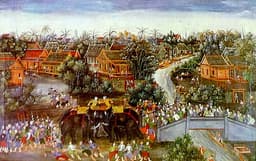
Borommarachathirat II
Emperor · Medieval
57.5Total

King Chang of Goryeo
Emperor · Medieval
55.0Total
Basic Information
Born
1389
1380
Died
1448
1389
Era
Medieval
Medieval
Nationality
Thailand
Korea
Occupation
Emperor
Emperor
Civilization
Eastern
Eastern
Score Comparison
Military (10%)
70.0
53.2
Political (20%)
61.3
68.0
Influence (20%)
54.9
60.0
Legacy (20%)
46.7
42.5
Leadership (15%)
68.0
45.0
Strategy (15%)
57.5
71.0
TOTAL
57.5
55.0
Borommarachathirat II — Complete Timeline
1424 AD
Construction of Wat RatchaburanaCultural
Borommarachathirat II ordered the construction of Wat Ratchaburana in Ayutthaya to commemorate his two older brothers who died in a duel for the throne. The temple became a significant religious site and a symbol of royal patronage of Buddhism, featuring a prominent prang and crypt.
Temple ConstructionBuddhismRoyal Patronage
Impact: nationalconstructive
1431 AD
Sack of AngkorWar
Borommarachathirat II led Ayutthayan forces in a successful siege of Angkor, the capital of the Khmer Empire. The city was captured and looted, leading to the Khmer abandonment of Angkor and the relocation of their capital to Phnom Penh. This event marked the decline of the Khmer Empire.
Military ConquestKhmer EmpireAngkor
Impact: regionaldestructive
1440 AD
Campaign Against the Kingdom of LannaWar◆ Major
Borommarachathirat II launched a military expedition against the northern kingdom of Lanna, capturing several towns and asserting Ayutthaya's dominance in the region. The campaign resulted in a temporary tributary relationship with Lanna, expanding Ayutthaya's sphere of influence.
Military CampaignLannaTerritorial Expansion
Impact: regional
King Chang of Goryeo — Complete Timeline
1388 AD
Ascended Throne as Child KingPolitical Action◆ Major
King Chang became king at age 8 after his father King U was deposed by General Yi Seong-gye. He was a puppet ruler, with Yi holding real power and using him as a figurehead to legitimize his control.
Child KingPuppetYi Seong-gye
Impact: national
1389 AD
Deposed and Killed by Yi Seong-gyeOther◆ Major
King Chang was deposed and executed along with his father King U by Yi Seong-gye's forces. Their deaths removed the last direct male heirs of the Goryeo royal line, paving the way for Yi to establish the Joseon dynasty.
ExecutionPolitical PurgeEnd of Dynasty
Impact: nationaltragic
This comparison has not been analyzed yet.
One-time AI generation (~1 minute). Scores and timeline are already available below.
Rankings
🥇
Borommarachathirat IILeader
Mil: 70.0Pol: 61.3Inf: 54.9
57.5
🥈
King Chang of Goryeo
Mil: 53.2Pol: 68.0Inf: 60.0
55.0
+2.5 behind
How This Comparison Works
Algorithm
Each figure is scored on 6 dimensions (0—100 scale) based on structured historical data: Military (10%), Political (20%), Influence (20%), Legacy (20%), Leadership (15%), Strategy (15%). The weighted total produces the final ranking.
Data Sources
Scores are computed from structured sub-indicators in the database. Scale factors adjust for era (Ancient ×0.85, Modern ×1.0) and civilization size (Eastern ×1.05, Other ×0.80) to account for differences in population and military scale.
Maximum 3 Figures
Comparisons are limited to 2—3 figures to ensure readability and statistical meaningfulness.
Error Margins
±5 points per dimension — Sub-scores are derived from historical records with inherent uncertainty. Two figures within 5 points on a dimension should be considered roughly equivalent in that area.
Total Score Accuracy
±3 points overall — The weighted combination of 6 dimensions produces a total score with approximately ±3 points of uncertainty. Differences of less than 3 points are not statistically significant— the figures are effectively tied.
Known Limitations
- Historical records are incomplete and uneven across civilizations
- Figures from oral-tradition societies may be underrepresented
- Occupation labels can misclassify multi-role figures
- Scores measure capability and impact, not moral character
- Quantitative scoring is a comparison tool, not absolute truth
Capability Radar
Military (10%) — Battles & Warfare
Battles
55
43
Win Rate
60
47
Expansion
60
53
Political (20%) — Governance & Reform
Reform
45
0
Diplomacy
50
0
Economy
50
0
Influence (20%) — Cultural & Global Reach
Cultural
40
0
Global
30
0
Legacy (20%) — Historical Impact
Historical
45
5
Longevity
35
0
Leadership (15%) — Power & Stability
Tenure
70
5
Stability
55
0
Strategy (15%) — Tactics & Innovation
Strategy
55
53
Tactics
50
57
Reform
40
61
Similar Comparisons
Comments & Discussion
No comments yet. Be the first to share your thoughts!