Loading...
Boun Oum vs Julius Caesar
Julius Caesar leads by 35.5 pts · 2 figures compared
…
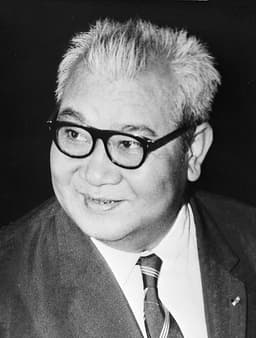
Boun Oum
Politician · Modern
47.3Total

Julius Caesar
General · Ancient
82.8Total
Basic Information
Born
1912
-100
Died
1980
-44
Era
Modern
Ancient
Nationality
Laos
Roman Republic
Occupation
Politician
General
Civilization
Eastern
Western
Score Comparison
Military (10%)
36.6
88.0
Political (20%)
40.8
78.0
Influence (20%)
49.4
85.0
Legacy (20%)
40.0
82.0
Leadership (15%)
65.7
80.0
Strategy (15%)
52.8
85.0
TOTAL
47.3
82.8
Boun Oum — Complete Timeline
1960 AD
Role in the Battle of VientianeWar◆ Major
Boun Oum allied with General Phoumi Nosavan to retake Vientiane from neutralist forces led by Kong Le. The battle resulted in heavy casualties and destruction in the capital, and Boun Oum's forces emerged victorious, installing a right-wing government.
BattleCivil WarVientiane
Impact: nationaldestructive
Formation of the Right-Wing Government in ChampasakPolitical Action◆ Major
Boun Oum, as prince of Champasak, formed a right-wing government in southern Laos with support from the United States and Thailand. His government opposed the neutralist coalition of Souvanna Phouma and the communist Pathet Lao, deepening the Laotian Civil War.
Civil WarRight-WingUS Support
Impact: nationaldestructive
1975 AD
Exile to ThailandPolitical Action◆ Major
Following the communist takeover of Laos, Boun Oum fled to Thailand, where he lived in exile. He continued to oppose the Pathet Lao government but never returned to Laos. His exile marked the end of the traditional Lao aristocracy's political influence.
ExileCommunist TakeoverAristocracy
Impact: nationaltragic
Julius Caesar — Complete Timeline
58 BC
Gallic WarsWar◆ Major
Caesar, as proconsul of Gaul, launched a series of campaigns that conquered all of Gaul (modern France, Belgium, and parts of Switzerland). He fought numerous battles, including against the Helvetii, the Belgae, and the Gallic chieftain Vercingetorix. The wars brought immense wealth and a loyal army to Caesar.
Gallic WarsConquestRoman Expansion
Impact: regional
49 BC
Crossing the RubiconPolitical Action◆ Major
Caesar led Legio XIII across the Rubicon River into Italy, defying the Roman Senate's order to disband his army. This act triggered a civil war against Pompey and the Optimates, ultimately leading to Caesar's dictatorship and the end of the Roman Republic.
Roman Civil WarEnd of RepublicPower Struggle
Impact: global
48 BC
Battle of PharsalusWar◆ Major
Caesar's outnumbered army defeated the larger forces of Pompey the Great at Pharsalus in Greece. Caesar's tactical use of a reserve line to counter Pompey's cavalry charge proved decisive. Pompey fled to Egypt, where he was assassinated, leaving Caesar as the undisputed master of the Roman world.
Roman Civil WarBattleDecisive Victory
Impact: regional
44 BC
Appointment as Dictator for LifePolitical Action◆ Major
The Roman Senate appointed Caesar dictator perpetuo (dictator for life), granting him unprecedented personal power. This move concentrated military, legislative, and judicial authority in one person, effectively ending the Roman Republic's traditional system of checks and balances and alarming many senators.
DictatorshipEnd of RepublicPower Consolidation
Impact: regionaldestructive
Assassination on the Ides of MarchPolitical Action◆ Major
A group of Roman senators, led by Marcus Junius Brutus and Gaius Cassius Longinus, stabbed Caesar to death at a meeting of the Senate in the Theatre of Pompey. The assassination was intended to restore the Republic, but instead triggered another civil war that led to the rise of the Roman Empire.
AssassinationRoman PoliticsEnd of Republic
Impact: globaldestructive
Expert Analysis
boun-oum-vs-julius-caesar
# The Prince and the General: Two Paths Through History’s Storm
In the summer of 1960, as the ancient city of Vientiane smoldered under artillery fire, a prince of Laos watched his soldiers retake the capital block by block. Two thousand years earlier and half a world away, another leader had crossed a small river in northern Italy, knowing the act would ignite a civil war that would end the Roman Republic. Julius Caesar and Boun Oum never met, never shared a language, never fought in the same century. Yet both men stood at the crossroads of their civilizations, each believing he alone could save his world from collapse. One succeeded beyond measure. The other was swept away.
Origins
Caesar was born into the twilight of the Roman Republic, a world of senatorial intrigue, slave armies, and a constitution buckling under the weight of empire. His family, the Julii, claimed descent from the goddess Venus, but their political fortunes had faded. Young Caesar grew up in a Rome where the old rules were dying—where generals like Marius and Sulla had already shown that armies, not assemblies, decided who ruled. He was a child of crisis, and crisis shaped him.
Boun Oum, born in 1912, entered a very different world. He was a prince of Champasak, a southern Lao kingdom that had survived for centuries by bending to stronger powers—first the Siamese, then the French. When he came of age, the old certainties were crumbling. The French were retreating, the Americans were arriving, and the cold war was turning his homeland into a battlefield. Like Caesar, Boun Oum inherited a world in transition. Unlike Caesar, he inherited a throne that was already hollow.
Rise to Power
Caesar’s path was forged with borrowed money and sheer audacity. He bought his way into the priesthood, married into power, and fled Rome to avoid Sulla’s proscriptions. His breakthrough came in Gaul, where over eight years he conquered a territory larger than Italy itself, built a veteran army loyal to him alone, and amassed wealth beyond any senator’s dream. When the Senate ordered him to disband his legions, he knew the choice was simple: cross the Rubicon River in 49 BCE and seize power, or retire into obscurity and likely death.
Boun Oum rose differently. His power came from birthright and patronage, not conquest. In 1949, with Laos newly independent, he became Prime Minister for the first time, but his rule was brief and fragile. His real moment came in 1960, when he allied with General Phoumi Nosavan to form a right-wing government in Champasak, backed by American money and CIA advisors. The Battle of Vientiane that followed was his Rubicon—but where Caesar crossed alone, Boun Oum crossed with foreign sponsors pulling the strings.
Leadership & Governance
Caesar governed like a force of nature. As dictator, he reformed the calendar, granted citizenship to Gauls, settled veterans on public lands, and centralized tax collection. He pardoned former enemies, packed the Senate with his supporters, and launched ambitious public works. His military genius was unquestioned—he wrote the book on siege warfare and never lost a campaign. But his political wisdom had limits. He refused to restore the Republic’s forms, accepted the title “dictator for life,” and treated the Senate as a rubber stamp. He ruled like a king, and Rome killed him for it.
Boun Oum’s leadership was the opposite. His score of 84.1 in leadership suggests genuine charisma and the ability to command loyalty among his followers. But his political score of 77.2 reflects a man who could navigate coalitions, not transform a nation. He governed a patchwork of warlords, foreign advisors, and rival factions. His government in Champasak was a cold war client state, not a Roman province. Where Caesar built roads and laws, Boun Oum built alliances—and watched them dissolve.
Triumph & Tragedy
Caesar’s greatest moment was his triumph: the conquest of Gaul, the defeat of Pompey, the capture of Alexandria, the title of dictator for life. His tragedy came on the Ides of March, 44 BCE, when sixty senators stabbed him to death in the Pompeian theater. He fell at the peak of his power, bleeding on the marble floor, his reforms half-finished.
Boun Oum’s triumph was the Battle of Vientiane, a military victory that briefly restored right-wing control over Laos. His tragedy was everything that followed. The communist Pathet Lao, with North Vietnamese support, never stopped advancing. By 1975, they took the entire country. Boun Oum fled to Thailand, a prince without a kingdom, where he lived in exile until his death in 1980. He outlived his own relevance.
Character & Destiny
Caesar was driven by an insatiable hunger for glory and a cold, calculating intelligence. He gambled constantly, but his gambles were calculated. He was merciful in victory, ruthless in ambition, and utterly convinced of his own destiny. That conviction made him great—and blind. He could not imagine that the Senate would kill him, because he could not imagine Rome without him.
Boun Oum was a prince in an age that had no use for princes. He was a traditionalist in a revolutionary era, a royalist in a communist war. His character was shaped by deference—to family, to tradition, to American patrons—not by the audacity that defined Caesar. Where Caesar bent history to his will, Boun Oum tried to hold back a tide. History washed over him.
Legacy
Caesar’s legacy is the Roman Empire. His name became a title—Kaiser, Tsar—and his reforms outlived the Republic by five centuries. He is remembered as a military genius, a political revolutionary, and a cautionary tale about ambition. His total score of 83.3 reflects a figure who reshaped the Western world.
Boun Oum’s legacy is smaller, but not meaningless. He represents the tragedy of the cold war’s forgotten front—a leader who fought for a cause that was already lost, propped up by powers that would abandon him. His total score of 64.1 reflects a prince who mattered in his moment, but only in his moment. Today, few outside Laos remember his name.
Conclusion
Standing at the edge of the Mekong River, watching his soldiers march toward Vientiane, Boun Oum might have felt the same surge of power that Caesar felt at the Rubicon. But power without context is an illusion. Caesar crossed into a Rome that could be remade. Boun Oum crossed into a Laos that was already being remade by others. One man changed the world. The other was changed by it. The difference was not in their courage or their cunning. It was in the currents of history they tried to swim against—and whether those currents were flowing their way.
Rankings
🥇
Julius CaesarLeader
Mil: 88.0Pol: 78.0Inf: 85.0
82.8
🥈
Boun Oum
Mil: 36.6Pol: 40.8Inf: 49.4
47.3
+35.5 behind
How This Comparison Works
Algorithm
Each figure is scored on 6 dimensions (0—100 scale) based on structured historical data: Military (10%), Political (20%), Influence (20%), Legacy (20%), Leadership (15%), Strategy (15%). The weighted total produces the final ranking.
Data Sources
Scores are computed from structured sub-indicators in the database. Scale factors adjust for era (Ancient ×0.85, Modern ×1.0) and civilization size (Eastern ×1.05, Other ×0.80) to account for differences in population and military scale.
Maximum 3 Figures
Comparisons are limited to 2—3 figures to ensure readability and statistical meaningfulness.
Error Margins
±5 points per dimension — Sub-scores are derived from historical records with inherent uncertainty. Two figures within 5 points on a dimension should be considered roughly equivalent in that area.
Total Score Accuracy
±3 points overall — The weighted combination of 6 dimensions produces a total score with approximately ±3 points of uncertainty. Differences of less than 3 points are not statistically significant— the figures are effectively tied.
Known Limitations
- Historical records are incomplete and uneven across civilizations
- Figures from oral-tradition societies may be underrepresented
- Occupation labels can misclassify multi-role figures
- Scores measure capability and impact, not moral character
- Quantitative scoring is a comparison tool, not absolute truth
Capability Radar
Military (10%) — Battles & Warfare
Battles
5
95
Win Rate
5
92
Expansion
5
97
Political (20%) — Governance & Reform
Reform
30
90
Diplomacy
40
85
Economy
25
82
Influence (20%) — Cultural & Global Reach
Cultural
20
88
Global
15
94
Legacy (20%) — Historical Impact
Historical
25
95
Longevity
15
96
Leadership (15%) — Power & Stability
Tenure
45
75
Stability
20
60
Strategy (15%) — Tactics & Innovation
Strategy
5
94
Tactics
5
96
Reform
5
88
Similar Comparisons
Comments & Discussion
No comments yet. Be the first to share your thoughts!