Loading...
Boutros Boutros-Ghali vs Roman Herzog
Roman Herzog leads by 2.0 pts · 2 figures compared
…
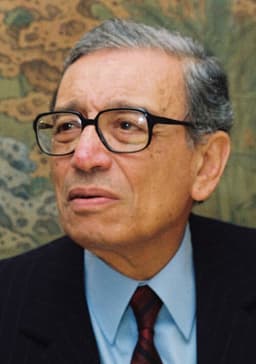
Boutros Boutros-Ghali
Politician · Modern
53.0Total

Roman Herzog
Politician · Modern
55.0Total
Basic Information
Born
1922
1934
Died
—
—
Era
Modern
Modern
Nationality
Egypt
Germany
Occupation
Politician
Politician
Civilization
Middle Eastern
Western
Score Comparison
Military (10%)
50.0
50.0
Political (20%)
45.0
68.0
Influence (20%)
55.0
55.7
Legacy (20%)
49.2
46.7
Leadership (15%)
72.0
66.0
Strategy (15%)
44.4
43.0
TOTAL
53.0
55.0
Boutros Boutros-Ghali — Complete Timeline
1992 AD
Elected Secretary-General of the United NationsPolitical Action◆ Major
Boutros Boutros-Ghali became the sixth Secretary-General of the United Nations, the first from Africa. His election came during a period of post-Cold War transition, and he focused on peacekeeping and conflict resolution.
UN Secretary-GeneralPeacekeepingPost-Cold War
Impact: globalconstructive
Published An Agenda for PeacePolitical Action◆ Major
Boutros-Ghali released An Agenda for Peace, a landmark report outlining preventive diplomacy, peacemaking, and peacekeeping strategies. The report influenced UN operations in conflicts like Somalia, Bosnia, and Rwanda.
PeacekeepingUN ReformDiplomacy
Impact: globalconstructive
1994 AD
Oversaw UN peacekeeping in the Rwandan GenocideWar◆ Major
During the Rwandan Genocide, Boutros-Ghali's UN peacekeeping mission failed to prevent the killing of an estimated 800,000 Tutsis and moderate Hutus. The UN's inaction drew widespread criticism and led to calls for reform.
RwandaGenocideUN Failure
Impact: globaltragic
1996 AD
Vetoed by the United States for a second termPolitical Action◆ Major
The United States vetoed Boutros-Ghali's bid for a second term as UN Secretary-General, citing disagreements over UN reform and peacekeeping operations. He was succeeded by Kofi Annan.
UN PoliticsUS VetoLeadership
Impact: globaldestructive
1997 AD
Served as Secretary-General of the FrancophoniePolitical Action
After leaving the UN, Boutros-Ghali became the first Secretary-General of the International Organisation of the Francophonie, promoting French language and cultural cooperation among member states.
FrancophonieCultural DiplomacyPost-UN
Impact: regionalconstructive
Roman Herzog — Complete Timeline
1994 AD
Elected President of GermanyPolitical Action◆ Major
Roman Herzog was elected as the seventh President of the Federal Republic of Germany (the first after reunification). He served until 1999.
PresidencyReunified Germany
Impact: nationalconstructive
1997 AD
Delivered 'Ruck' speech on economic reformPolitical Action◆ Major
Herzog delivered a speech calling for a 'Ruck' (jolt) to reform Germany's economy and welfare state. He argued that the country needed to modernize to remain competitive, sparking debate.
SpeechEconomic Reform
Impact: nationalconstructive
Expert Analysis
Origins
Boutros Boutros-Ghali was born on November 14, 1922, in Cairo, Egypt, into a prominent Coptic Christian family with a history of political service. His grandfather served as prime minister. He studied at Cairo University, earning a law degree, and later a PhD in international law from the University of Paris. His elite background steeped in diplomacy shaped his career.
Roman Herzog was born on April 5, 1934, in Landshut, Germany. His father was a Protestant theologian. He studied law at the University of Munich, earning a doctorate in 1958. He became a professor of constitutional law and later a judge, reflecting a deep legal foundation. His rise occurred in post-war West Germany, a context of rebuilding and democratic consolidation.
Rise to Power
Boutros-Ghali rose through Egypt's diplomatic ranks, serving as Minister of State for Foreign Affairs from 1977 to 1991. He played a key role in the Camp David Accords between Egypt and Israel. His international profile grew, leading to his election as UN Secretary-General in 1992, the first African and Arab to hold the post. He secured 14 of 15 Security Council votes, with only the US abstaining.
Herzog's rise was through the judiciary and politics. He served as a judge on the Federal Constitutional Court from 1983 to 1994, becoming its president in 1987. In 1994, he was elected President of Germany, the first after reunification. His election was marked by broad consensus, reflecting his reputation as a centrist reformer.
Leadership & Governance
As UN Secretary-General, Boutros-Ghali advocated for a more assertive UN role in peacekeeping. His 1992 report "An Agenda for Peace" proposed preventive diplomacy and peace enforcement. However, he faced resistance from major powers, especially the US, which opposed expanded UN authority. His leadership style was intellectual and distant, often failing to build consensus. He scored 72.0 in leadership but only 44.4 in strategy, reflecting idealistic goals without pragmatic execution.
Herzog, as German president, focused on domestic economic reform. His 1997 "Ruck" speech called for a jolt to modernize Germany's welfare state and labor market. He advocated for reducing bureaucracy and increasing flexibility. His leadership score of 66.0 was solid, but his political influence was limited by the largely ceremonial role of the German presidency. He scored 68.0 in political skill, effectively using his moral authority to push reforms.
Triumph & Tragedy
Boutros-Ghali's greatest triumph was his early vision for UN reform, encapsulated in "An Agenda for Peace." However, his tenure was marred by the UN's failure in the Rwandan Genocide (1994). Despite warnings, the UN peacekeeping force was reduced, and an estimated 800,000 Tutsis and moderate Hutus were killed. He later admitted the UN's response was inadequate. His veto by the US for a second term in 1996 was a personal and institutional failure.
Herzog's triumph was his successful presidency as a unifying figure after reunification. His "Ruck" speech galvanized debate on economic reform, though tangible results were limited. His greatest failure was the inability to translate his calls into concrete legislation, as the presidency lacked executive power. He left office in 1999 with modest policy achievements.
Character & Destiny
Boutros-Ghali was an intellectual elitist, confident in his diplomatic experience but often perceived as arrogant. His insistence on UN independence alienated key Security Council members. His character led to a confrontational relationship with the US, sealing his fate as a one-term Secretary-General. He scored 49.2 in legacy, reflecting a mixed record.
Herzog was a pragmatic reformer, using his legal background to advocate for change. His character was steady and principled, but his position limited his impact. He scored 46.7 in legacy, similar to Boutros-Ghali. Both were constrained by their institutional roles.
Legacy
Boutros-Ghali's legacy is his expansion of UN peacekeeping and the concept of preventive diplomacy, though his failures in Rwanda and Somalia tarnished his reputation. The UN's subsequent reforms in peacekeeping doctrine owe partly to his initiatives. He scored 55.0 in influence, reflecting a global impact.
Herzog's legacy is as a moral voice for economic reform in Germany. His "Ruck" speech remains a reference point in German political discourse. However, his influence on policy was minimal. He scored 55.7 in influence, slightly higher than Boutros-Ghali.
Conclusion
Roman Herzog had a slightly higher total score (55.0 vs 53.0), but the comparison is close. However, impact must be measured by the scale of challenges faced. Boutros-Ghali dealt with global crises like Rwanda and Somalia, with higher stakes. Despite his failures, his efforts to reshape UN peacekeeping were more consequential than Herzog's domestic advocacy. Herzog's reforms were largely symbolic. Therefore, Boutros-Ghali had a greater overall impact, even if his legacy is more contested. He scored 72.0 in leadership, reflecting a willingness to take risks, whereas Herzog's 66.0 was within a safer role.
Rankings
🥇
Roman HerzogLeader
Mil: 50.0Pol: 68.0Inf: 55.7
55.0
🥈
Boutros Boutros-Ghali
Mil: 50.0Pol: 45.0Inf: 55.0
53.0
+2.0 behind
How This Comparison Works
Algorithm
Each figure is scored on 6 dimensions (0—100 scale) based on structured historical data: Military (10%), Political (20%), Influence (20%), Legacy (20%), Leadership (15%), Strategy (15%). The weighted total produces the final ranking.
Data Sources
Scores are computed from structured sub-indicators in the database. Scale factors adjust for era (Ancient ×0.85, Modern ×1.0) and civilization size (Eastern ×1.05, Other ×0.80) to account for differences in population and military scale.
Maximum 3 Figures
Comparisons are limited to 2—3 figures to ensure readability and statistical meaningfulness.
Error Margins
±5 points per dimension — Sub-scores are derived from historical records with inherent uncertainty. Two figures within 5 points on a dimension should be considered roughly equivalent in that area.
Total Score Accuracy
±3 points overall — The weighted combination of 6 dimensions produces a total score with approximately ±3 points of uncertainty. Differences of less than 3 points are not statistically significant— the figures are effectively tied.
Known Limitations
- Historical records are incomplete and uneven across civilizations
- Figures from oral-tradition societies may be underrepresented
- Occupation labels can misclassify multi-role figures
- Scores measure capability and impact, not moral character
- Quantitative scoring is a comparison tool, not absolute truth
Capability Radar
Military (10%) — Battles & Warfare
Battles
24
27
Win Rate
24
31
Expansion
28
36
Political (20%) — Governance & Reform
Reform
55
60
Diplomacy
85
50
Economy
40
55
Influence (20%) — Cultural & Global Reach
Cultural
40
30
Global
65
35
Legacy (20%) — Historical Impact
Historical
55
40
Longevity
40
30
Leadership (15%) — Power & Stability
Tenure
60
55
Stability
50
60
Strategy (15%) — Tactics & Innovation
Strategy
31
36
Tactics
32
41
Reform
34
46
Similar Comparisons
Comments & Discussion
No comments yet. Be the first to share your thoughts!