Loading...
Boutros Boutros-Ghali vs Napoleon Bonaparte
Napoleon Bonaparte leads by 17.9 pts · 2 figures compared
…
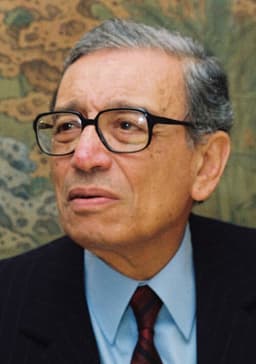
Boutros Boutros-Ghali
Politician · Modern
53.0Total

Napoleon Bonaparte
General · Modern
70.9Total
Basic Information
Born
1922
1769
Died
—
1821
Era
Modern
Modern
Nationality
Egypt
France
Occupation
Politician
General
Civilization
Middle Eastern
Western
Score Comparison
Military (10%)
50.0
94.0
Political (20%)
45.0
72.0
Influence (20%)
55.0
40.0
Legacy (20%)
49.2
80.0
Leadership (15%)
72.0
78.0
Strategy (15%)
44.4
90.0
TOTAL
53.0
70.9
Boutros Boutros-Ghali — Complete Timeline
1992 AD
Elected Secretary-General of the United NationsPolitical Action◆ Major
Boutros Boutros-Ghali became the sixth Secretary-General of the United Nations, the first from Africa. His election came during a period of post-Cold War transition, and he focused on peacekeeping and conflict resolution.
UN Secretary-GeneralPeacekeepingPost-Cold War
Impact: globalconstructive
Published An Agenda for PeacePolitical Action◆ Major
Boutros-Ghali released An Agenda for Peace, a landmark report outlining preventive diplomacy, peacemaking, and peacekeeping strategies. The report influenced UN operations in conflicts like Somalia, Bosnia, and Rwanda.
PeacekeepingUN ReformDiplomacy
Impact: globalconstructive
1994 AD
Oversaw UN peacekeeping in the Rwandan GenocideWar◆ Major
During the Rwandan Genocide, Boutros-Ghali's UN peacekeeping mission failed to prevent the killing of an estimated 800,000 Tutsis and moderate Hutus. The UN's inaction drew widespread criticism and led to calls for reform.
RwandaGenocideUN Failure
Impact: globaltragic
1996 AD
Vetoed by the United States for a second termPolitical Action◆ Major
The United States vetoed Boutros-Ghali's bid for a second term as UN Secretary-General, citing disagreements over UN reform and peacekeeping operations. He was succeeded by Kofi Annan.
UN PoliticsUS VetoLeadership
Impact: globaldestructive
1997 AD
Served as Secretary-General of the FrancophoniePolitical Action
After leaving the UN, Boutros-Ghali became the first Secretary-General of the International Organisation of the Francophonie, promoting French language and cultural cooperation among member states.
FrancophonieCultural DiplomacyPost-UN
Impact: regionalconstructive
Napoleon Bonaparte — Complete Timeline
1799 AD
Coup of 18 BrumaireOther◆ Major
Napoleon Bonaparte, with support from his brother Lucien and key political figures, overthrew the Directory in a bloodless coup. He established the Consulate with himself as First Consul, effectively becoming the ruler of France. This event ended the French Revolution's most unstable period.
French RevolutionCoupRise to Power
Impact: regional
1804 AD
Promulgation of the Napoleonic CodeOther◆ Major
Napoleon enacted the Civil Code of the French, known as the Napoleonic Code, a comprehensive set of laws that replaced the fragmented feudal legal systems. The code established legal equality, protected property rights, and secularized law. It became the basis for legal systems in many European and world countries.
Legal ReformNapoleonic CodeCivil Law
Impact: globalconstructive
1805 AD
Battle of AusterlitzWar◆ Major
Napoleon's Grande Arm
Napoleonic WarsBattleDecisive Victory
Impact: global
1812 AD
Invasion of RussiaWar◆ Major
Napoleon led the Grande Arm
Napoleonic WarsInvasionDisaster
Impact: globaldestructive
1815 AD
Battle of WaterlooWar◆ Major
Napoleon's French army was defeated by the combined forces of the Duke of Wellington's Anglo-Allied army and Gebhard Leberecht von Bl
Napoleonic WarsBattleFinal Defeat
Impact: globaldestructive
Expert Analysis
boutros-boutros-ghali-vs-napoleon-bonaparte
# The General and the Diplomat: Two Lives, Two Visions of Power
In the winter of 1992, as the Cold War ended and a new world order trembled into being, an Egyptian diplomat named Boutros Boutros-Ghali stood before the United Nations General Assembly and called for a bold reimagining of international peacekeeping. Half a continent away and nearly two centuries earlier, a young Corsican artillery officer had stood before the smoldering ruins of Toulon, having just driven the British from the harbor, and begun his own ascent toward an empire. One man commanded armies that reshaped the map of Europe; the other commanded words that sought to reshape the conscience of the world. Both believed they could impose order on chaos. Both were ultimately broken by forces they could not control.
Origins
Napoleon Bonaparte was born in 1769 on the island of Corsica, a place recently annexed by France, into a minor noble family that spoke Italian at home. He was short, intense, and fiercely ambitious in a way that only those who feel they have something to prove can be. The French Revolution, which erupted when he was twenty years old, shattered the old aristocratic order and opened paths that would have been impossible under the Bourbon monarchy. Napoleon seized the moment with both hands, understanding instinctively that in an age of upheaval, a brilliant artilleryman could become a general, and a general could become a king.
Boutros Boutros-Ghali was born in 1922 in Cairo, into a Coptic Christian family with a long tradition of public service. His grandfather had been prime minister of Egypt; his father was a prominent politician and statesman. Where Napoleon was forged in the fire of revolution, Boutros-Ghali was shaped by the careful diplomacy of decolonization. He studied at Cairo University, then at the Sorbonne in Paris, and later at Sciences Po. He was a man of the international elite, fluent in Arabic, French, and English, comfortable in the corridors of power where decisions were made over tea and carefully worded communiqués.
The difference in their origins is not merely biographical; it is the key to understanding everything that followed. Napoleon came from a world where power was taken by force; Boutros-Ghali came from a world where power was negotiated.
Rise to Power
Napoleon’s rise was meteoric, almost mythic. In 1793, at the age of twenty-four, he was promoted to brigadier general after his decisive use of artillery at the Siege of Toulon. By 1796, he was commanding the French Army of Italy, where he won a series of stunning victories that forced Austria to sue for peace. In 1799, he returned from a disastrous campaign in Egypt to find France in political chaos, and in the coup of 18 Brumaire, he seized power as First Consul. By 1804, he had crowned himself Emperor of the French. The entire journey from obscure officer to master of Europe took just over a decade.
Boutros-Ghali’s path was slower, more deliberate. He served as a professor of international law, then as a diplomat for Egypt, eventually becoming Minister of State for Foreign Affairs. In 1992, at the age of seventy, he was elected Secretary-General of the United Nations, the first Arab and African to hold the post. His election was itself a diplomatic triumph, a recognition of the changing balance of power in the post-colonial world. But where Napoleon had seized power through audacity and violence, Boutros-Ghali had been chosen through consensus and compromise.
Leadership & Governance
Napoleon governed with the same energy he brought to war. He reformed French law through the Napoleonic Code, which established legal equality, protected property rights, and secularized the state. He reorganized education, created the Bank of France, and restored relations with the Catholic Church through the Concordat of 1801. His military genius was undeniable: his scores of 94 for military and 93 for strategy reflect a commander who could read a battlefield with an almost supernatural clarity. At Austerlitz in 1805, he destroyed a combined Russian and Austrian army in one of history’s greatest tactical victories.
Boutros-Ghali’s governance was of a different kind. He oversaw UN peacekeeping operations in Somalia, Rwanda, and the Balkans, trying to manage conflicts with the limited tools at his disposal. His 1992 report, *An Agenda for Peace*, was a landmark document that sought to redefine the UN’s role in a post-Cold War world, advocating for preventive diplomacy and peace enforcement. But where Napoleon could command armies, Boutros-Ghali could only persuade member states. His political score of 72 and leadership score of 74 reflect a man who was respected but never truly powerful.
Triumph & Tragedy
Napoleon’s greatest moment was probably Austerlitz, where he achieved the perfect battle. His greatest tragedy was the invasion of Russia in 1812, a catastrophic campaign that destroyed his Grand Army and began his downfall. He was exiled to Elba in 1814, returned to power for the Hundred Days in 1815, and was finally defeated at Waterloo. He died in exile on Saint Helena in 1821, at the age of fifty-one.
Boutros-Ghali’s tragedy was more bureaucratic but no less devastating. During the Rwandan Genocide of 1994, the UN peacekeeping mission he oversaw failed to prevent the killing of an estimated 800,000 people. His warnings went unheeded by the Security Council, particularly the United States, which had been reluctant to intervene after the debacle in Somalia. In 1996, the United States vetoed his bid for a second term as Secretary-General, effectively ending his career. He died in 2016, at the age of ninety-three, remembered as much for his failures as for his vision.
Character & Destiny
Napoleon was driven by an insatiable ambition that bordered on megalomania. He once said, “Power is my mistress. I have worked too hard at her conquest to allow anyone to take her away from me.” This drive made him a conqueror but also a tragic figure, unable to stop even when victory was impossible. Boutros-Ghali was more measured, more cautious, but also more frustrated. He said of his UN tenure, “The world is not governed by justice but by power.” He understood the limits of his position but could not transcend them.
Legacy
Napoleon’s legacy is immense. The Napoleonic Code influenced legal systems across Europe and the world. His military campaigns are studied in war colleges to this day. His scores of 82 for influence and 78 for legacy reflect a man who changed the course of history, even if his empire crumbled.
Boutros-Ghali’s legacy is more ambiguous. His *Agenda for Peace* remains a foundational text for international relations, but his tenure is often remembered for the failures in Rwanda and Bosnia. His score of 72 for influence and 65 for legacy reflect a man who tried to build a better world but was crushed by the realities of power.
Conclusion
What drove these two men? Napoleon believed that history was made by the will of great men, that the world could be remade by force of arms. Boutros-Ghali believed that history was made by institutions, that the world could be remade by law and diplomacy. Both were right, and both were wrong. Napoleon conquered Europe but could not hold it. Boutros-Ghali tried to save the world but could not save his own career. In the end, the general and the diplomat remind us that power, in all its forms, is a fleeting and fragile thing. The question is not whether we can change the world, but whether the world will let us.
Rankings
🥇
Napoleon BonaparteLeader
Mil: 94.0Pol: 72.0Inf: 40.0
70.9
🥈
Boutros Boutros-Ghali
Mil: 50.0Pol: 45.0Inf: 55.0
53.0
+17.9 behind
How This Comparison Works
Algorithm
Each figure is scored on 6 dimensions (0—100 scale) based on structured historical data: Military (10%), Political (20%), Influence (20%), Legacy (20%), Leadership (15%), Strategy (15%). The weighted total produces the final ranking.
Data Sources
Scores are computed from structured sub-indicators in the database. Scale factors adjust for era (Ancient ×0.85, Modern ×1.0) and civilization size (Eastern ×1.05, Other ×0.80) to account for differences in population and military scale.
Maximum 3 Figures
Comparisons are limited to 2—3 figures to ensure readability and statistical meaningfulness.
Error Margins
±5 points per dimension — Sub-scores are derived from historical records with inherent uncertainty. Two figures within 5 points on a dimension should be considered roughly equivalent in that area.
Total Score Accuracy
±3 points overall — The weighted combination of 6 dimensions produces a total score with approximately ±3 points of uncertainty. Differences of less than 3 points are not statistically significant— the figures are effectively tied.
Known Limitations
- Historical records are incomplete and uneven across civilizations
- Figures from oral-tradition societies may be underrepresented
- Occupation labels can misclassify multi-role figures
- Scores measure capability and impact, not moral character
- Quantitative scoring is a comparison tool, not absolute truth
Capability Radar
Military (10%) — Battles & Warfare
Battles
24
95
Win Rate
24
90
Expansion
28
95
Political (20%) — Governance & Reform
Reform
55
95
Diplomacy
85
80
Economy
40
85
Influence (20%) — Cultural & Global Reach
Cultural
40
85
Global
65
90
Legacy (20%) — Historical Impact
Historical
55
95
Longevity
40
90
Leadership (15%) — Power & Stability
Tenure
60
85
Stability
50
70
Strategy (15%) — Tactics & Innovation
Strategy
31
95
Tactics
32
98
Reform
34
92
Similar Comparisons
Comments & Discussion
征服者还是空谈者6/17/2026
拿破仑在1796年意大利战役中,带着三万衣衫褴褛的士兵,两周内连赢六场战役,打垮了奥地利与撒丁王国的联军。而布特罗斯-加利在索马里,两万蓝盔部队连一个军阀都镇不住。这就是实战统帅与纸上外交家的根本区别——一个用胜利说话,一个在用和平奖章做挡箭牌。军队的废墟不会骗人。
DATA_SKEPTIC6/17/2026
The analysis romanticizes both. Napoleon’s “empire” cost Europe over a million lives. Boutros-Ghali’s “new world order” in Rwanda? 800,000 dead while he hesitated to call it genocide. The real comparison isn’t vision—it’s body count. Both had big plans. Both failed the people on the ground. Let’s talk about the numbers, not the myths.
经典学者6/17/2026
仔细想想,这两人对权力的理解实在截然不同。拿破仑在1799年发动雾月政变后,立即编纂《拿破仑法典》,用法律锚定权力。而布特罗斯-加利在世界峰会上提出了《和平议程》,却从未让任何大国真正执行。法律能塑造国家,但空洞的话语只会被大国无视——这是历史最基本的教训,从罗马到联合国从未改变。
REVISIONIST_CRITIC6/17/2026
You’re missing the colonial subtext. Napoleon invaded Egypt in 1798 with scientists and guns. Boutros-Ghali, an Egyptian, became UN Secretary-General and got crushed by American power. One conquered the Orient; the other was its token. The real story is the West using both men to project its dominance, then discarding them. Read the history written by Cairo, not Paris.
历史迷6/17/2026
拿破仑和布特罗斯-加利都是被时代推上舞台的人,但结局却天差地别。1815年滑铁卢后,拿破仑还有流亡地厄尔巴岛可归;而1996年布特罗斯-加利被美国一票否决连任后,连联合国大楼都不愿再进。前一个失败是战场的,后一个失败是政治的——说实话,将军和外交官谁更惨,恐怕后者连枪都没得开就已经输了。
ParchmentProbe6/17/2026
The difference is simple: Napoleon broke borders, Boutros-Ghali tried to fix them. One won at Austerlitz, the other lost in Somalia. They both dreamed of order—but Napoleon understood that order comes from force, not paper. Boutros-Ghali’s UN had no army worth the name, only press releases. That’s why we remember maps drawn by the Little Corporal, not resolutions by the Old Diplomat.