Loading...
Brian Mulroney vs Pavel Milyukov
Brian Mulroney leads by 4.7 pts · 2 figures compared
…
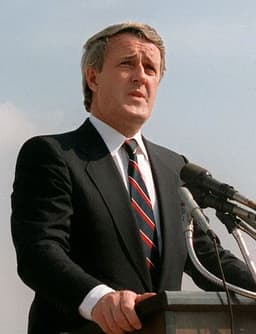
Brian Mulroney
Politician · Modern
60.8Total

Pavel Milyukov
Politician · Modern
56.1Total
Basic Information
Born
1939
1859
Died
—
1943
Era
Modern
Modern
Nationality
Canada
Russia
Occupation
Politician
Politician
Civilization
Western
Western
Score Comparison
Military (10%)
48.4
50.0
Political (20%)
78.0
72.0
Influence (20%)
61.0
55.7
Legacy (20%)
56.0
44.2
Leadership (15%)
72.0
74.0
Strategy (15%)
42.5
42.6
TOTAL
60.8
56.1
Brian Mulroney — Complete Timeline
1988 AD
Negotiation of the Canada-US Free Trade AgreementPolitical Action◆ Major
Mulroney's government negotiated the Canada-US Free Trade Agreement (CUSFTA), which eliminated tariffs and trade barriers between the two countries. The deal was controversial in Canada but passed after a federal election fought largely on the issue.
Free TradeUS-Canada RelationsEconomic Policy
Impact: regionalconstructive
1991 AD
Introduction of the Goods and Services TaxReform◆ Major
Mulroney's government implemented a 7% federal Goods and Services Tax (GST) to replace the hidden Manufacturers' Sales Tax. The GST was deeply unpopular and contributed to the Progressive Conservative Party's electoral collapse in 1993.
Tax ReformGSTFiscal Policy
Impact: nationaldestructive
1992 AD
Signing of the North American Free Trade AgreementPolitical Action◆ Major
Mulroney signed NAFTA alongside US President George H.W. Bush and Mexican President Carlos Salinas de Gortari. The agreement expanded CUSFTA to include Mexico, creating a trilateral trade bloc that reshaped North American commerce.
NAFTATrade BlocNorth America
Impact: regionalconstructive
Pavel Milyukov — Complete Timeline
1907 AD
Leadership of the Constitutional Democratic PartyPolitical Action◆ Major
Milyukov became the leader of the Constitutional Democratic Party (Kadets), the main liberal party in Russia. He advocated for a constitutional monarchy, civil liberties, and parliamentary government. Under his leadership, the Kadets became a major force in the Duma.
KadetsLiberal PartyDuma
Impact: nationalconstructive
1917 AD
Appointment as Foreign MinisterPolitical Action◆ Major
After the February Revolution, Milyukov was appointed Foreign Minister in the Provisional Government. He pursued a policy of continuing the war against the Central Powers and honoring Russia's commitments to the Allies, which became increasingly unpopular.
Foreign MinisterProvisional GovernmentWorld War I
Impact: national
Milyukov NotePolitical Action◆ Major
Milyukov sent a note to the Allies reaffirming Russia's commitment to the war and its war aims, including annexation of the Straits. The note sparked massive protests in Petrograd, leading to the April Crisis and Milyukov's resignation as Foreign Minister.
Milyukov NoteApril CrisisWar Aims
Impact: nationaldestructive
1918 AD
Exile and Anti-Bolshevik ActivitiesPolitical Action
After the Bolshevik takeover, Milyukov fled to the south of Russia and later emigrated to France. He initially supported the White movement but later advocated for a more conciliatory approach toward the Bolsheviks. He continued to write and publish historical works.
ExileWhite MovementEmigration
Impact: national
Expert Analysis
Origins
Brian Mulroney was born in 1939 in Baie-Comeau, Quebec, a remote company town. His father worked as an electrician. Mulroney studied political science at St. Francis Xavier University and later law at Université Laval. He became a labor lawyer and developed connections in the Progressive Conservative Party. He never held elected office before becoming party leader in 1983.
Pavel Milyukov was born in 1859 in St. Petersburg, Russia, into a noble family of modest means. He studied history at Moscow University, earning a doctorate. He became a historian and liberal activist, writing on Russian political thought. He was exiled for his opposition to Tsarism but returned to lead the Constitutional Democratic Party after the 1905 revolution.
Rise to Power
Mulroney entered politics by running for the Progressive Conservative leadership in 1976, losing to Joe Clark. He returned to law but won the leadership in 1983, then a parliamentary seat. In the 1984 election, he led the PCs to a landslide victory, winning 211 of 282 seats, the largest majority in Canadian history. His rise was fueled by his charisma and bilingualism, appealing to Quebec and the West.
Milyukov rose as a leading liberal intellectual. He helped found the Kadet Party in 1905, advocating for constitutional monarchy and civil liberties. He served in the Duma and became the party's leader. After the February Revolution in 1917, he was appointed Foreign Minister in the Provisional Government, a position of great influence despite the chaos.
Leadership & Governance
Mulroney governed with a focus on economic integration with the United States. He negotiated the Canada-US Free Trade Agreement (CUSFTA) in 1988, eliminating tariffs. He then signed NAFTA in 1992, expanding the deal to Mexico. Domestically, he introduced the Goods and Services Tax (GST) in 1991, a 7% value-added tax that replaced a hidden manufacturers' sales tax. The GST was deeply unpopular but improved tax efficiency. He also attempted constitutional reform through the Meech Lake and Charlottetown Accords, both of which failed. His political score of 78.0 reflects his ability to pass major legislation despite opposition.
Milyukov led the Kadets as a liberal opposition in the Duma. As Foreign Minister, he pursued a policy of continuing World War I against Germany, honoring Russia's commitments to the Allies. He sent the 'Milyukov Note' in April 1917, reaffirming Russia's war aims, including annexation of the Turkish Straits. This sparked mass protests (the April Crisis), leading to his resignation. His leadership score of 74.0 shows his principled but rigid approach.
Triumph & Tragedy
Mulroney's greatest triumph was NAFTA, which reshaped North American trade. It increased trade flows and integrated supply chains. His tragedy was the failure of constitutional reform and the deep unpopularity of the GST. His Progressive Conservative Party collapsed in the 1993 election, winning only two seats. His legacy score of 56.0 reflects both his achievements and the electoral disaster.
Milyukov's triumph was leading the Kadets to become the largest liberal party and briefly holding power in 1917. His tragedy was the Milyukov Note, which triggered protests that destabilized the Provisional Government. The Bolsheviks later seized power, and Milyukov fled into exile, where he spent the rest of his life opposing the Soviet regime. His influence score of 55.7 shows his limited long-term impact.
Character & Destiny
Mulroney was a pragmatic dealmaker, comfortable with big business and American leaders. He was criticized for his closeness to US President Ronald Reagan and for his lavish lifestyle. His destiny was to be a transformative but divisive figure: NAFTA and the GST endured, but his party was destroyed. His strategy score of 42.5 suggests his long-term political strategy was flawed.
Milyukov was a principled intellectual, committed to liberal democracy and legalism. He was inflexible, refusing to compromise with socialists or nationalists. His destiny was to be swept away by the Bolsheviks, who rejected his constitutionalism. His military score of 50.0 reflects his inability to manage the war crisis.
Legacy
Mulroney's legacy is NAFTA (now USMCA) and the GST. NAFTA created the world's largest free trade zone, influencing global trade. The GST remains a key revenue source for Canada. He is remembered as a prime minister who modernized Canada's economy but failed politically. His total score of 60.8 places him as a moderately influential leader.
Milyukov's legacy is as a symbol of Russian liberalism that failed. The Kadets were suppressed by the Bolsheviks, and liberal democracy in Russia was crushed for decades. He is remembered by historians as a tragic figure who could not prevent the rise of communism. His total score of 56.1 reflects a lesser historical footprint.
Conclusion
Brian Mulroney had a greater impact than Pavel Milyukov. Mulroney's policies—NAFTA and the GST—reshaped Canada's economy and remain in place. Milyukov's liberal vision was extinguished by the Bolsheviks, leaving no lasting institutional legacy. Mulroney scores 60.8 to Milyukov's 56.1, and the gap widens when considering tangible outcomes. Mulroney changed trade for millions; Milyukov's ideas, while noble, were swept aside by history.
Rankings
🥇
Brian MulroneyLeader
Mil: 48.4Pol: 78.0Inf: 61.0
60.8
🥈
Pavel Milyukov
Mil: 50.0Pol: 72.0Inf: 55.7
56.1
+4.7 behind
How This Comparison Works
Algorithm
Each figure is scored on 6 dimensions (0—100 scale) based on structured historical data: Military (10%), Political (20%), Influence (20%), Legacy (20%), Leadership (15%), Strategy (15%). The weighted total produces the final ranking.
Data Sources
Scores are computed from structured sub-indicators in the database. Scale factors adjust for era (Ancient ×0.85, Modern ×1.0) and civilization size (Eastern ×1.05, Other ×0.80) to account for differences in population and military scale.
Maximum 3 Figures
Comparisons are limited to 2—3 figures to ensure readability and statistical meaningfulness.
Error Margins
±5 points per dimension — Sub-scores are derived from historical records with inherent uncertainty. Two figures within 5 points on a dimension should be considered roughly equivalent in that area.
Total Score Accuracy
±3 points overall — The weighted combination of 6 dimensions produces a total score with approximately ±3 points of uncertainty. Differences of less than 3 points are not statistically significant— the figures are effectively tied.
Known Limitations
- Historical records are incomplete and uneven across civilizations
- Figures from oral-tradition societies may be underrepresented
- Occupation labels can misclassify multi-role figures
- Scores measure capability and impact, not moral character
- Quantitative scoring is a comparison tool, not absolute truth
Capability Radar
Military (10%) — Battles & Warfare
Battles
31
26
Win Rate
32
34
Expansion
36
34
Political (20%) — Governance & Reform
Reform
75
60
Diplomacy
80
55
Economy
75
40
Influence (20%) — Cultural & Global Reach
Cultural
40
30
Global
65
35
Legacy (20%) — Historical Impact
Historical
65
40
Longevity
55
25
Leadership (15%) — Power & Stability
Tenure
65
45
Stability
60
20
Strategy (15%) — Tactics & Innovation
Strategy
38
37
Tactics
39
41
Reform
46
44
Similar Comparisons
Comments & Discussion
No comments yet. Be the first to share your thoughts!