Loading...
Bronislaw Komorowski vs Shigeru Yoshida
Shigeru Yoshida leads by 6.8 pts · 2 figures compared
…
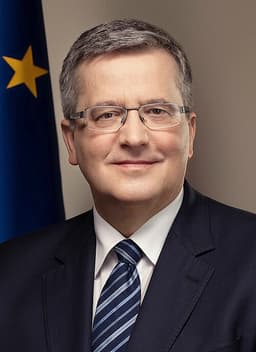
Bronislaw Komorowski
Politician · Modern
49.9Total

Shigeru Yoshida
Politician · Modern
56.7Total
Basic Information
Born
1952
1878
Died
—
1967
Era
Modern
Modern
Nationality
Poland
Japan
Occupation
Politician
Politician
Civilization
Western
Eastern
Score Comparison
Military (10%)
49.4
11.5
Political (20%)
68.0
82.0
Influence (20%)
50.2
56.7
Legacy (20%)
40.0
55.0
Leadership (15%)
53.2
78.0
Strategy (15%)
42.7
36.5
TOTAL
49.9
56.7
Bronislaw Komorowski — Complete Timeline
2009 AD
Signed the Treaty of LisbonPolitical Action◆ Major
As acting president after the Smolensk crash, Komorowski signed the Treaty of Lisbon ratification document on behalf of Poland. This completed Poland's ratification of the EU reform treaty, which had been delayed by the previous president.
European UnionTreaty of LisbonRatification
Impact: regionalconstructive
2010 AD
Elected President of PolandPolitical Action◆ Major
Bronislaw Komorowski was elected President of Poland in a snap election following the death of President Lech Kaczynski in the Smolensk air disaster. He defeated Jaroslaw Kaczynski in the runoff, becoming the second president of the Third Polish Republic.
Presidential ElectionSmolensk AftermathCivic Platform
Impact: national
2015 AD
Lost Re-election to Andrzej DudaPolitical Action◆ Major
Komorowski lost the presidential election to Andrzej Duda of the Law and Justice party. Duda won in the first round with 51.5% of the vote, marking a shift in Polish politics towards the conservative PiS.
Presidential ElectionDefeatPiS Victory
Impact: nationaltragic
2016 AD
Vetoed the Media LawPolitical Action
Komorowski vetoed a law that would have given the government more control over public media appointments. The veto was overridden by the Law and Justice (PiS) majority in parliament, leading to increased political polarization.
Media LawVetoPolitical Conflict
Impact: national
Shigeru Yoshida — Complete Timeline
1946 AD
Appointed Prime Minister of JapanPolitical Action◆ Major
Shigeru Yoshida became Prime Minister of Japan on May 22, 1946, during the Allied occupation. He succeeded Kijuro Shidehara and led Japan through post-war reconstruction. Yoshida's government focused on economic recovery, land reform, and drafting a new constitution under U.S. supervision.
Prime MinisterOccupationJapan
Impact: national
1950 AD
Implemented the Yoshida DoctrinePolitical Action
Yoshida articulated the Yoshida Doctrine, prioritizing Japan's economic recovery and reliance on U.S. security guarantees while maintaining a minimal military. This policy guided Japan's post-war strategy, leading to rapid economic growth and a low-profile international role. It was formalized during his tenure.
Yoshida DoctrineEconomic PolicySecurity
Impact: globalconstructive
1951 AD
Signed the Treaty of San FranciscoPolitical Action
Yoshida signed the Treaty of San Francisco on September 8, 1951, formally ending the state of war between Japan and the Allied powers. The treaty restored Japan's sovereignty and allowed it to rejoin the international community. It was a cornerstone of Yoshida's foreign policy.
Treaty of San FranciscoPost-WarSovereignty
Impact: globalconstructive
Signed the U.S.-Japan Security TreatyPolitical Action◆ Major
Yoshida signed the U.S.-Japan Security Treaty on September 8, 1951, alongside the Treaty of San Francisco. The treaty allowed U.S. military bases in Japan and committed the U.S. to Japan's defense. It was controversial domestically but formed the basis of Japan's post-war security policy.
Security TreatyU.S.-JapanAlliance
Impact: regional
Expert Analysis
Origins
Bronislaw Komorowski was born on June 4, 1952, in Oborniki Śląskie, Poland. He studied history at the University of Warsaw, graduating in 1977. His family had aristocratic roots, and his father was a professor. Komorowski became involved in the democratic opposition, working with the Workers' Defence Committee and Solidarity. During martial law in 1981, he was interned for several months. This background shaped his commitment to democratic governance and European integration.
Shigeru Yoshida was born on September 22, 1878, in Kōchi, Japan, into a samurai family. He studied law at Tokyo Imperial University, graduating in 1906. Yoshida entered the diplomatic service, serving in China, Italy, and the United Kingdom. His experience as a diplomat during the prewar period gave him a deep understanding of international relations. He was briefly imprisoned in 1945 for his opposition to the militarist regime, which later enhanced his credibility with the Allied occupation authorities.
Rise to Power
Komorowski rose to prominence as a Solidarity activist and later as a member of the Democratic Union party. He served as Minister of Defence from 2000 to 2001 under Prime Minister Jerzy Buzek. In 2007, he became Marshal of the Sejm (Speaker of Parliament). Following the Smolensk air disaster on April 10, 2010, which killed President Lech Kaczyński, Komorowski assumed acting presidency. He won the subsequent snap presidential election in July 2010 with 53% of the vote against Jarosław Kaczyński.
Yoshida's rise came after World War II. He served as Foreign Minister in the Shidehara cabinet in 1945 and became Prime Minister on May 22, 1946, during the Allied occupation. His diplomatic skills and pro-Western stance made him acceptable to General Douglas MacArthur. Yoshida led Japan through the critical early postwar years, focusing on economic recovery and securing a peace treaty. He served as prime minister for over seven years across two terms (1946-1947 and 1948-1954).
Leadership & Governance
Komorowski's leadership style was moderate and consensus-oriented. As president, he focused on European integration and maintaining good relations with Germany and Russia. He signed the Treaty of Lisbon ratification on behalf of Poland in 2009 as acting president, completing Poland's ratification. However, his governance was often constrained by the parliamentary system and the dominant Law and Justice party. He vetoed a media law in 2015 that would have increased government control over public media, but the veto was overridden. His political score of 68.0 reflects his ability to navigate a polarized environment.
Yoshida's leadership was decisive and pragmatic. He implemented the Yoshida Doctrine, prioritizing economic reconstruction over military spending, relying on the U.S. for security. This strategy allowed Japan to focus resources on industrial growth. He signed the Treaty of San Francisco in 1951, ending the state of war with the Allies, and the U.S.-Japan Security Treaty, establishing a long-term alliance. His political score of 82.0 indicates his effectiveness in shaping postwar Japan's direction. Yoshida's governance style was top-down, but he built strong institutions that endured.
Triumph & Tragedy
Komorowski's greatest success was overseeing Poland's stable transition after the Smolensk tragedy and maintaining democratic continuity. He also strengthened Poland's role in the EU. However, his defeat in the 2015 election to Andrzej Duda was a significant failure, as he lost in the first round with only 48.8% of the vote, partly due to perceived aloofness and failure to connect with rural voters. His military score of 49.4 and strategy score of 42.7 suggest limited impact in defense matters.
Yoshida's triumphs include the San Francisco Peace Treaty and the Yoshida Doctrine, which laid the foundation for Japan's economic miracle. He also secured Japan's alliance with the U.S., ensuring security. However, his failure was the inability to prevent the Korean War from causing inflation, and his heavy reliance on the U.S. limited Japan's independent foreign policy. His military score of 11.5 reflects Japan's demilitarization under his watch, while his strategy score of 36.5 indicates a narrow focus on economic goals.
Character & Destiny
Komorowski was seen as a pragmatic, cautious leader, but his reserved personality sometimes came across as detached. His decision-making was methodical, yet he struggled to counter the populist tide of Law and Justice. His character, shaped by the Solidarity movement, emphasized democratic values but lacked the charisma to inspire mass support. This contributed to his electoral defeat.
Yoshida was known for his sharp intellect, diplomatic finesse, and stubbornness. He was nicknamed "One-Man Yoshida" for his dominant leadership style. His character was suited for the postwar era, where strong, pro-Western leadership was needed to rebuild Japan. His destiny was to be the architect of Japan's postwar recovery, but his refusal to adopt a more independent stance left a legacy of reliance on the U.S.
Legacy
Komorowski's legacy is mixed. He is remembered as a caretaker president who upheld democratic norms but failed to adapt to changing political currents. His signing of the Lisbon Treaty and veto of media law are notable. However, his influence on Poland's long-term direction is limited, reflected in his legacy score of 40.0. He scored 50.2 in influence, indicating moderate impact.
Yoshida's legacy is profound. The Yoshida Doctrine guided Japan's economic resurgence and shaped its postwar identity. The U.S.-Japan alliance remains central to Japanese security. His influence score of 56.7 and legacy score of 55.0 reflect his lasting impact. He is considered one of Japan's most consequential prime ministers.
Conclusion
Shigeru Yoshida had a greater impact than Bronislaw Komorowski. Yoshida's total score of 56.7 versus Komorowski's 49.9 reflects his superior political leadership (82.0 vs 68.0) and influence (56.7 vs 50.2). While Komorowski maintained stability in a difficult transition, Yoshida fundamentally reshaped Japan's trajectory, setting it on a path to becoming an economic superpower. His doctrine and treaties had global significance, whereas Komorowski's influence was largely confined to Poland's domestic sphere. Thus, Yoshida's historical impact is clearly larger.
Rankings
🥇
Shigeru YoshidaLeader
Mil: 11.5Pol: 82.0Inf: 56.7
56.7
🥈
Bronislaw Komorowski
Mil: 49.4Pol: 68.0Inf: 50.2
49.9
+6.8 behind
How This Comparison Works
Algorithm
Each figure is scored on 6 dimensions (0—100 scale) based on structured historical data: Military (10%), Political (20%), Influence (20%), Legacy (20%), Leadership (15%), Strategy (15%). The weighted total produces the final ranking.
Data Sources
Scores are computed from structured sub-indicators in the database. Scale factors adjust for era (Ancient ×0.85, Modern ×1.0) and civilization size (Eastern ×1.05, Other ×0.80) to account for differences in population and military scale.
Maximum 3 Figures
Comparisons are limited to 2—3 figures to ensure readability and statistical meaningfulness.
Error Margins
±5 points per dimension — Sub-scores are derived from historical records with inherent uncertainty. Two figures within 5 points on a dimension should be considered roughly equivalent in that area.
Total Score Accuracy
±3 points overall — The weighted combination of 6 dimensions produces a total score with approximately ±3 points of uncertainty. Differences of less than 3 points are not statistically significant— the figures are effectively tied.
Known Limitations
- Historical records are incomplete and uneven across civilizations
- Figures from oral-tradition societies may be underrepresented
- Occupation labels can misclassify multi-role figures
- Scores measure capability and impact, not moral character
- Quantitative scoring is a comparison tool, not absolute truth
Capability Radar
Military (10%) — Battles & Warfare
Battles
30
17
Win Rate
30
20
Expansion
37
19
Political (20%) — Governance & Reform
Reform
40
85
Diplomacy
50
90
Economy
45
80
Influence (20%) — Cultural & Global Reach
Cultural
20
50
Global
20
65
Legacy (20%) — Historical Impact
Historical
25
70
Longevity
15
60
Leadership (15%) — Power & Stability
Tenure
55
75
Stability
45
85
Strategy (15%) — Tactics & Innovation
Strategy
40
21
Tactics
40
27
Reform
43
27
Similar Comparisons
Comments & Discussion
No comments yet. Be the first to share your thoughts!