Loading...
Shigeru Yoshida vs Vincent Auriol
Shigeru Yoshida leads by 0.9 pts · 2 figures compared
…

Shigeru Yoshida
Politician · Modern
56.7Total
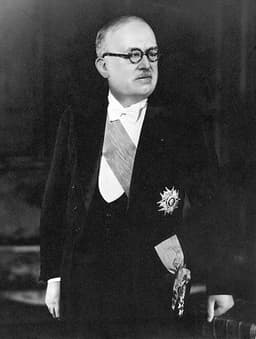
Vincent Auriol
Politician · Modern
55.8Total
Basic Information
Born
1878
1884
Died
1967
1966
Era
Modern
Modern
Nationality
Japan
France
Occupation
Politician
Politician
Civilization
Eastern
Western
Score Comparison
Military (10%)
11.5
49.6
Political (20%)
82.0
60.0
Influence (20%)
56.7
55.7
Legacy (20%)
55.0
46.7
Leadership (15%)
78.0
79.8
Strategy (15%)
36.5
43.0
TOTAL
56.7
55.8
Shigeru Yoshida — Complete Timeline
1946 AD
Appointed Prime Minister of JapanPolitical Action◆ Major
Shigeru Yoshida became Prime Minister of Japan on May 22, 1946, during the Allied occupation. He succeeded Kijuro Shidehara and led Japan through post-war reconstruction. Yoshida's government focused on economic recovery, land reform, and drafting a new constitution under U.S. supervision.
Prime MinisterOccupationJapan
Impact: national
1950 AD
Implemented the Yoshida DoctrinePolitical Action
Yoshida articulated the Yoshida Doctrine, prioritizing Japan's economic recovery and reliance on U.S. security guarantees while maintaining a minimal military. This policy guided Japan's post-war strategy, leading to rapid economic growth and a low-profile international role. It was formalized during his tenure.
Yoshida DoctrineEconomic PolicySecurity
Impact: globalconstructive
1951 AD
Signed the Treaty of San FranciscoPolitical Action
Yoshida signed the Treaty of San Francisco on September 8, 1951, formally ending the state of war between Japan and the Allied powers. The treaty restored Japan's sovereignty and allowed it to rejoin the international community. It was a cornerstone of Yoshida's foreign policy.
Treaty of San FranciscoPost-WarSovereignty
Impact: globalconstructive
Signed the U.S.-Japan Security TreatyPolitical Action◆ Major
Yoshida signed the U.S.-Japan Security Treaty on September 8, 1951, alongside the Treaty of San Francisco. The treaty allowed U.S. military bases in Japan and committed the U.S. to Japan's defense. It was controversial domestically but formed the basis of Japan's post-war security policy.
Security TreatyU.S.-JapanAlliance
Impact: regional
Vincent Auriol — Complete Timeline
1936 AD
Served as Minister of FinancePolitical Action
Auriol served as Minister of Finance in the Popular Front government of L
Popular FrontLabor Reforms
Impact: nationalprogressive
1947 AD
Elected President of FrancePolitical Action◆ Major
Vincent Auriol was elected the first President of the Fourth French Republic, serving from 1947 to 1954. His presidency oversaw post-war reconstruction, the beginning of the Cold War, and the early stages of decolonization.
PresidencyFourth Republic
Impact: nationalconstructive
1951 AD
Presided over the Creation of the European Coal and Steel CommunityPolitical Action◆ Major
As president, Auriol supported the Schuman Plan and the Treaty of Paris (1951), which established the European Coal and Steel Community, a key step toward European integration.
European Integration
Impact: regionalconstructive
Expert Analysis
Origins
Shigeru Yoshida was born on September 22, 1878, in Tokyo, Japan, into a samurai-class family. He studied at the Imperial University of Tokyo and entered the diplomatic service in 1906. His early career included postings in China and Italy, shaping his pragmatic view of international relations. Vincent Auriol was born on August 27, 1884, in Revel, France, to a modest family. He studied law at the University of Toulouse and became a socialist politician. Auriol was a deputy in the French National Assembly from 1914 and served as Minister of Finance in the Popular Front government of Léon Blum in 1936.
Rise to Power
Yoshida rose to prominence during the Allied occupation of Japan. After serving as foreign minister, he became Prime Minister on May 22, 1946, succeeding Kijuro Shidehara. His close relationship with General Douglas MacArthur, the Supreme Commander for the Allied Powers, was crucial. Yoshida's diplomatic skills helped him navigate the occupation and secure a favorable peace settlement. Auriol's rise was marked by his role in the French Resistance during World War II. After the war, he was elected President of the Provisional Government and then became the first President of the Fourth French Republic on January 16, 1947. His election came after the adoption of the new constitution.
Leadership & Governance
Yoshida's leadership style was pragmatic and focused on economic recovery. He implemented the Yoshida Doctrine, which prioritized Japan's economic growth while relying on the United States for security. He signed the U.S.-Japan Security Treaty on September 8, 1951, allowing American military bases in Japan. His governance led to rapid economic growth, with Japan's GDP increasing by an average of 9% per year during his tenure. Auriol's leadership was more political and symbolic. As president, he supported the Schuman Plan, leading to the Treaty of Paris in 1951 that established the European Coal and Steel Community (ECSC). He also faced challenges such as the French war in Indochina and political instability. Auriol's political score of 60.0 reflects his role in guiding France through the early Cold War.
Triumph & Tragedy
Yoshida's greatest triumph was the signing of the Treaty of San Francisco on September 8, 1951, which formally ended the state of war with the Allies and restored Japan's sovereignty. His economic policies laid the foundation for Japan's post-war miracle. However, his reliance on the U.S. security umbrella limited Japan's independent foreign policy, and his conservative domestic policies faced criticism from the left. Auriol's triumph was his role in launching European integration through the ECSC, a key step toward the European Union. His tragedy was the failure to prevent the collapse of the Fourth Republic, which ended in 1958 due to the Algerian crisis. Auriol's leadership score of 79.8 indicates his effectiveness, but his legacy score of 46.7 reflects the short-lived nature of the Fourth Republic.
Character & Destiny
Yoshida was known for his pragmatism, intelligence, and stubbornness. He often clashed with other Japanese politicians but maintained a clear vision for Japan's future. His character shaped his destiny as the architect of Japan's post-war recovery. Auriol was a committed socialist and a skilled politician, but his presidency was constrained by the weak constitutional framework of the Fourth Republic. His character led him to support European unity, but he could not overcome the political instability that plagued France.
Legacy
Yoshida's legacy is immense in Japan. The Yoshida Doctrine influenced Japanese foreign policy for decades, and his economic policies set the stage for Japan's rise as an economic superpower. His influence score of 56.7 reflects his enduring impact. Auriol's legacy is tied to the early European integration. The ECSC evolved into the European Union, making him a founding figure. However, his personal legacy is overshadowed by later leaders. His total score of 55.8 is slightly lower than Yoshida's 56.7.
Conclusion
Shigeru Yoshida had a greater impact than Vincent Auriol. Yoshida's score of 56.7 edges Auriol's 55.8, but the difference is more than numerical. Yoshida's policies directly transformed Japan from a defeated nation into a global economic power, while Auriol's contributions, though significant, were part of a broader European movement. Yoshida's strategic focus on economic recovery and security alignment with the U.S. created a durable framework for Japan's success, whereas Auriol's Fourth Republic was short-lived and unstable. Thus, Yoshida's leadership and legacy are more substantial in shaping the modern world.
Rankings
🥇
Shigeru YoshidaLeader
Mil: 11.5Pol: 82.0Inf: 56.7
56.7
🥈
Vincent Auriol
Mil: 49.6Pol: 60.0Inf: 55.7
55.8
+0.9 behind
How This Comparison Works
Algorithm
Each figure is scored on 6 dimensions (0—100 scale) based on structured historical data: Military (10%), Political (20%), Influence (20%), Legacy (20%), Leadership (15%), Strategy (15%). The weighted total produces the final ranking.
Data Sources
Scores are computed from structured sub-indicators in the database. Scale factors adjust for era (Ancient ×0.85, Modern ×1.0) and civilization size (Eastern ×1.05, Other ×0.80) to account for differences in population and military scale.
Maximum 3 Figures
Comparisons are limited to 2—3 figures to ensure readability and statistical meaningfulness.
Error Margins
±5 points per dimension — Sub-scores are derived from historical records with inherent uncertainty. Two figures within 5 points on a dimension should be considered roughly equivalent in that area.
Total Score Accuracy
±3 points overall — The weighted combination of 6 dimensions produces a total score with approximately ±3 points of uncertainty. Differences of less than 3 points are not statistically significant— the figures are effectively tied.
Known Limitations
- Historical records are incomplete and uneven across civilizations
- Figures from oral-tradition societies may be underrepresented
- Occupation labels can misclassify multi-role figures
- Scores measure capability and impact, not moral character
- Quantitative scoring is a comparison tool, not absolute truth
Capability Radar
Military (10%) — Battles & Warfare
Battles
17
29
Win Rate
20
31
Expansion
19
36
Political (20%) — Governance & Reform
Reform
85
55
Diplomacy
90
60
Economy
80
50
Influence (20%) — Cultural & Global Reach
Cultural
50
30
Global
65
35
Legacy (20%) — Historical Impact
Historical
70
40
Longevity
60
30
Leadership (15%) — Power & Stability
Tenure
75
65
Stability
85
45
Strategy (15%) — Tactics & Innovation
Strategy
21
36
Tactics
27
41
Reform
27
47
Similar Comparisons
Comments & Discussion
No comments yet. Be the first to share your thoughts!