Loading...
Bruno Kreisky vs Zhang Jian
Bruno Kreisky leads by 12.3 pts · 2 figures compared
…
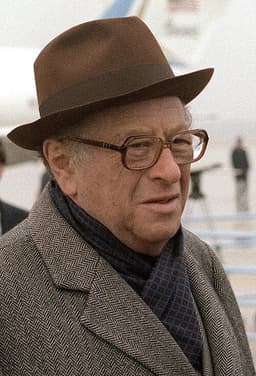
Bruno Kreisky
Politician · Modern
61.7Total

Zhang Jian
Politician · Modern
49.4Total
Basic Information
Born
1911
1853
Died
1990
1926
Era
Modern
Modern
Nationality
Austria
China
Occupation
Politician
Politician
Civilization
Western
Eastern
Score Comparison
Military (10%)
49.6
10.4
Political (20%)
78.0
60.0
Influence (20%)
56.7
68.0
Legacy (20%)
58.0
40.0
Leadership (15%)
80.0
65.0
Strategy (15%)
43.4
26.0
TOTAL
61.7
49.4
Bruno Kreisky — Complete Timeline
1970 AD
Election as Chancellor of AustriaPolitical Action◆ Major
Kreisky became chancellor on April 21, 1970, after leading the Social Democratic Party to a plurality in the national elections. He formed a minority government, later securing a majority in 1971. His chancellorship lasted until 1983, the longest continuous tenure in Austrian history.
ElectionSocial DemocracyLong Tenure
Impact: nationalconstructive
1971 AD
Enactment of the Kreisky reformsReform◆ Major
Kreisky's government implemented a series of social reforms, including the introduction of the 40-hour work week, expanded social security benefits, and the legalization of abortion during the first trimester. These reforms modernized Austrian social policy and expanded the welfare state.
Social ReformWelfare StateModernization
Impact: nationalprogressive
1975 AD
Promotion of Austrian neutrality and mediationPolitical Action◆ Major
Kreisky actively promoted Austria's role as a neutral mediator in international conflicts. He hosted the 1975 Helsinki Accords follow-up meetings and offered Vienna as a venue for US-Soviet arms control talks. His policy strengthened Austria's international standing as a bridge between East and West.
NeutralityDiplomacyCold War
Impact: globalconstructive
1983 AD
Resignation as ChancellorPolitical Action◆ Major
After the Social Democratic Party lost its absolute majority in the 1983 elections, Kreisky resigned as chancellor on April 24, 1983. He had led the government for 13 years, overseeing a period of economic growth and social reform, but his later years were marked by controversy over his dealings with Middle Eastern leaders.
ResignationEnd of EraPolitical Transition
Impact: national
Zhang Jian — Complete Timeline
1895 AD
Founded the Dasheng Cotton MillInvention◆ Major
Zhang Jian established the Dasheng Cotton Mill in Nantong, one of China's first modern industrial enterprises. This venture pioneered Chinese capitalist industry and became a model for later industrial development.
IndustrializationCotton IndustryCapitalism
Impact: nationalconstructive
1903 AD
Created the Nantong Model of Urban DevelopmentReform◆ Major
Zhang Jian implemented comprehensive urban planning in Nantong, building schools, museums, libraries, and hospitals. This integrated approach to social and economic development became known as the Nantong Model.
Urban PlanningEducationPhilanthropy
Impact: regionalconstructive
1912 AD
Established Nantong UniversityCultural
Zhang Jian founded Nantong University (later merged into other institutions), one of China's earliest modern universities. It focused on practical education in agriculture, textiles, and medicine.
EducationUniversityModernization
Impact: regionalconstructive
1913 AD
Served as Minister of Agriculture, Commerce, and IndustryPolitical Action
Zhang Jian served in the Beiyang government as Minister of Agriculture, Commerce, and Industry. He drafted laws to promote private enterprise and modernize China's economy, though political instability limited implementation.
Government ServiceEconomic Reform
Impact: nationalconstructive
Expert Analysis
Origins
Bruno Kreisky was born on January 22, 1911, in Vienna, Austria, into a Jewish family. His father was a textile manufacturer. Kreisky studied law at the University of Vienna, but his education was interrupted by the rise of fascism. He was arrested in 1938 and later emigrated to Sweden, where he worked as a journalist and political activist. This exile shaped his commitment to democracy and neutrality.
Zhang Jian was born on July 1, 1853, in Haimen, Jiangsu, China, into a scholarly family. He passed the imperial civil service examinations at the highest level, earning the title of zhuangyuan (top scholar) in 1894. However, disillusioned with the Qing court's corruption, he turned to industrial and educational reform. His background as a traditional scholar gave him unique credibility and connections.
Rise to Power
Kreisky returned to Austria after World War II and joined the Social Democratic Party. He served as State Secretary in the Foreign Ministry (1953-1959) and then as Foreign Minister (1959-1966). His diplomatic skills and advocacy for neutrality earned him recognition. In 1967, he became chairman of the SPÖ. After the 1970 election, Kreisky formed a minority government and became Chancellor on April 21, 1970. He consolidated power through social reforms and international mediation.
Zhang Jian's rise was unconventional. After his examination success, he became a secretary in the Grand Secretariat but quickly left to pursue local development. He petitioned the Qing government to allow private enterprise and established the Dasheng Cotton Mill in 1895. His success attracted support from reformers like Zhang Zhidong. He later served as Minister of Agriculture, Commerce, and Industry under the Beiyang government (1913-1915), but his influence was primarily local, centered on Nantong.
Leadership & Governance
Kreisky's leadership style was pragmatic and consensus-oriented. As Chancellor from 1970 to 1983, he implemented the 'Kreisky reforms': a 40-hour work week, expanded social security, and liberalization of family law. He scored 80.0 in leadership and 78.0 in political influence. His governance emphasized neutrality, hosting international conferences like the Helsinki follow-up meetings. He also pursued a policy of 'active neutrality', mediating between East and West. However, his economic policies led to rising public debt, scoring only 49.6 in military (reflecting limited defense spending).
Zhang Jian's governance was rooted in local experimentation. He created the 'Nantong Model', integrating industry, education, and social welfare. He founded schools, a museum, a library, and a hospital, all funded by his industrial profits. His leadership score of 65.0 reflects his pragmatic, bottom-up approach. As Minister, he drafted laws promoting private enterprise but faced bureaucratic resistance. His strategy score of 26.0 indicates limited national impact; his influence was concentrated in Nantong.
Triumph & Tragedy
Kreisky's greatest triumph was maintaining Austria's neutrality and prosperity during the Cold War. He successfully mediated between superpowers and hosted the 1979 SALT II talks. His social reforms improved living standards. However, his tragedy was the 1983 election loss after the SPÖ lost its absolute majority, partly due to economic stagnation and a scandal involving his deputy. His legacy score of 58.0 reflects mixed long-term impact.
Zhang Jian's triumph was establishing China's first modern cotton mill and creating a self-sufficient urban model. His industrial ventures pioneered Chinese capitalism. However, his tragedy was the failure to scale his model nationally. After his death in 1926, his enterprises declined due to war and political instability. His legacy score of 40.0 indicates limited endurance, though his educational institutions survived.
Character & Destiny
Kreisky was charismatic, intellectual, and diplomatic. He scored 80.0 in leadership, reflecting his ability to build consensus. His Jewish background and exile made him a staunch defender of human rights. His destiny was shaped by Austria's neutral position; he became a global mediator. However, his reliance on international diplomacy sometimes overshadowed domestic issues.
Zhang Jian was a Confucian scholar with a capitalist vision. His score of 65.0 in leadership reflects his local effectiveness but national limitations. He was idealistic but practical, believing in gradual reform. His destiny was constrained by China's turbulent transition from empire to republic. His failure to influence national policy limited his overall impact.
Legacy
Kreisky's legacy is the model of Austrian neutrality and the welfare state. He scored 56.7 in influence and 58.0 in legacy. His reforms shaped Austrian society for decades. However, his economic policies are criticized for creating debt. Internationally, he is remembered as a mediator.
Zhang Jian's legacy is as the 'father of Chinese modern industry'. His Nantong Model influenced later urban development. He scored 68.0 in influence (high for local impact) but 40.0 in legacy (limited national endurance). His educational institutions, like Nantong University, persisted, but his industrial empire collapsed.
Conclusion
Bruno Kreisky had a greater overall impact, with a total score of 61.7 compared to Zhang Jian's 49.4. Kreisky's political and leadership scores (78.0 and 80.0) significantly outpaced Zhang's (60.0 and 65.0). While Zhang pioneered industrial development, his influence remained local and short-lived. Kreisky shaped a nation's policy of neutrality and social welfare for decades, with lasting international relevance. The 12.3-point gap reflects Kreisky's broader, more sustained influence. Zhang's contributions were important but ultimately less transformative on a global scale.
Rankings
🥇
Bruno KreiskyLeader
Mil: 49.6Pol: 78.0Inf: 56.7
61.7
🥈
Zhang Jian
Mil: 10.4Pol: 60.0Inf: 68.0
49.4
+12.3 behind
How This Comparison Works
Algorithm
Each figure is scored on 6 dimensions (0—100 scale) based on structured historical data: Military (10%), Political (20%), Influence (20%), Legacy (20%), Leadership (15%), Strategy (15%). The weighted total produces the final ranking.
Data Sources
Scores are computed from structured sub-indicators in the database. Scale factors adjust for era (Ancient ×0.85, Modern ×1.0) and civilization size (Eastern ×1.05, Other ×0.80) to account for differences in population and military scale.
Maximum 3 Figures
Comparisons are limited to 2—3 figures to ensure readability and statistical meaningfulness.
Error Margins
±5 points per dimension — Sub-scores are derived from historical records with inherent uncertainty. Two figures within 5 points on a dimension should be considered roughly equivalent in that area.
Total Score Accuracy
±3 points overall — The weighted combination of 6 dimensions produces a total score with approximately ±3 points of uncertainty. Differences of less than 3 points are not statistically significant— the figures are effectively tied.
Known Limitations
- Historical records are incomplete and uneven across civilizations
- Figures from oral-tradition societies may be underrepresented
- Occupation labels can misclassify multi-role figures
- Scores measure capability and impact, not moral character
- Quantitative scoring is a comparison tool, not absolute truth
Capability Radar
Military (10%) — Battles & Warfare
Battles
29
15
Win Rate
34
20
Expansion
33
20
Political (20%) — Governance & Reform
Reform
70
70
Diplomacy
85
40
Economy
72
85
Influence (20%) — Cultural & Global Reach
Cultural
55
60
Global
60
55
Legacy (20%) — Historical Impact
Historical
65
70
Longevity
60
65
Leadership (15%) — Power & Stability
Tenure
75
30
Stability
80
50
Strategy (15%) — Tactics & Innovation
Strategy
39
24
Tactics
42
25
Reform
44
32
Similar Comparisons
Comments & Discussion
No comments yet. Be the first to share your thoughts!