Loading...
Bulent Ecevit vs Gerhard Schroder
Gerhard Schroder leads by 4.3 pts · 2 figures compared
…
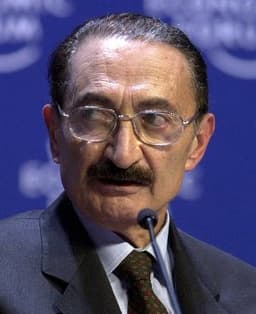
Bulent Ecevit
Politician · Modern
54.3Total

Gerhard Schroder
Politician · Modern
58.6Total
Basic Information
Born
1925
1944
Died
—
—
Era
Modern
Modern
Nationality
Turkey
Germany
Occupation
Politician
Politician
Civilization
Middle Eastern
Western
Score Comparison
Military (10%)
47.5
49.6
Political (20%)
68.0
70.0
Influence (20%)
60.0
60.0
Legacy (20%)
50.0
52.0
Leadership (15%)
53.2
72.0
Strategy (15%)
38.3
43.1
TOTAL
54.3
58.6
Bulent Ecevit — Complete Timeline
1974 AD
Ordered the Cyprus InvasionWar
Ecevit ordered the Turkish military invasion of Cyprus following a Greek-backed coup on the island. The invasion led to the partition of Cyprus and the establishment of the Turkish Republic of Northern Cyprus.
Cyprus InvasionMilitary ActionPartition
Impact: regionaldestructive
First Term as Prime Minister of TurkeyPolitical Action◆ Major
Bulent Ecevit became Prime Minister of Turkey for the first time, leading a coalition government of the Republican People's Party (CHP). He served as prime minister four times between 1974 and 1999.
Prime MinisterRepublican People's PartyCoalition
Impact: nationalconstructive
1980 AD
Ousted by the 1980 Military CoupPolitical Action◆ Major
The Turkish military coup overthrew Ecevit's government. He was arrested and banned from politics for a decade, along with other party leaders.
Military CoupArrestPolitical Ban
Impact: nationaldestructive
1999 AD
Return to Politics and Fourth Term as Prime MinisterPolitical Action◆ Major
Ecevit returned as prime minister after the 1999 elections, leading a coalition government. His term was marked by economic crisis and the capture of PKK leader Abdullah Ocalan.
Return to PoliticsCoalitionEconomic Crisis
Impact: national
Capture of Abdullah OcalanPolitical Action◆ Major
Under Ecevit's government, Turkish authorities captured Abdullah Ocalan, leader of the Kurdistan Workers' Party (PKK), in Kenya. Ocalan's capture led to a ceasefire and reduced violence.
PKKAbdullah OcalanCounterterrorism
Impact: nationalconstructive
Gerhard Schroder — Complete Timeline
2003 AD
Implementation of Agenda 2010 ReformsReform
Schroder's government enacted the Agenda 2010 package of labor market and welfare reforms, which cut unemployment benefits, deregulated the labor market, and reduced the power of unions. The reforms were credited with later reducing unemployment but were deeply unpopular with the SPD's base.
Labor ReformWelfare StateHartz Reforms
Impact: nationaldestructive
Opposition to the Iraq WarPolitical Action◆ Major
Schroder firmly opposed the US-led invasion of Iraq, refusing to commit German troops even if a UN mandate was obtained. This stance was popular in Germany but strained relations with the US, particularly with President George W. Bush.
Iraq WarForeign PolicyUS-Germany Relations
Impact: globalconstructive
2005 AD
Loss of Confidence Vote and Early ElectionPolitical Action◆ Major
Schroder deliberately lost a confidence vote in the Bundestag to trigger early federal elections after his SPD lost a key state election. The gambit backfired as the CDU/CSU won the most seats, leading to a grand coalition under Angela Merkel and Schroder's departure.
Confidence VoteElectionPolitical Strategy
Impact: nationaldestructive
Expert Analysis
Origins
Bülent Ecevit was born on May 28, 1925, in Istanbul, Turkey, into a political family. His father was a professor and a member of parliament. Ecevit studied at Robert College and later at the School of Language, History and Geography in Ankara. He began his career as a journalist and poet before entering politics in the 1950s as a member of the Republican People's Party (CHP). He was influenced by left-wing nationalism and social democracy.
Gerhard Schröder was born on April 7, 1944, in Mossenberg, Germany, to a working-class family. His father died in World War II, and his mother worked as a cleaner. Schröder rose from humble beginnings, apprenticing as a retail salesman before earning his Abitur and studying law at the University of Göttingen. He joined the Social Democratic Party (SPD) in 1963 and became a lawyer, representing left-wing activists.
Rise to Power
Ecevit rose to prominence in the CHP as a reformist. He became party leader in 1972 after defeating the old guard. In 1973, he led the CHP to victory in the general election, becoming Prime Minister of Turkey for the first time in January 1974. His rise was marked by a shift toward social democracy and a more assertive foreign policy.
Schröder's political ascent began as a member of the Bundestag in 1980. He became Minister-President of Lower Saxony in 1990, a position he held until 1998. His pragmatic leadership and centrist policies helped him secure the SPD's nomination for Chancellor. In the 1998 federal election, Schröder defeated Helmut Kohl, becoming Chancellor of Germany.
Leadership & Governance
Ecevit's leadership style was intellectual and principled but often rigid. As Prime Minister, he pursued land reforms, industrialization, and a more independent foreign policy. His most decisive act was ordering the Cyprus invasion in July 1974, which led to the partition of the island. Domestically, his coalition government struggled with economic instability and political violence. During his fourth term (1999-2002), he faced a severe economic crisis and implemented IMF-backed austerity measures, but his popularity waned.
Schröder governed with a pragmatic, centrist approach. His signature achievement was Agenda 2010, a set of labor market and welfare reforms that reduced unemployment benefits and deregulated the economy. These reforms were controversial within his own party but are credited with revitalizing the German economy. Schröder also opposed the Iraq War, strengthening Germany's independent foreign policy. However, his decision to trigger an early election in 2005 backfired, leading to a narrow loss.
Triumph & Tragedy
Ecevit's greatest triumph was the Cyprus invasion, which secured Turkish Cypriot interests but also deepened ethnic division. He also oversaw the capture of PKK leader Abdullah Öcalan in 1999, a major counterterrorism success. His tragedies include the 1980 military coup that ousted him, leading to his imprisonment and political ban. His final term ended with a severe economic crisis, high inflation, and unemployment.
Schröder's triumph was Agenda 2010, which improved Germany's economic competitiveness and reduced unemployment. His opposition to the Iraq War boosted his popularity. His tragedy was losing the 2005 election after his confidence vote gambit, ending his chancellorship. Critics argue his reforms increased income inequality and eroded the welfare state.
Character & Destiny
Ecevit was known for his intellectualism, integrity, and stubbornness. He was a poet and writer, often seen as aloof. His character shaped his fate: his principled but inflexible approach led to both bold actions like Cyprus and political isolation. He scored 53.2 in leadership, reflecting mixed effectiveness.
Schröder was a pragmatic, charismatic politician, adept at navigating coalitions. His character allowed him to push through unpopular reforms but also led to accusations of opportunism. His leadership score of 72.0 indicates strong executive skills. His destiny was to be a reformer who revitalized Germany but lost power due to his own political calculation.
Legacy
Ecevit's legacy is complex: he is remembered for the Cyprus invasion, which remains a contentious issue in Turkish politics. His social democratic ideals influenced later Turkish politicians, but his economic policies were marred by crisis. His total score of 54.3 reflects moderate overall impact.
Schröder's legacy is more positive: Agenda 2010 is credited with laying the groundwork for Germany's economic strength in the 2010s. He is also remembered for his anti-war stance. However, his close ties to Russia after leaving office have tarnished his reputation. His total score of 58.6 is higher, reflecting greater influence.
Conclusion
Gerhard Schröder had a greater impact than Bülent Ecevit. Schröder's Agenda 2010 reforms fundamentally reshaped Germany's economy and social policy, with lasting effects on European labor markets. Ecevit's Cyprus invasion had significant regional consequences but did not lead to sustained improvements in Turkey's governance or economy. Schröder's total score of 58.6 vs. Ecevit's 54.3 reflects this. While both faced challenges, Schröder's policies created a foundation for growth, whereas Ecevit's tenure ended in crisis. Therefore, Schröder's legacy is more substantial and enduring.
Rankings
🥇
Gerhard SchroderLeader
Mil: 49.6Pol: 70.0Inf: 60.0
58.6
🥈
Bulent Ecevit
Mil: 47.5Pol: 68.0Inf: 60.0
54.3
+4.3 behind
How This Comparison Works
Algorithm
Each figure is scored on 6 dimensions (0—100 scale) based on structured historical data: Military (10%), Political (20%), Influence (20%), Legacy (20%), Leadership (15%), Strategy (15%). The weighted total produces the final ranking.
Data Sources
Scores are computed from structured sub-indicators in the database. Scale factors adjust for era (Ancient ×0.85, Modern ×1.0) and civilization size (Eastern ×1.05, Other ×0.80) to account for differences in population and military scale.
Maximum 3 Figures
Comparisons are limited to 2—3 figures to ensure readability and statistical meaningfulness.
Error Margins
±5 points per dimension — Sub-scores are derived from historical records with inherent uncertainty. Two figures within 5 points on a dimension should be considered roughly equivalent in that area.
Total Score Accuracy
±3 points overall — The weighted combination of 6 dimensions produces a total score with approximately ±3 points of uncertainty. Differences of less than 3 points are not statistically significant— the figures are effectively tied.
Known Limitations
- Historical records are incomplete and uneven across civilizations
- Figures from oral-tradition societies may be underrepresented
- Occupation labels can misclassify multi-role figures
- Scores measure capability and impact, not moral character
- Quantitative scoring is a comparison tool, not absolute truth
Capability Radar
Military (10%) — Battles & Warfare
Battles
30
29
Win Rate
40
34
Expansion
30
33
Political (20%) — Governance & Reform
Reform
55
75
Diplomacy
50
60
Economy
45
70
Influence (20%) — Cultural & Global Reach
Cultural
40
40
Global
50
50
Legacy (20%) — Historical Impact
Historical
55
55
Longevity
40
45
Leadership (15%) — Power & Stability
Tenure
60
65
Stability
40
55
Strategy (15%) — Tactics & Innovation
Strategy
40
37
Tactics
35
41
Reform
20
47
Similar Comparisons
Comments & Discussion
No comments yet. Be the first to share your thoughts!