Loading...
Burnaburiash II vs Menkaure
Burnaburiash II leads by 0.4 pts · 2 figures compared
…
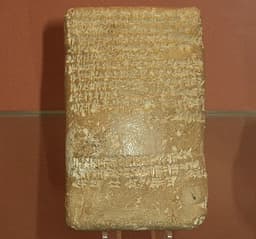
Burnaburiash II
Emperor · Ancient
43.1Total

Menkaure
Emperor · Ancient
42.7Total
Basic Information
Born
-1359
-2532
Died
-1333
-2503
Era
Ancient
Ancient
Nationality
Kassite Dynasty
Egypt
Occupation
Emperor
Emperor
Civilization
Middle Eastern
Middle Eastern
Score Comparison
Military (10%)
25.9
36.4
Political (20%)
40.8
27.9
Influence (20%)
47.1
51.0
Legacy (20%)
38.3
44.2
Leadership (15%)
62.2
36.7
Strategy (15%)
36.8
55.2
TOTAL
43.1
42.7
Burnaburiash II — Complete Timeline
1350 BC
Correspondence with AkhenatenPolitical Action◆ Major
Burnaburiash II exchanged diplomatic letters with the Egyptian pharaoh Akhenaten, as recorded in the Amarna letters. The correspondence dealt with marriage alliances, trade, and mutual recognition, reflecting the diplomatic network of the Late Bronze Age.
DiplomacyAmarna LettersEgypt
Impact: regional
1345 BC
Conflict with Assyria over Border TerritoriesWar
Burnaburiash II engaged in a conflict with Assyria over border territories, as mentioned in the Amarna letters. The dispute highlighted the shifting power dynamics in Mesopotamia, though the outcome was inconclusive and did not lead to major territorial changes.
ConflictAssyriaBorder
Impact: regional
Menkaure — Complete Timeline
2530 BC
Construction of the Third Pyramid at GizaCultural◆ Major
Menkaure built the third and smallest pyramid at Giza, standing 65 meters tall. The pyramid complex includes three subsidiary pyramids and a mortuary temple, and its construction marked the end of the major pyramid-building era at Giza.
PyramidArchitectureGiza
Impact: regionalconstructive
Expert Analysis
Origins
Burnaburiash II was a Kassite king of Babylon, reigning approximately from 1359 to 1333 BCE. He was born into the Kassite dynasty, which had ruled Babylonia since the 16th century BCE. The Kassites originated from the Zagros Mountains and adopted Mesopotamian culture. Burnaburiash II's family background is obscure, but he inherited a kingdom that controlled key trade routes and cities like Babylon, Nippur, and Larsa. His education likely included cuneiform writing, diplomacy, and military strategy.
Menkaure (also known as Mycerinus) was an Egyptian pharaoh of the 4th Dynasty, ruling around 2530–2510 BCE. He was the son of Pharaoh Khafre and grandson of Khufu, the builder of the Great Pyramid. Born into the royal family at Memphis, Menkaure was groomed for kingship from an early age. His education would have included religious rituals, administration, and monumental construction projects.
Rise to Power
Burnaburiash II ascended to the Kassite throne following the death of his father, likely without major conflict. He ruled during a period when the Near East was dominated by great powers: Egypt, Mitanni, Hatti, and Assyria. His rise was marked by diplomatic maneuvering, as evidenced by his correspondence with Egyptian Pharaoh Akhenaten (reigned 1353–1336 BCE). The Amarna letters, a cache of clay tablets, contain several letters from Burnaburiash II to Akhenaten, discussing marriage alliances and trade. These letters show Burnaburiash II asserting his status as a "Great King," equal to the pharaoh.
Menkaure became pharaoh after the death of his father Khafre. The transition was likely smooth, as the 4th Dynasty was stable. Menkaure's rise was rooted in the tradition of pyramid building, a central project for each pharaoh to ensure their afterlife and demonstrate power. He chose a site at Giza, adjacent to the pyramids of his father and grandfather.
Leadership & Governance
Burnaburiash II's leadership style was diplomatic and bureaucratic. He maintained Babylon's status through correspondence and gift exchanges. In his letters, he complains about the quality of Egyptian gold and requests more, showing a pragmatic approach to resource acquisition. He also dealt with the rising power of Assyria, which was challenging Babylonian border territories. His governance relied on a network of provincial governors and scribes, typical of Kassite administration.
Menkaure's governance was focused on monumental construction and religious duties. He oversaw the building of the third pyramid at Giza, which stood 65 meters tall (originally 65.5 m) with a base length of 102.2 meters. Unlike his predecessors, his pyramid used smaller blocks and included a mortuary temple and three subsidiary pyramids for his queens. Menkaure also commissioned statues, including the famous triad depicting him with goddesses. His reign was likely peaceful, with no recorded military campaigns.
Triumph & Tragedy
Burnaburiash II's greatest success was his diplomatic engagement with Egypt, which ensured Babylon's place in the international system. He secured a marriage alliance: his daughter married Akhenaten, strengthening ties. However, his failure was the inability to stop Assyrian encroachment. The Amarna letters reveal his frustration over Assyrian expansion, and later, Assyria would dominate Babylon. His score of 25.9 in military reflects this weakness.
Menkaure's triumph is the enduring pyramid complex, a UNESCO World Heritage site. The pyramid, despite being the smallest, is well-preserved and displays fine craftsmanship. However, his reign is less documented than others; no major military or administrative innovations are known. His total score of 42.7 is slightly lower than Burnaburiash II's 43.1. Menkaure's pyramid is often overshadowed by the larger ones of Khufu and Khafre.
Character & Destiny
Burnaburiash II appears as a shrewd diplomat, proud of his royal lineage. In his letters, he demands respect from Akhenaten, insisting on equal treatment. His character suggests a king who relied on negotiation rather than force. This may have been a necessity given Babylon's military limitations. His destiny was to be remembered mainly through the Amarna letters, a unique window into ancient diplomacy.
Menkaure is portrayed in later Greek sources as a just and pious ruler. Herodotus claimed he was kind and reversed his father's harsh policies. While likely embellished, it suggests a reputation for fairness. His destiny was to be immortalized by his pyramid, but his individual achievements are less celebrated than those of Khufu or Khafre.
Legacy
Burnaburiash II's legacy lies in the Amarna letters, which provide invaluable insight into Late Bronze Age diplomacy. His correspondence demonstrates the complex relationships between great powers and the importance of gift exchange. His political score of 40.8 reflects his role in maintaining Babylon's influence. However, his legacy is limited to scholarly circles; his name is not widely known.
Menkaure's legacy is monumental. The third pyramid at Giza is a symbol of ancient Egyptian civilization and a major tourist attraction. His pyramid complex contributed to the Giza necropolis, a testament to Old Kingdom engineering. His influence score of 51.0 is higher than Burnaburiash II's 47.1, reflecting the pyramid's visibility. Yet, his personal contribution is often merged with the collective achievement of the 4th Dynasty.
Conclusion
Between Burnaburiash II and Menkaure, the latter has had greater impact on human history. Although Burnaburiash II's total score (43.1) slightly exceeds Menkaure's (42.7), Menkaure's pyramid is a tangible, enduring legacy that has inspired for millennia. The pyramid is a pinnacle of ancient architecture, while Burnaburiash II's letters, though historically valuable, are known mainly to specialists. Menkaure's influence (51.0 vs 47.1) and legacy (44.2 vs 38.3) scores are higher, supporting this conclusion. The 0.4-point gap is negligible, but the cultural weight of the pyramid outweighs diplomatic correspondence. Thus, Menkaure stands as the more significant figure.
Rankings
🥇
Burnaburiash IILeader
Mil: 25.9Pol: 40.8Inf: 47.1
43.1
🥈
Menkaure
Mil: 36.4Pol: 27.9Inf: 51.0
42.7
+0.4 behind
How This Comparison Works
Algorithm
Each figure is scored on 6 dimensions (0—100 scale) based on structured historical data: Military (10%), Political (20%), Influence (20%), Legacy (20%), Leadership (15%), Strategy (15%). The weighted total produces the final ranking.
Data Sources
Scores are computed from structured sub-indicators in the database. Scale factors adjust for era (Ancient ×0.85, Modern ×1.0) and civilization size (Eastern ×1.05, Other ×0.80) to account for differences in population and military scale.
Maximum 3 Figures
Comparisons are limited to 2—3 figures to ensure readability and statistical meaningfulness.
Error Margins
±5 points per dimension — Sub-scores are derived from historical records with inherent uncertainty. Two figures within 5 points on a dimension should be considered roughly equivalent in that area.
Total Score Accuracy
±3 points overall — The weighted combination of 6 dimensions produces a total score with approximately ±3 points of uncertainty. Differences of less than 3 points are not statistically significant— the figures are effectively tied.
Known Limitations
- Historical records are incomplete and uneven across civilizations
- Figures from oral-tradition societies may be underrepresented
- Occupation labels can misclassify multi-role figures
- Scores measure capability and impact, not moral character
- Quantitative scoring is a comparison tool, not absolute truth
Capability Radar
Military (10%) — Battles & Warfare
Battles
10
40
Win Rate
10
39
Expansion
10
44
Political (20%) — Governance & Reform
Reform
30
10
Diplomacy
50
15
Economy
30
20
Influence (20%) — Cultural & Global Reach
Cultural
20
35
Global
20
30
Legacy (20%) — Historical Impact
Historical
30
40
Longevity
20
45
Leadership (15%) — Power & Stability
Tenure
40
18
Stability
40
25
Strategy (15%) — Tactics & Innovation
Strategy
10
46
Tactics
10
48
Reform
10
56
Similar Comparisons
Comments & Discussion
No comments yet. Be the first to share your thoughts!