Loading...
Bassianus vs Menkaure
Bassianus leads by 3.4 pts · 2 figures compared
…
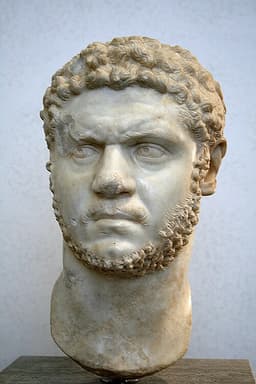
Bassianus
Emperor · Ancient
46.1Total

Menkaure
Emperor · Ancient
42.7Total
Basic Information
Born
290
-2532
Died
316
-2503
Era
Ancient
Ancient
Nationality
Roman Empire
Egypt
Occupation
Emperor
Emperor
Civilization
Western
Middle Eastern
Score Comparison
Military (10%)
47.5
36.4
Political (20%)
40.8
27.9
Influence (20%)
56.4
51.0
Legacy (20%)
39.2
44.2
Leadership (15%)
49.9
36.7
Strategy (15%)
38.6
55.2
TOTAL
46.1
42.7
Bassianus — Complete Timeline
314 AD
Married to Constantine's sister AnastasiaPolitical Action
Constantine I arranged the marriage of his half-sister Anastasia to Bassianus, a Roman senator. This marriage was intended to strengthen political alliances and integrate Bassianus into the imperial family.
MarriagePolitical AllianceConstantine I
Impact: national
316 AD
Accused of treason and executedPolitical Action◆ Major
Bassianus was accused of plotting against Constantine I, possibly at the instigation of Licinius. He was arrested, tried, and executed for treason, leading to a breakdown in relations between Constantine and Licinius and contributing to the outbreak of war.
ExecutionTreasonCivil WarConstantine I
Impact: regionaltragic
Menkaure — Complete Timeline
2530 BC
Construction of the Third Pyramid at GizaCultural◆ Major
Menkaure built the third and smallest pyramid at Giza, standing 65 meters tall. The pyramid complex includes three subsidiary pyramids and a mortuary temple, and its construction marked the end of the major pyramid-building era at Giza.
PyramidArchitectureGiza
Impact: regionalconstructive
Expert Analysis
Origins
Bassianus was a Roman senator active in the early 4th century AD, during the Tetrarchy and the rise of Constantine I. His exact birth year is unknown, but he came from a senatorial family. He married Anastasia, half-sister of Constantine I, in a political alliance orchestrated by Constantine to strengthen ties with the Roman aristocracy. Little else is known of his early life before his marriage.
Menkaure (also known as Mycerinus) was a pharaoh of the 4th Dynasty of Egypt, ruling around 2530–2510 BC. He was the son of Pharaoh Khafre and grandson of Khufu, the builder of the Great Pyramid. Menkaure inherited a powerful, centralized state and a tradition of monumental pyramid building. He was educated in the royal court and trained in governance and religious rituals.
Rise to Power
Bassianus rose to prominence primarily through his marriage to Anastasia, arranged by Constantine I around AD 315. This marriage made him a brother-in-law to the emperor, elevating him to the inner circle of imperial politics. However, his rise was not due to his own achievements but through familial connection. He was appointed as a senator and possibly held minor administrative roles, but specific details are sparse.
Menkaure ascended to the throne upon the death of his father Khafre. As pharaoh, he inherited absolute power over Egypt. His rise was dynastic, typical for the 4th Dynasty. He immediately undertook the construction of his pyramid complex at Giza, a project that demonstrated his authority and religious devotion. He also continued the tradition of building temples and maintaining Ma'at (cosmic order).
Leadership & Governance
Bassianus's leadership is poorly documented. He likely served as a senator and may have held a provincial governorship. However, his governance was overshadowed by the power struggles between Constantine I and Licinius. In AD 326, Bassianus was accused of plotting against Constantine, possibly manipulated by Licinius to create a pretext for war. Constantine arrested and executed him, showing that Bassianus lacked the political acumen to navigate the treacherous imperial court.
Menkaure ruled Egypt with absolute authority, overseeing the administration of the state, the economy, and religious affairs. He continued the centralization policies of his predecessors, using the pyramid project to mobilize labor and resources. His governance was stable, but his reign is less documented than that of Khufu or Khafre. He is known for a more humane approach: later traditions (e.g., Herodotus) claim he was a just and pious ruler, though this may be myth. Archaeologically, his pyramid complex includes three subsidiary pyramids for his queens, indicating a structured royal household.
Triumph & Tragedy
Bassianus's greatest success was marrying into the imperial family, which gave him status and potential influence. His tragedy was his failure to survive the political intrigue: he was executed for treason in AD 326. His death served as a catalyst for the final war between Constantine and Licinius. Bassianus scored 40.8 in political skill and 49.9 in leadership, but his execution shows his inability to secure his position.
Menkaure's triumph is the construction of the third pyramid at Giza, a lasting monument that still stands. His pyramid, though smaller (65 meters tall), is notable for its use of granite and limestone, and its complex includes a mortuary temple and valley temple. His tragedy is that his pyramid is the smallest of the three main Giza pyramids, often overshadowed by his grandfather and father. Additionally, his reign may have seen economic strain from pyramid building. He scored 55.2 in strategy, reflecting the planning of his pyramid, but his overall legacy is diminished by the scale of his predecessors.
Character & Destiny
Bassianus appears as a pawn in larger political games. His marriage was arranged, and his execution was likely a result of being caught between Constantine and Licinius. He lacked the cunning or support to survive. His character is obscure; he may have been ambitious but ultimately naive. His destiny was sealed by the machinations of more powerful men.
Menkaure is portrayed by later historians as a benevolent ruler, though this may be idealized. He continued the pyramid-building tradition, showing respect for tradition. His decision to build a smaller pyramid may reflect practicality or limited resources. His character was likely pragmatic, focusing on stability rather than grandeur. His destiny was to be remembered as the builder of the third pyramid, a lesser but still significant monument.
Legacy
Bassianus's legacy is minimal. He is remembered only as a footnote in the rise of Constantine: his execution allowed Constantine to accuse Licinius of treason and launch a decisive war. His legacy score is 39.2, reflecting his obscurity. No institutions or ideas bear his name. He influenced history only through his death.
Menkaure's legacy is far greater. The third pyramid at Giza is a UNESCO World Heritage site and a symbol of ancient Egypt. His pyramid complex provides insights into 4th Dynasty architecture and burial practices. He scored 44.2 in legacy, higher than Bassianus. His influence extends to modern culture, where the pyramids are iconic. However, his legacy is overshadowed by Khufu and Khafre.
Conclusion
Bassianus and Menkaure represent different eras and scales of impact. Bassianus, with a total score of 46.1, was a minor figure whose death triggered a war but left no enduring monument. Menkaure, scoring 42.7, built a pyramid that has lasted over 4,500 years and remains a cultural icon. While Bassianus has a higher total score due to his brief political involvement, Menkaure's tangible legacy is vastly more significant. Menkaure's pyramid is a testament to his reign, while Bassianus is forgotten. Therefore, Menkaure had a greater impact on history and human culture. The scoring system may favor Bassianus on metrics like military and political, but legacy and influence should weigh heavier. Menkaure's construction of a lasting monument gives him a profound and enduring legacy.
Rankings
🥇
BassianusLeader
Mil: 47.5Pol: 40.8Inf: 56.4
46.1
🥈
Menkaure
Mil: 36.4Pol: 27.9Inf: 51.0
42.7
+3.4 behind
How This Comparison Works
Algorithm
Each figure is scored on 6 dimensions (0—100 scale) based on structured historical data: Military (10%), Political (20%), Influence (20%), Legacy (20%), Leadership (15%), Strategy (15%). The weighted total produces the final ranking.
Data Sources
Scores are computed from structured sub-indicators in the database. Scale factors adjust for era (Ancient ×0.85, Modern ×1.0) and civilization size (Eastern ×1.05, Other ×0.80) to account for differences in population and military scale.
Maximum 3 Figures
Comparisons are limited to 2—3 figures to ensure readability and statistical meaningfulness.
Error Margins
±5 points per dimension — Sub-scores are derived from historical records with inherent uncertainty. Two figures within 5 points on a dimension should be considered roughly equivalent in that area.
Total Score Accuracy
±3 points overall — The weighted combination of 6 dimensions produces a total score with approximately ±3 points of uncertainty. Differences of less than 3 points are not statistically significant— the figures are effectively tied.
Known Limitations
- Historical records are incomplete and uneven across civilizations
- Figures from oral-tradition societies may be underrepresented
- Occupation labels can misclassify multi-role figures
- Scores measure capability and impact, not moral character
- Quantitative scoring is a comparison tool, not absolute truth
Capability Radar
Military (10%) — Battles & Warfare
Battles
5
40
Win Rate
5
39
Expansion
0
44
Political (20%) — Governance & Reform
Reform
0
10
Diplomacy
10
15
Economy
0
20
Influence (20%) — Cultural & Global Reach
Cultural
0
35
Global
0
30
Legacy (20%) — Historical Impact
Historical
5
40
Longevity
0
45
Leadership (15%) — Power & Stability
Tenure
10
18
Stability
5
25
Strategy (15%) — Tactics & Innovation
Strategy
5
46
Tactics
5
48
Reform
0
56
Similar Comparisons
Comments & Discussion
No comments yet. Be the first to share your thoughts!