Loading...
This comparison has not been analyzed yet.
One-time AI generation (~1 minute). Scores and timeline are already available below.
Camillo Benso Count of Cavour vs Zulfikar Ali Bhutto
Camillo Benso Count of Cavour leads by 11.8 pts · 2 figures compared
…

Camillo Benso Count of Cavour
Politician · Modern
63.0Total
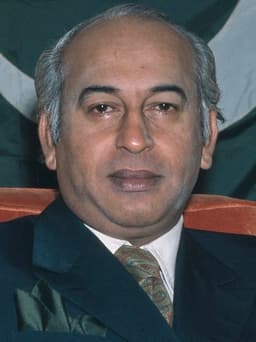
Zulfikar Ali Bhutto
Politician · Modern
51.2Total
Basic Information
Born
1810
1928
Died
1861
—
Era
Modern
Modern
Nationality
Italy
Pakistan
Occupation
Politician
Politician
Civilization
Western
Indian
Score Comparison
Military (10%)
14.9
32.0
Political (20%)
82.0
55.0
Influence (20%)
68.0
61.0
Legacy (20%)
65.0
50.0
Leadership (15%)
79.8
40.0
Strategy (15%)
39.6
60.0
TOTAL
63.0
51.2
Camillo Benso Count of Cavour — Complete Timeline
1852 AD
Appointed Prime Minister of Piedmont-SardiniaPolitical Action◆ Major
Cavour was appointed Prime Minister of the Kingdom of Piedmont-Sardinia by King Victor Emmanuel II. He implemented economic reforms, modernized the army, and pursued a policy of diplomatic maneuvering to unify Italy under Piedmontese leadership.
Italian UnificationPoliticsPiedmont
Impact: nationalconstructive
1855 AD
Crimean War ParticipationWar◆ Major
Cavour sent Piedmontese troops to fight alongside Britain and France in the Crimean War. This participation gained Piedmont-Sardinia a seat at the Congress of Paris, where Cavour raised the Italian question, gaining international sympathy for unification.
DiplomacyCrimean WarItalian Unification
Impact: regional
1858 AD
Plombières Agreement with Napoleon IIIPolitical Action◆ Major
Cavour secretly met with French Emperor Napoleon III at Plombi
DiplomacyAllianceItalian Unification
Impact: regional
1859 AD
Second Italian War of IndependenceWar
Cavour provoked Austria into declaring war, leading to the Second Italian War of Independence. Franco-Piedmontese forces won key battles at Magenta and Solferino, resulting in the annexation of Lombardy and the unification of central Italian states under Piedmont.
WarItalian UnificationAustria
Impact: regionalconstructive
1861 AD
Proclamation of the Kingdom of ItalyPolitical Action
Cavour oversaw the proclamation of the Kingdom of Italy under King Victor Emmanuel II, with the first Italian parliament meeting in Turin. He died shortly after, but his diplomatic and political efforts had largely achieved Italian unification.
Italian UnificationKingdom of ItalyPolitics
Impact: globalconstructive
Zulfikar Ali Bhutto — Complete Timeline
1971 AD
Became President of PakistanPolitical Action◆ Major
After the secession of East Pakistan (Bangladesh), Zulfikar Ali Bhutto took over as President of Pakistan. He inherited a defeated and dismembered nation.
PresidentPost-WarPakistan
Impact: national
1972 AD
Nationalized IndustriesReform◆ Major
Bhutto's government nationalized major industries, including steel, banking, and oil. This policy aimed to reduce economic inequality but led to inefficiencies and a decline in private investment.
NationalizationEconomic PolicySocialism
Impact: national
Simla AgreementPolitical Action◆ Major
Bhutto signed the Simla Agreement with Indian Prime Minister Indira Gandhi. The agreement established a Line of Control in Kashmir and committed both nations to bilateral resolution of disputes.
Peace TreatyKashmirIndia
Impact: regional
1973 AD
Constitution of 1973Reform
Bhutto oversaw the drafting and adoption of Pakistan's current constitution, which established a parliamentary system and declared Pakistan an Islamic republic. It remains the country's supreme law.
ConstitutionParliamentary SystemIslamic Republic
Impact: nationalconstructive
1979 AD
Executed by HangingPolitical Action
Bhutto was executed by hanging after being convicted of conspiracy to murder a political opponent. The trial was widely criticized as politically motivated by General Zia-ul-Haq's military regime.
ExecutionControversial TrialZia-ul-Haq
Impact: nationaltragic
This comparison has not been analyzed yet.
One-time AI generation (~1 minute). Scores and timeline are already available below.
Rankings
🥇
Camillo Benso Count of CavourLeader
Mil: 14.9Pol: 82.0Inf: 68.0
63.0
🥈
Zulfikar Ali Bhutto
Mil: 32.0Pol: 55.0Inf: 61.0
51.2
+11.8 behind
How This Comparison Works
Algorithm
Each figure is scored on 6 dimensions (0—100 scale) based on structured historical data: Military (10%), Political (20%), Influence (20%), Legacy (20%), Leadership (15%), Strategy (15%). The weighted total produces the final ranking.
Data Sources
Scores are computed from structured sub-indicators in the database. Scale factors adjust for era (Ancient ×0.85, Modern ×1.0) and civilization size (Eastern ×1.05, Other ×0.80) to account for differences in population and military scale.
Maximum 3 Figures
Comparisons are limited to 2—3 figures to ensure readability and statistical meaningfulness.
Error Margins
±5 points per dimension — Sub-scores are derived from historical records with inherent uncertainty. Two figures within 5 points on a dimension should be considered roughly equivalent in that area.
Total Score Accuracy
±3 points overall — The weighted combination of 6 dimensions produces a total score with approximately ±3 points of uncertainty. Differences of less than 3 points are not statistically significant— the figures are effectively tied.
Known Limitations
- Historical records are incomplete and uneven across civilizations
- Figures from oral-tradition societies may be underrepresented
- Occupation labels can misclassify multi-role figures
- Scores measure capability and impact, not moral character
- Quantitative scoring is a comparison tool, not absolute truth
Capability Radar
Military (10%) — Battles & Warfare
Battles
5
41
Win Rate
5
45
Expansion
40
49
Political (20%) — Governance & Reform
Reform
85
70
Diplomacy
90
60
Economy
80
55
Influence (20%) — Cultural & Global Reach
Cultural
60
50
Global
70
55
Legacy (20%) — Historical Impact
Historical
80
60
Longevity
75
40
Leadership (15%) — Power & Stability
Tenure
60
65
Stability
70
30
Strategy (15%) — Tactics & Innovation
Strategy
35
55
Tactics
5
58
Reform
30
57
Similar Comparisons
Comments & Discussion
No comments yet. Be the first to share your thoughts!