Loading...
This comparison has not been analyzed yet.
One-time AI generation (~1 minute). Scores and timeline are already available below.
Cao Kun vs Radomir Putnik
Radomir Putnik leads by 18.1 pts · 2 figures compared
…
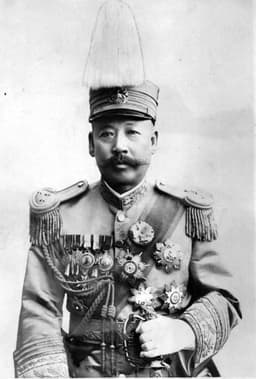
Cao Kun
General · Modern
43.2Total

Radomir Putnik
General · Modern
61.3Total
Basic Information
Born
1862
1847
Died
1938
1917
Era
Modern
Modern
Nationality
China
Serbia
Occupation
General
General
Civilization
Eastern
Western
Score Comparison
Military (10%)
38.3
61.7
Political (20%)
30.8
68.0
Influence (20%)
51.0
60.0
Legacy (20%)
40.8
50.0
Leadership (15%)
50.7
72.0
Strategy (15%)
41.7
66.3
TOTAL
43.2
61.3
Cao Kun — Complete Timeline
1920 AD
Zhili-Anhui WarWar◆ Major
Cao Kun led the Zhili clique to victory over the Anhui clique in the Zhili-Anhui War. This battle established the Zhili faction as the dominant force in northern China and expanded Cao Kun's political and military power.
Warlord EraWarZhili Clique
Impact: national
1922 AD
First Zhili-Fengtian WarWar◆ Major
Cao Kun's Zhili forces defeated the Fengtian clique under Zhang Zuolin in the First Zhili-Fengtian War. This victory solidified Zhili control over Beijing and the central government.
Warlord EraWarZhili Clique
Impact: national
1923 AD
Presidential Bribery ScandalPolitical Action
Cao Kun bribed members of the National Assembly to elect him President of the Republic of China, spending millions of yuan. This scandal discredited the Republican government and deepened public cynicism toward warlord politics.
Republic of ChinaCorruptionPresidency
Impact: nationaldestructive
1924 AD
Second Zhili-Fengtian WarWar◆ Major
Cao Kun's Zhili clique was defeated by the Fengtian clique in the Second Zhili-Fengtian War. The loss led to his overthrow and house arrest, ending his political career and the Zhili dominance.
Warlord EraWarDefeat
Impact: nationaltragic
Radomir Putnik — Complete Timeline
1912 AD
Command during the Balkan WarsWar◆ Major
Putnik led the Serbian Army to victories against the Ottoman Empire in the First Balkan War and against Bulgaria in the Second Balkan War. These wars doubled Serbia's territory and established it as a regional power.
Balkan WarsTerritorial ExpansionVictory
Impact: regionalconstructive
Appointment as Chief of General StaffPolitical Action◆ Major
Putnik was appointed Chief of the General Staff of the Serbian Army. He was responsible for planning and executing military operations during the Balkan Wars and World War I.
Military CommandBalkan Wars
Impact: nationalconstructive
1914 AD
Command during the Serbian Campaign of World War IWar◆ Major
Putnik commanded the Serbian Army during the initial Austro-Hungarian invasions. Despite being ill, he directed the successful defense of Serbia, including the victories at Cer and Kolubara.
World War IDefenseVictory
Impact: regionalconstructive
1915 AD
Retreat through AlbaniaWar
Putnik led the Serbian Army and government in a winter retreat across the Albanian mountains after a combined German, Austro-Hungarian, and Bulgarian offensive. The retreat saved the army but resulted in heavy casualties from cold, disease, and enemy attacks.
World War IRetreatSurvival
Impact: regionaltragic
This comparison has not been analyzed yet.
One-time AI generation (~1 minute). Scores and timeline are already available below.
Rankings
🥇
Radomir PutnikLeader
Mil: 61.7Pol: 68.0Inf: 60.0
61.3
🥈
Cao Kun
Mil: 38.3Pol: 30.8Inf: 51.0
43.2
+18.1 behind
How This Comparison Works
Algorithm
Each figure is scored on 6 dimensions (0—100 scale) based on structured historical data: Military (10%), Political (20%), Influence (20%), Legacy (20%), Leadership (15%), Strategy (15%). The weighted total produces the final ranking.
Data Sources
Scores are computed from structured sub-indicators in the database. Scale factors adjust for era (Ancient ×0.85, Modern ×1.0) and civilization size (Eastern ×1.05, Other ×0.80) to account for differences in population and military scale.
Maximum 3 Figures
Comparisons are limited to 2—3 figures to ensure readability and statistical meaningfulness.
Error Margins
±5 points per dimension — Sub-scores are derived from historical records with inherent uncertainty. Two figures within 5 points on a dimension should be considered roughly equivalent in that area.
Total Score Accuracy
±3 points overall — The weighted combination of 6 dimensions produces a total score with approximately ±3 points of uncertainty. Differences of less than 3 points are not statistically significant— the figures are effectively tied.
Known Limitations
- Historical records are incomplete and uneven across civilizations
- Figures from oral-tradition societies may be underrepresented
- Occupation labels can misclassify multi-role figures
- Scores measure capability and impact, not moral character
- Quantitative scoring is a comparison tool, not absolute truth
Capability Radar
Military (10%) — Battles & Warfare
Battles
30
75
Win Rate
35
70
Expansion
25
50
Political (20%) — Governance & Reform
Reform
10
40
Diplomacy
20
50
Economy
15
30
Influence (20%) — Cultural & Global Reach
Cultural
15
40
Global
10
50
Legacy (20%) — Historical Impact
Historical
25
55
Longevity
10
45
Leadership (15%) — Power & Stability
Tenure
40
55
Stability
10
45
Strategy (15%) — Tactics & Innovation
Strategy
30
78
Tactics
25
72
Reform
20
65
Similar Comparisons
Comments & Discussion
No comments yet. Be the first to share your thoughts!