Loading...
Caracalla vs Intef III
Caracalla leads by 10.8 pts · 2 figures compared
…
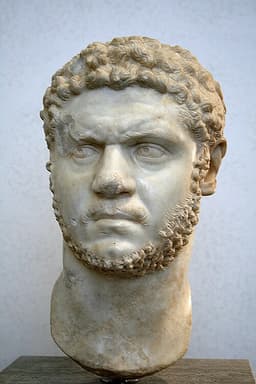
Caracalla
Emperor · Ancient
46.2Total

Intef III
Emperor · Ancient
35.4Total
Basic Information
Born
188
-2050
Died
217
-2040
Era
Ancient
Ancient
Nationality
Roman Empire
Middle Kingdom Egypt
Occupation
Emperor
Emperor
Civilization
Western
Middle Eastern
Score Comparison
Military (10%)
10.0
25.9
Political (20%)
48.0
27.9
Influence (20%)
57.2
43.2
Legacy (20%)
50.0
35.8
Leadership (15%)
45.0
34.6
Strategy (15%)
45.0
36.8
TOTAL
46.2
35.4
Caracalla — Complete Timeline
211 AD
Assassination of GetaPolitical Action◆ Major
Caracalla murdered his brother and co-emperor Geta in their mother Julia Domna's arms, after a period of intense rivalry. Geta's supporters were purged, and his name was erased from inscriptions (damnatio memoriae).
AssassinationBrotherDamnatio Memoriae
Impact: nationaltragic
212 AD
Constitutio AntoninianaReform
Caracalla issued the Constitutio Antoniniana, granting Roman citizenship to all free inhabitants of the Roman Empire. This edict aimed to increase tax revenue and unify the empire, but also diluted the traditional privileges of Roman citizens.
CitizenshipReformTaxation
Impact: globalconstructive
213 AD
Campaign against the AlemanniWar
Caracalla campaigned against the Alemanni tribe on the Rhine frontier, winning a victory and adopting the title Germanicus Maximus. He also attempted to imitate Alexander the Great by forming a Macedonian-style phalanx.
CampaignAlemanniFrontier
Impact: regional
216 AD
Construction of the Baths of CaracallaCultural◆ Major
Caracalla commissioned the Baths of Caracalla in Rome, one of the largest and most luxurious public bath complexes in the ancient world. The baths served as a social and cultural center for the Roman populace.
ArchitecturePublic WorksBaths
Impact: nationalconstructive
217 AD
Assassination of CaracallaPolitical Action◆ Major
Caracalla was assassinated on the road to Carrhae by a soldier named Martialis, at the instigation of the praetorian prefect Macrinus. His death ended the Severan dynasty's direct line and led to Macrinus's brief reign.
AssassinationEnd of DynastyMacrinus
Impact: globaltragic
Intef III — Complete Timeline
2050 BC
Accession as Theban pharaohPolitical Action◆ Major
Intef III succeeded his father Intef II as ruler of Thebes. His reign was short, lasting approximately 10 years, during which he continued the 11th Dynasty's military campaigns against the Heracleopolitan kingdom.
AccessionTheban DynastyFirst Intermediate Period
Impact: regional
2045 BC
Military campaign in Middle EgyptWar
Intef III led a campaign into Middle Egypt, capturing the city of Asyut. This victory weakened the Heracleopolitan kingdom and brought the Thebans closer to final reunification, though Intef III died before achieving it.
Military CampaignAsyutReunification
Impact: regional
Expert Analysis
Origins
Caracalla was born Lucius Septimius Bassianus in 188 AD in Lugdunum (modern Lyon, Gaul) to Emperor Septimius Severus and Julia Domna. He was of Roman and Syrian descent, raised in the imperial court with his younger brother Geta. His education emphasized military and administrative skills, preparing him for succession. Intef III was a pharaoh of the 11th Dynasty, ruling from Thebes around 2060–2050 BC. He was the son of Intef II and father of Mentuhotep II. Little is known of his early life, but he inherited a kingdom engaged in a prolonged conflict with the Heracleopolitan dynasty for control of Egypt.
Rise to Power
Caracalla became co-emperor with his father Septimius Severus in 198 AD, and later with his brother Geta after Severus's death in 211 AD. The brothers' rivalry quickly escalated, leading Caracalla to have Geta murdered in 212 AD, after which he ruled alone. He secured his position by purging Geta's supporters, executing thousands. Intef III ascended the throne after his father's death, around 2060 BC. His reign was short (approx. 10 years), and he continued the Theban campaign against the Heracleopolitans. His key achievement was capturing the strategic city of Asyut in Middle Egypt, which weakened the enemy and expanded Theban influence. However, he died before completing the reunification of Egypt.
Leadership & Governance
Caracalla's leadership was autocratic and militaristic. He spent most of his reign on campaign, focusing on the Rhine and Danube frontiers, and later against the Parthians. He issued the Constitutio Antoniniana in 212 AD, granting Roman citizenship to all free inhabitants of the empire. This was primarily a fiscal measure to increase tax revenue, as citizens were subject to inheritance taxes. He also commissioned massive building projects like the Baths of Caracalla. However, his governance was marred by brutality and paranoia. Intef III ruled as a Theban pharaoh during the First Intermediate Period, a time of fragmented rule. His governance centered on military consolidation. He likely followed his father's policy of building alliances with local nomarchs. His capture of Asyut demonstrated strategic leadership, but his short reign limited administrative reforms.
Triumph & Tragedy
Caracalla's greatest triumph was the Constitutio Antoniniana, which transformed Roman society by extending citizenship to millions. The Baths of Caracalla remain a symbol of Roman engineering. However, his assassination of Geta and the subsequent massacre of supporters stained his legacy. He was assassinated in 217 AD by a soldier, ending his reign abruptly. Intef III's triumph was his military success at Asyut, which brought Thebes closer to reunifying Egypt. His tragedy was his premature death, preventing him from completing the reunification. His son Mentuhotep II would later achieve that goal.
Character & Destiny
Caracalla was ruthless and ambitious. He sought to emulate Alexander the Great, dressing like a Macedonian and leading campaigns. His decision to murder Geta reveals a willingness to eliminate rivals. His character led to his downfall, as his cruelty alienated the Praetorian Guard. He scored 10.0 in military, reflecting his focus on warfare, but his political score of 48.0 indicates instability. Intef III was a capable military leader, with a military score of 25.9 and political score of 27.9. He showed determination in continuing his father's war. His early death suggests he was not destined to finish the task, but his son's success shows his legacy continued.
Legacy
Caracalla's Constitutio Antoniniana had a profound impact, effectively ending the distinction between Romans and provincials, and paving the way for a more unified empire. His baths remained a model for public architecture. However, his reign is often viewed negatively due to his cruelty. Intef III's legacy is overshadowed by his son Mentuhotep II, who completed the reunification. He is remembered as a stepping stone in the rise of the 11th Dynasty. His capture of Asyut was crucial, but his overall influence score of 43.2 is lower than Caracalla's 57.2.
Conclusion
Caracalla had greater impact on history than Intef III. His Constitutio Antoniniana fundamentally altered the Roman Empire, affecting citizenship and taxation for centuries. His total score of 46.2 surpasses Intef III's 35.4. While Intef III contributed to Egypt's reunification, his role was secondary to his son's. Caracalla's actions had broader and more enduring consequences, despite his personal flaws.
Rankings
🥇
CaracallaLeader
Mil: 10.0Pol: 48.0Inf: 57.2
46.2
🥈
Intef III
Mil: 25.9Pol: 27.9Inf: 43.2
35.4
+10.8 behind
How This Comparison Works
Algorithm
Each figure is scored on 6 dimensions (0—100 scale) based on structured historical data: Military (10%), Political (20%), Influence (20%), Legacy (20%), Leadership (15%), Strategy (15%). The weighted total produces the final ranking.
Data Sources
Scores are computed from structured sub-indicators in the database. Scale factors adjust for era (Ancient ×0.85, Modern ×1.0) and civilization size (Eastern ×1.05, Other ×0.80) to account for differences in population and military scale.
Maximum 3 Figures
Comparisons are limited to 2—3 figures to ensure readability and statistical meaningfulness.
Error Margins
±5 points per dimension — Sub-scores are derived from historical records with inherent uncertainty. Two figures within 5 points on a dimension should be considered roughly equivalent in that area.
Total Score Accuracy
±3 points overall — The weighted combination of 6 dimensions produces a total score with approximately ±3 points of uncertainty. Differences of less than 3 points are not statistically significant— the figures are effectively tied.
Known Limitations
- Historical records are incomplete and uneven across civilizations
- Figures from oral-tradition societies may be underrepresented
- Occupation labels can misclassify multi-role figures
- Scores measure capability and impact, not moral character
- Quantitative scoring is a comparison tool, not absolute truth
Capability Radar
Military (10%) — Battles & Warfare
Battles
45
10
Win Rate
40
10
Expansion
25
10
Political (20%) — Governance & Reform
Reform
80
15
Diplomacy
30
15
Economy
25
15
Influence (20%) — Cultural & Global Reach
Cultural
50
10
Global
55
5
Legacy (20%) — Historical Impact
Historical
65
15
Longevity
60
10
Leadership (15%) — Power & Stability
Tenure
40
20
Stability
15
20
Strategy (15%) — Tactics & Innovation
Strategy
30
10
Tactics
35
10
Reform
20
10
Similar Comparisons
Comments & Discussion
No comments yet. Be the first to share your thoughts!