Loading...
Cardinal Richelieu vs Giuseppe Motta
Cardinal Richelieu leads by 14.0 pts · 2 figures compared
…
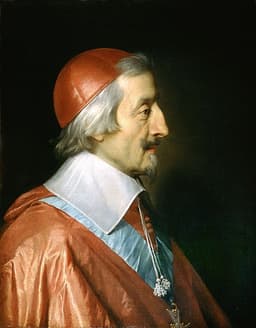
Cardinal Richelieu
Politician · Modern
66.6Total

Giuseppe Motta
Politician · Modern
52.6Total
Basic Information
Born
1585
1871
Died
1642
1940
Era
Modern
Modern
Nationality
France
Switzerland
Occupation
Politician
Politician
Civilization
Western
Western
Score Comparison
Military (10%)
50.0
26.3
Political (20%)
75.0
62.7
Influence (20%)
65.0
53.3
Legacy (20%)
65.0
44.2
Leadership (15%)
75.0
79.8
Strategy (15%)
66.3
41.8
TOTAL
66.6
52.6
Cardinal Richelieu — Complete Timeline
1627 AD
Siege of La RochelleWar◆ Major
Richelieu personally commanded the siege of La Rochelle, a Huguenot stronghold, which lasted 14 months. The city's surrender ended Huguenot political and military power in France, centralizing royal authority and enforcing Catholic uniformity.
SiegeHuguenotsCentralization
Impact: nationaldestructive
1635 AD
Entry of France into the Thirty Years' WarWar
Richelieu declared war on Spain, bringing France directly into the Thirty Years' War on the side of the Protestant powers. This decision prioritized French state interests over Catholic solidarity, aiming to weaken Habsburg dominance in Europe.
War DeclarationThirty Years' WarHabsburg
Impact: global
Establishment of the Académie FrançaiseCultural◆ Major
Richelieu founded the Acad
Cultural InstitutionLanguageRoyal Patronage
Impact: nationalconstructive
Giuseppe Motta — Complete Timeline
1911 AD
Election to the Swiss Federal CouncilPolitical Action◆ Major
Motta was elected to the Swiss Federal Council, representing the Catholic Conservative Party. He served for nearly 30 years, becoming one of the longest-serving members of the executive.
Federal CouncilGovernmentCatholic
Impact: nationalconstructive
1915 AD
Presidency of the Swiss ConfederationPolitical Action◆ Major
Motta served his first term as President of the Swiss Confederation. He held the office five times (1915, 1920, 1927, 1932, 1937), a record at the time, reflecting his political influence.
PresidencyLeadershipRecord
Impact: nationalconstructive
1920 AD
Leadership of the Political DepartmentPolitical Action◆ Major
Motta took over the Political Department (foreign affairs) and led Swiss diplomacy for over a decade. He advocated for Swiss neutrality and membership in the League of Nations.
Foreign PolicyDiplomacyNeutrality
Impact: nationalconstructive
Switzerland's Accession to the League of NationsPolitical Action◆ Major
Motta led the negotiations for Switzerland's entry into the League of Nations, securing a special status of 'differential neutrality' that exempted Switzerland from military sanctions. This preserved Swiss neutrality.
League of NationsNeutralityDiplomacy
Impact: globalconstructive
Expert Analysis
Origins
Cardinal Richelieu, born Armand Jean du Plessis in 1585 to a minor noble family in Paris, was raised for a military career but entered the clergy to secure a bishopric. He studied at the Collège de Navarre and rose through church ranks, becoming Bishop of Luçon at age 22. His early political acumen caught the attention of Marie de' Medici, regent for Louis XIII.
Giuseppe Motta, born in 1871 in Airolo, Switzerland, into a modest Catholic family, studied law at the universities of Freiburg and Heidelberg. He entered politics early, serving in the Swiss Federal Assembly from 1895, representing the Catholic Conservative Party. His upbringing in a multilingual canton shaped his diplomatic approach.
Rise to Power
Richelieu's rise began as a delegate to the Estates-General in 1614, where he impressed Marie de' Medici. He became Secretary of State in 1616, but fell from favor after a coup. He regained influence by reconciling with Louis XIII, becoming chief minister in 1624. He consolidated power by crushing the Huguenot rebellion (Siege of La Rochelle, 1627-1628) and executing nobles like the Duke of Montmorency.
Motta was elected to the Swiss Federal Council in 1911, representing Ticino. He served as President of the Confederation five times (1915, 1920, 1927, 1932, 1937), a record at the time. His rise was steady, built on consensus and Catholic Conservative backing, not dramatic upheaval.
Leadership & Governance
Richelieu centralized French authority by curbing noble power, reducing Huguenot privileges, and reforming administration. He introduced intendants to enforce royal decrees in provinces, bypassing local nobles. He founded the Académie Française in 1635 to standardize language and promote cultural unity. His foreign policy prioritized state interests over religion, allying with Protestant powers in the Thirty Years' War.
Motta's leadership focused on neutrality and diplomacy. As head of the Political Department (1915-1938), he guided Switzerland through two world wars. He secured Switzerland's entry into the League of Nations in 1920 with a special 'differential neutrality' status, exempting it from military sanctions. His governance style was consensus-driven, reflecting Swiss federalism.
Triumph & Tragedy
Richelieu's triumphs include ending Huguenot political power, strengthening the French monarchy, and positioning France as a European power. His greatest failure was the heavy human and financial cost of the Thirty Years' War; France's involvement strained the economy and caused widespread suffering. He also failed to eliminate noble conspiracies entirely.
Motta's triumph was maintaining Swiss neutrality during turbulent times. He successfully integrated Switzerland into the League of Nations while preserving its sovereign stance. His tragedy was the League's eventual failure to prevent World War II; his vision of collective security collapsed. He died in 1940, seeing the rise of fascism.
Character & Destiny
Richelieu was pragmatic, calculating, and ruthless. He suppressed dissent without hesitation, using spies and networks. His character—driven by raison d'état—shaped his destiny: he died in power but left a centralized state that would evolve into absolutism. Historians like Carl J. Burckhardt note his 'cold realism.'
Motta was diplomatic, patient, and principled. His commitment to neutrality and federalism defined his career. He navigated crises with moderation. His character suited Switzerland's small-state context, ensuring stability but limiting global impact.
Legacy
Richelieu's legacy is the modern French state: centralized administration, cultural institutions like the Académie Française, and a foreign policy tradition of state interest. His scores reflect this: Political 75.0, Influence 65.0, Legacy 65.0. He is remembered as a founding figure of French absolutism.
Motta's legacy is Swiss neutrality and internationalism. He set precedents for neutrality in international organizations. His scores: Political 62.7, Legacy 44.2, Leadership 79.8. He is a model of consensus leadership but less known outside Switzerland.
Conclusion
Cardinal Richelieu had greater impact on world history. His centralization of power in France changed the course of European politics, establishing a model of modern statecraft. Motta's influence, while significant for Switzerland, was confined to preserving neutrality. Richelieu's Political score of 75.0 versus Motta's 62.7, and higher overall score (66.6 vs 52.6), reflect his broader reach. Richelieu's actions shaped centuries of French power; Motta's legacy, though durable, is more regional. Richelieu was the more consequential figure.
Rankings
🥇
Cardinal RichelieuLeader
Mil: 50.0Pol: 75.0Inf: 65.0
66.6
🥈
Giuseppe Motta
Mil: 26.3Pol: 62.7Inf: 53.3
52.6
+14.0 behind
How This Comparison Works
Algorithm
Each figure is scored on 6 dimensions (0—100 scale) based on structured historical data: Military (10%), Political (20%), Influence (20%), Legacy (20%), Leadership (15%), Strategy (15%). The weighted total produces the final ranking.
Data Sources
Scores are computed from structured sub-indicators in the database. Scale factors adjust for era (Ancient ×0.85, Modern ×1.0) and civilization size (Eastern ×1.05, Other ×0.80) to account for differences in population and military scale.
Maximum 3 Figures
Comparisons are limited to 2—3 figures to ensure readability and statistical meaningfulness.
Error Margins
±5 points per dimension — Sub-scores are derived from historical records with inherent uncertainty. Two figures within 5 points on a dimension should be considered roughly equivalent in that area.
Total Score Accuracy
±3 points overall — The weighted combination of 6 dimensions produces a total score with approximately ±3 points of uncertainty. Differences of less than 3 points are not statistically significant— the figures are effectively tied.
Known Limitations
- Historical records are incomplete and uneven across civilizations
- Figures from oral-tradition societies may be underrepresented
- Occupation labels can misclassify multi-role figures
- Scores measure capability and impact, not moral character
- Quantitative scoring is a comparison tool, not absolute truth
Capability Radar
Military (10%) — Battles & Warfare
Battles
55
25
Win Rate
60
28
Expansion
75
30
Political (20%) — Governance & Reform
Reform
95
55
Diplomacy
90
65
Economy
70
50
Influence (20%) — Cultural & Global Reach
Cultural
75
30
Global
75
30
Legacy (20%) — Historical Impact
Historical
85
40
Longevity
80
35
Leadership (15%) — Power & Stability
Tenure
85
70
Stability
80
60
Strategy (15%) — Tactics & Innovation
Strategy
85
29
Tactics
65
33
Reform
70
40
Similar Comparisons
Comments & Discussion
No comments yet. Be the first to share your thoughts!