Loading...
This comparison has not been analyzed yet.
One-time AI generation (~1 minute). Scores and timeline are already available below.
Carl-Heinrich von Stulpnagel vs Ziaur Rahman
Ziaur Rahman leads by 8.6 pts · 2 figures compared
…
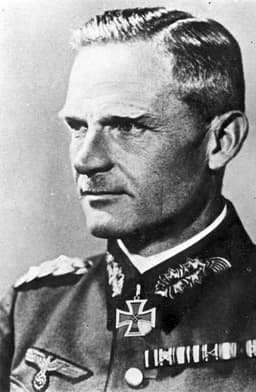
Carl-Heinrich von Stulpnagel
General · Modern
45.7Total

Ziaur Rahman
General · Modern
54.3Total
Basic Information
Born
1886
1936
Died
1944
—
Era
Modern
Modern
Nationality
Germany
Bangladesh
Occupation
General
General
Civilization
Western
Indian
Score Comparison
Military (10%)
50.0
20.0
Political (20%)
37.9
62.7
Influence (20%)
51.8
58.0
Legacy (20%)
42.5
49.2
Leadership (15%)
50.7
74.0
Strategy (15%)
38.3
50.0
TOTAL
45.7
54.3
Carl-Heinrich von Stulpnagel — Complete Timeline
1942 AD
Appointed Military Governor of FrancePolitical Action◆ Major
Stülpnagel was appointed Military Governor of German-occupied France on February 5, 1942. He administered the occupation, oversaw the Vichy regime, and was responsible for implementing Nazi policies, including the deportation of Jews.
World War IIOccupation of FranceVichy Regime
Impact: regionaldestructive
1944 AD
Participated in the July 20 PlotPolitical Action◆ Major
Stülpnagel was a key conspirator in the July 20 plot. He was responsible for ordering the arrest of SS and Gestapo officers in Paris after the assassination attempt. He also attempted to negotiate with the Allies.
July 20 PlotParisArrest of SS
Impact: national
Attempted Suicide and ExecutedPolitical Action◆ Major
After the failure of the July 20 plot, St
July 20 PlotSuicide AttemptExecutionPlötzensee
Impact: nationaltragic
Ziaur Rahman — Complete Timeline
1971 AD
Declaration of Bangladeshi IndependencePolitical Action
On March 26, 1971, Ziaur Rahman, as a major in the Pakistan Army, read a declaration of independence over radio from Kalurghat, Chittagong. This act is widely credited with rallying the Bengali nation to begin the Bangladesh Liberation War against Pakistan.
Bangladesh Liberation WarIndependenceRadio Broadcast
Impact: nationalconstructive
1978 AD
Formation of the Bangladesh Nationalist PartyPolitical Action◆ Major
Ziaur Rahman founded the Bangladesh Nationalist Party (BNP) in 1978 as a political platform to consolidate his rule. The BNP became one of Bangladesh's two major political parties, shaping the country's post-independence political landscape.
Political PartyBNPBangladesh Politics
Impact: nationalconstructive
1981 AD
Assassination of Ziaur RahmanPolitical Action◆ Major
Ziaur Rahman was assassinated on May 30, 1981, during a failed military coup in Chittagong. The coup was led by a group of army officers. His death plunged Bangladesh into political instability and led to the eventual rise of Hussain Muhammad Ershad.
AssassinationCoupPolitical Instability
Impact: nationaltragic
This comparison has not been analyzed yet.
One-time AI generation (~1 minute). Scores and timeline are already available below.
Rankings
🥇
Ziaur RahmanLeader
Mil: 20.0Pol: 62.7Inf: 58.0
54.3
🥈
Carl-Heinrich von Stulpnagel
Mil: 50.0Pol: 37.9Inf: 51.8
45.7
+8.6 behind
How This Comparison Works
Algorithm
Each figure is scored on 6 dimensions (0—100 scale) based on structured historical data: Military (10%), Political (20%), Influence (20%), Legacy (20%), Leadership (15%), Strategy (15%). The weighted total produces the final ranking.
Data Sources
Scores are computed from structured sub-indicators in the database. Scale factors adjust for era (Ancient ×0.85, Modern ×1.0) and civilization size (Eastern ×1.05, Other ×0.80) to account for differences in population and military scale.
Maximum 3 Figures
Comparisons are limited to 2—3 figures to ensure readability and statistical meaningfulness.
Error Margins
±5 points per dimension — Sub-scores are derived from historical records with inherent uncertainty. Two figures within 5 points on a dimension should be considered roughly equivalent in that area.
Total Score Accuracy
±3 points overall — The weighted combination of 6 dimensions produces a total score with approximately ±3 points of uncertainty. Differences of less than 3 points are not statistically significant— the figures are effectively tied.
Known Limitations
- Historical records are incomplete and uneven across civilizations
- Figures from oral-tradition societies may be underrepresented
- Occupation labels can misclassify multi-role figures
- Scores measure capability and impact, not moral character
- Quantitative scoring is a comparison tool, not absolute truth
Capability Radar
Military (10%) — Battles & Warfare
Battles
20
45
Win Rate
15
40
Expansion
10
30
Political (20%) — Governance & Reform
Reform
20
60
Diplomacy
35
50
Economy
15
45
Influence (20%) — Cultural & Global Reach
Cultural
10
40
Global
10
40
Legacy (20%) — Historical Impact
Historical
30
50
Longevity
15
45
Leadership (15%) — Power & Stability
Tenure
40
55
Stability
10
35
Strategy (15%) — Tactics & Innovation
Strategy
30
55
Tactics
25
50
Reform
10
60
Similar Comparisons
Comments & Discussion
No comments yet. Be the first to share your thoughts!