Loading...
Carl-Heinrich von Stulpnagel vs Napoleon Bonaparte
Napoleon Bonaparte leads by 25.2 pts · 2 figures compared
…
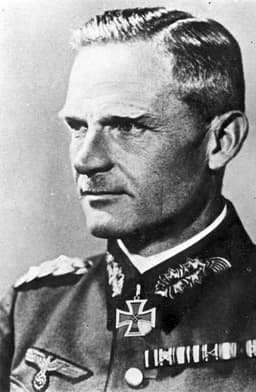
Carl-Heinrich von Stulpnagel
General · Modern
45.7Total

Napoleon Bonaparte
General · Modern
70.9Total
Basic Information
Born
1886
1769
Died
1944
1821
Era
Modern
Modern
Nationality
Germany
France
Occupation
General
General
Civilization
Western
Western
Score Comparison
Military (10%)
50.0
94.0
Political (20%)
37.9
72.0
Influence (20%)
51.8
40.0
Legacy (20%)
42.5
80.0
Leadership (15%)
50.7
78.0
Strategy (15%)
38.3
90.0
TOTAL
45.7
70.9
Carl-Heinrich von Stulpnagel — Complete Timeline
1942 AD
Appointed Military Governor of FrancePolitical Action◆ Major
Stülpnagel was appointed Military Governor of German-occupied France on February 5, 1942. He administered the occupation, oversaw the Vichy regime, and was responsible for implementing Nazi policies, including the deportation of Jews.
World War IIOccupation of FranceVichy Regime
Impact: regionaldestructive
1944 AD
Participated in the July 20 PlotPolitical Action◆ Major
Stülpnagel was a key conspirator in the July 20 plot. He was responsible for ordering the arrest of SS and Gestapo officers in Paris after the assassination attempt. He also attempted to negotiate with the Allies.
July 20 PlotParisArrest of SS
Impact: national
Attempted Suicide and ExecutedPolitical Action◆ Major
After the failure of the July 20 plot, St
July 20 PlotSuicide AttemptExecutionPlötzensee
Impact: nationaltragic
Napoleon Bonaparte — Complete Timeline
1799 AD
Coup of 18 BrumaireOther◆ Major
Napoleon Bonaparte, with support from his brother Lucien and key political figures, overthrew the Directory in a bloodless coup. He established the Consulate with himself as First Consul, effectively becoming the ruler of France. This event ended the French Revolution's most unstable period.
French RevolutionCoupRise to Power
Impact: regional
1804 AD
Promulgation of the Napoleonic CodeOther◆ Major
Napoleon enacted the Civil Code of the French, known as the Napoleonic Code, a comprehensive set of laws that replaced the fragmented feudal legal systems. The code established legal equality, protected property rights, and secularized law. It became the basis for legal systems in many European and world countries.
Legal ReformNapoleonic CodeCivil Law
Impact: globalconstructive
1805 AD
Battle of AusterlitzWar◆ Major
Napoleon's Grande Arm
Napoleonic WarsBattleDecisive Victory
Impact: global
1812 AD
Invasion of RussiaWar◆ Major
Napoleon led the Grande Arm
Napoleonic WarsInvasionDisaster
Impact: globaldestructive
1815 AD
Battle of WaterlooWar◆ Major
Napoleon's French army was defeated by the combined forces of the Duke of Wellington's Anglo-Allied army and Gebhard Leberecht von Bl
Napoleonic WarsBattleFinal Defeat
Impact: globaldestructive
Expert Analysis
carl-heinrich-von-stulpnagel-vs-napoleon-bonaparte
# The Conqueror and the Conspirator
On a June morning in 1815, Napoleon Bonaparte stood on a ridge near Waterloo, watching his imperial guard march into the maw of British cannon fire. One hundred and twenty-nine years later, on a July evening in 1944, Carl-Heinrich von Stülpnagel sat in a car on a road near Verdun, pressing a pistol to his temple. The first man had conquered Europe; the second had tried to save it. Both failed, but their failures could not have been more different—one born of hubris, the other of conscience.
Origins
Napoleon Bonaparte entered the world on Corsica in 1769, a year after the island passed from Genoa to France. His family was minor nobility, poor and proud. He spoke Italian-accented French as a boy, an outsider in a nation he would one day rule. The French Revolution, erupting when he was twenty, shattered the old order and created a ladder for talent. Napoleon climbed it.
Carl-Heinrich von Stülpnagel was born in Berlin in 1886 into the Prussian military aristocracy. His family had served kings and kaisers for generations. Where Napoleon’s world was one of revolutionary upheaval, Stülpnagel’s was one of rigid order, duty, and obedience. The German Empire under Bismarck and Wilhelm II had no room for Corsican-style ambition; it demanded conformity and loyalty. These two men, both soldiers, inhabited different moral universes before they ever drew a sword.
Rise to Power
Napoleon’s ascent was meteoric. In 1793, at age twenty-four, he drove the British from Toulon and became a brigadier general. By 1796 he commanded the Army of Italy, where his lightning campaigns forced Austria to sue for peace. He was thirty years old when he seized power in the coup of 18 Brumaire in 1799, becoming First Consul. Five years later he crowned himself Emperor. His path was one of relentless, aggressive ambition—a man who believed his star would never set.
Stülpnagel’s rise was slower, more conventional. He served as a staff officer in World War I, then remained in the truncated Reichswehr of the Weimar Republic. He was a colonel by 1932, a major general by 1937. Unlike Napoleon, he did not seek power; he inherited a position within a system. His turning point was moral, not martial. By 1942, when Hitler appointed him Military Governor of France, Stülpnagel had already begun to doubt the regime he served. The invasion of the Soviet Union and the mass murder of Jews had turned his loyalty into revulsion.
Leadership & Governance
As emperor, Napoleon governed with breathtaking energy. He reformed French law through the Napoleonic Code, standardized education, established the Bank of France, and made peace with the Catholic Church. His military genius was undeniable—he won sixty battles, from Austerlitz in 1805 to Wagram in 1809. But his political wisdom had limits: he placed family members on thrones, ignored the realities of guerrilla warfare in Spain, and refused any compromise with Britain. His leadership was brilliant but brittle, sustained by victory alone.
Stülpnagel’s governance of occupied France was a study in moral complexity. As military governor, he administered the occupation, enforced anti-Jewish decrees, and deported workers to Germany. Yet he also protected some French prisoners, delayed deportations when possible, and maintained contact with the resistance. His political score of 66.0 reflects a man caught between duty and conscience. He was not a reformer like Napoleon; he was a saboteur from within, using his position to prepare for a coup he knew might kill him.
Triumph & Tragedy
Napoleon’s greatest triumph was Austerlitz, where he destroyed a Russo-Austrian army with a trap so perfect it is still studied in military academies. His greatest tragedy was the invasion of Russia in 1812—600,000 men crossed the Niemen, fewer than 40,000 returned. He never recovered. Exiled to Elba, he escaped and ruled for a Hundred Days, only to meet Wellington at Waterloo. The defeat was absolute. He died in 1821 on Saint Helena, a prisoner of the British.
Stülpnagel’s triumph was not military but moral. On July 20, 1944, when Colonel Claus von Stauffenberg’s bomb exploded at Hitler’s headquarters, Stülpnagel ordered the arrest of the SS and Gestapo in Paris. For a few hours, the conspiracy seemed to work. Then word came: Hitler lived. Stülpnagel’s tragedy was immediate. Recalled to Berlin, he stopped his car near Verdun, scene of the bloodiest battles of his youth, and shot himself. The bullet blinded him but did not kill him. He was executed by strangulation on August 30, 1944.
Character & Destiny
Napoleon’s character was forged in fire and ambition. He once said, “Impossible is a word to be found only in the dictionary of fools.” He believed he could bend the world to his will. That belief made him a conqueror, but it also blinded him. He could not stop, could not consolidate, could not share power. His destiny was to rise higher than any man of his age—and fall further.
Stülpnagel’s character was shaped by duty and doubt. He was not a revolutionary; he was a Prussian officer who came to see that obedience to evil was itself a sin. His strategy score of 40.6 reflects a man who was not a great battlefield commander, but his leadership score of 75.9 shows a man who could inspire loyalty. His destiny was to be a footnote to a failed plot, a conspirator who acted too late and died alone.
Legacy
Napoleon’s legacy is immense. The Napoleonic Code underpins legal systems across Europe and the Americas. His military innovations—the corps system, the use of speed and mass—changed warfare forever. He is remembered as both tyrant and genius, the man who spread revolutionary ideals with his bayonets and then betrayed them with his crown.
Stülpnagel’s legacy is quieter but no less important. In Germany, he is honored as a member of the resistance, one of the few military men who tried to stop Hitler. His name appears on memorials, in history books, and in the collective memory of a nation that must reckon with its past. He did not win; he did not even survive. But he chose.
Conclusion
Napoleon and Stülpnagel faced the same question: what does a soldier do when his ambition or his orders lead to ruin? Napoleon answered with conquest, and his answer ended in exile. Stülpnagel answered with conscience, and his answer ended on a meat hook. One sought to rule the world; the other sought only to save its soul. History remembers the conqueror, but it is the conspirator who teaches us something harder—that sometimes the bravest act is not to charge forward, but to stop, think, and refuse.
Rankings
🥇
Napoleon BonaparteLeader
Mil: 94.0Pol: 72.0Inf: 40.0
70.9
🥈
Carl-Heinrich von Stulpnagel
Mil: 50.0Pol: 37.9Inf: 51.8
45.7
+25.2 behind
How This Comparison Works
Algorithm
Each figure is scored on 6 dimensions (0—100 scale) based on structured historical data: Military (10%), Political (20%), Influence (20%), Legacy (20%), Leadership (15%), Strategy (15%). The weighted total produces the final ranking.
Data Sources
Scores are computed from structured sub-indicators in the database. Scale factors adjust for era (Ancient ×0.85, Modern ×1.0) and civilization size (Eastern ×1.05, Other ×0.80) to account for differences in population and military scale.
Maximum 3 Figures
Comparisons are limited to 2—3 figures to ensure readability and statistical meaningfulness.
Error Margins
±5 points per dimension — Sub-scores are derived from historical records with inherent uncertainty. Two figures within 5 points on a dimension should be considered roughly equivalent in that area.
Total Score Accuracy
±3 points overall — The weighted combination of 6 dimensions produces a total score with approximately ±3 points of uncertainty. Differences of less than 3 points are not statistically significant— the figures are effectively tied.
Known Limitations
- Historical records are incomplete and uneven across civilizations
- Figures from oral-tradition societies may be underrepresented
- Occupation labels can misclassify multi-role figures
- Scores measure capability and impact, not moral character
- Quantitative scoring is a comparison tool, not absolute truth
Capability Radar
Military (10%) — Battles & Warfare
Battles
20
95
Win Rate
15
90
Expansion
10
95
Political (20%) — Governance & Reform
Reform
20
95
Diplomacy
35
80
Economy
15
85
Influence (20%) — Cultural & Global Reach
Cultural
10
85
Global
10
90
Legacy (20%) — Historical Impact
Historical
30
95
Longevity
15
90
Leadership (15%) — Power & Stability
Tenure
40
85
Stability
10
70
Strategy (15%) — Tactics & Innovation
Strategy
30
95
Tactics
25
98
Reform
10
92
Similar Comparisons
Comments & Discussion
SwordPundit6/17/2026
Comparing Waterloo to Verdun is a false equivalence dressed up as deep history. Napoleon’s 1815 campaign was a strategic disaster born of overreach—he invaded Russia, alienated his allies, and then gambled everything on one battle. Stülpnagel’s 1944 conspiratorial suicide was a moral gesture with zero operational impact. One failed because he was too ambitious, the other because he was too cowardly to act earlier. Hubris vs. conscience? More like hubris vs. hesitation.
战史判官6/17/2026
把拿破仑和冯·施蒂尔普纳格尔放在一起比较,本身就是对历史的侮辱。拿破仑率领六十万大军入侵俄国时,有多少德国军官在普鲁士军队里效力?施蒂尔普纳格尔1944年才想起来反对希特勒,这时候整个法国已经被他治下的德军压榨了四年。他亲手签署了多少枪决人质的命令?迟到的良知不是良知,是怕死的遮羞布。
MarshalMetrics6/17/2026
Let's talk numbers: Napoleon commanded 72,000 troops at Waterloo against Wellington's 68,000 and Blücher's arriving 48,000. Stülpnagel? He was military governor of France in 1944, overseeing occupation forces of roughly 300,000 men. But when the coup came, he couldn't even secure Paris. Napoleon lost a battle; Stülpnagel lost his nerve. Objectively, one was a tactical defeat, the other a total operational failure.
经典学究6/17/2026
拿破仑失败是命运的转折点,施蒂尔普纳格尔失败是道德选择的终点。拿破仑在滑铁卢输了战役,但没有输掉历史——他的法典、他的行政改革至今影响欧洲。施蒂尔普纳格尔呢?他参与的“女武神行动”七二〇事件失败了,连累三千多人被处决。一个留下的是法律体系,另一个留下的只是几封忏悔信。这不是同一重量级的比较。
ReformCritic6/17/2026
The analysis frames Stülpnagel as a man of conscience, but let's not whitewash: he served as military commander in France from 1942-1944, overseeing deportations of Jews and reprisals against Resistance fighters. He only joined the resistance after Stalingrad when the war was clearly lost. Napoleon was an ambitious conqueror; Stülpnagel was a late-coming plotter who chose suicide over trial. Call it moral cowardice, not tragic conscience.