Loading...
Carlos Manuel de Cespedes vs Lech Walesa
Lech Walesa leads by 8.0 pts · 2 figures compared
…
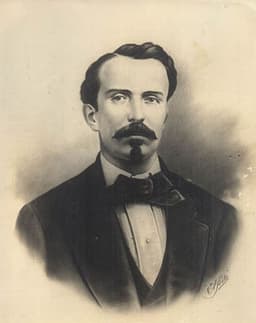
Carlos Manuel de Cespedes
Revolutionary · Modern
44.4Total

Lech Walesa
Revolutionary · Modern
52.4Total
Basic Information
Born
1819
1943
Died
1874
—
Era
Modern
Modern
Nationality
Cuba
Poland
Occupation
Revolutionary
Revolutionary
Civilization
Western
Western
Score Comparison
Military (10%)
50.0
14.2
Political (20%)
27.9
72.0
Influence (20%)
58.0
62.0
Legacy (20%)
50.0
56.0
Leadership (15%)
30.0
48.8
Strategy (15%)
36.8
33.6
TOTAL
44.4
52.4
Carlos Manuel de Cespedes — Complete Timeline
1868 AD
Grito de Yara (1868)Political Action
Carlos Manuel de C
IndependenceRevolutionTen Years' War
Impact: nationalprogressive
1869 AD
President of the Republic in Arms (1869)Political Action◆ Major
Céspedes was elected President of the Republic of Cuba in Arms by the Assembly of Guáimaro. He led the rebel government during the early years of the Ten Years' War, advocating for independence and the abolition of slavery. His leadership was marked by internal divisions.
PresidencyRebel GovernmentWar
Impact: national
1873 AD
Deposed and Killed (1873-1874)Political Action◆ Major
Céspedes was deposed as president by the rebel assembly in 1873 due to disagreements over military strategy and political direction. He was killed in a skirmish with Spanish troops in 1874. His death made him a martyr for Cuban independence.
DepositionDeathMartyr
Impact: nationaltragic
Lech Walesa — Complete Timeline
1980 AD
Founding of SolidarityPolitical Action
Walesa co-founded the Solidarity trade union in August 1980 after leading the Gda
SolidarityLabor Movement
Impact: globalprogressive
1981 AD
Martial Law and ImprisonmentPolitical Action◆ Major
Walesa was arrested and interned on December 13, 1981, when General Jaruzelski imposed martial law in Poland. He was held for 11 months, while Solidarity was banned and its leaders suppressed.
Martial LawRepression
Impact: nationaltragic
1983 AD
Nobel Peace PrizeCultural◆ Major
Walesa was awarded the Nobel Peace Prize on December 10, 1983, for his nonviolent struggle for workers' rights and democracy. He was unable to collect it in person due to travel restrictions.
Nobel PrizePeace
Impact: globalconstructive
1989 AD
Round Table TalksPolitical Action
Walesa led Solidarity in the Round Table Talks with the communist government from February to April 1989. The agreements led to partially free elections, which Solidarity won, ending communist rule in Poland.
TransitionDemocracy
Impact: globalconstructive
1990 AD
President of PolandPolitical Action◆ Major
Walesa was elected President of Poland on December 22, 1990, in the first direct presidential election. His presidency focused on economic reform and NATO integration, but was marked by political conflicts and declining popularity.
PresidencyDemocracy
Impact: national
Expert Analysis
Carlos Manuel de Cespedes vs Lech Walesa
# The Shipyard Electrician and the Sugar Planter
In a shipyard in Gdańsk, a young electrician scaled a fence and climbed onto a bulldozer, his voice carrying across a crowd of 17,000 striking workers. In a sugar plantation in eastern Cuba, a wealthy landowner freed his slaves and declared independence from the Spanish Empire, his voice barely heard beyond the cane fields. Lech Wałęsa and Carlos Manuel de Céspedes both ignited revolutions, but their paths diverged as dramatically as the centuries that separated them. One became a Nobel laureate and president; the other died in exile, shot by a Spanish patrol in the mountains. What explains the difference between triumph and tragedy?
Origins
Wałęsa was born in 1943 in the village of Popowo, Poland, into a peasant family that had lost everything in the war. His father died from exhaustion after being forced into a Nazi labor camp. The young Wałęsa left school at sixteen to become an electrician, a trade that placed him at the heart of Poland's industrial workforce. He was shaped by the grey, suffocating reality of Soviet communism—the endless queues, the lies, the fear—but also by the Catholic Church, which offered a moral alternative to state ideology.
Céspedes was born in 1819 in Bayamo, Cuba, into one of the island's wealthiest families. He studied law in Spain, traveled through Europe, and returned to Cuba as a lawyer and plantation owner. He was a man of the Enlightenment, fluent in French and English, deeply read in Rousseau and the American revolutionaries. Where Wałęsa learned politics from the shop floor, Céspedes learned it from books. Their origins determined not just their tools, but their vision: Wałęsa sought to reform an existing system; Céspedes sought to create a nation from scratch.
Rise to Power
Wałęsa's rise was slow, collective, and rooted in organization. In 1980, after leading the Gdańsk Shipyard strikes, he co-founded Solidarity, the first independent trade union in the Soviet bloc. His power came not from charisma alone but from the movement he built—ten million members, a tenth of Poland's population. When General Jaruzelski imposed martial law on December 13, 1981, Wałęsa was arrested and interned for eleven months. Yet his imprisonment only deepened his legend.
Céspedes's rise was sudden and personal. On October 10, 1868, he issued the Grito de Yara from his plantation, La Demajagua, declaring Cuban independence. He freed his own slaves and called them to arms. Within days, he had a ragtag army of a few hundred men. He was elected President of the Republic of Cuba in Arms in 1869, but his authority was always contested. Where Wałęsa built a movement before seeking power, Céspedes claimed power and then tried to build a movement.
Leadership & Governance
Wałęsa's leadership was pragmatic, patient, and nonviolent. He understood that the Soviet Union could not be defeated militarily—it had to be outlasted politically. He negotiated, compromised, and waited. His strategy was a slow erosion of communist legitimacy through strikes, negotiations, and international pressure. The Round Table Talks of 1989—where Solidarity faced the communist government across a table, not a barricade—were his masterpiece. They led to semi-free elections, which Solidarity won, and eventually to his presidency in 1990.
Céspedes's leadership was idealistic, impatient, and military. He believed that a single decisive blow could break Spanish rule. He underestimated the Spanish Empire's resolve and overestimated the Cuban population's readiness for war. As president, he struggled with internal divisions: the wealthy planters wanted a moderate republic, the former slaves wanted radical land reform, and the military commanders wanted a centralized war effort. Céspedes tried to please everyone and satisfied no one. The Assembly of Guáimaro in 1869, which drafted a constitution, actually weakened his authority by creating a civilian government that constantly second-guessed his decisions.
Triumph & Tragedy
Wałęsa's greatest moment came on December 10, 1983, when he was awarded the Nobel Peace Prize from his prison cell. The prize transformed him from a Polish dissident into a global symbol. His tragedy was the presidency itself: after 1990, he struggled to govern, his confrontational style unsuited to peacetime politics. He lost reelection in 1995, a figure of the past in a country eager to move forward.
Céspedes's tragedy was absolute. In 1873, the rebel assembly deposed him, accusing him of military incompetence and authoritarian tendencies. He retreated to a mountain hideout, where he was discovered by Spanish troops on February 27, 1874. He refused to surrender and was shot dead. His greatest moment—the Grito de Yara—had happened six years earlier. The rest was a slow descent into irrelevance and death.
Character & Destiny
Wałęsa was a survivor. He had the instincts of a labor organizer: he knew when to push and when to retreat, when to speak and when to stay silent. He was not a great intellectual—his speeches were simple, direct, and often crude—but he had an uncanny sense of timing. He understood that history moves in cycles, and that patience is a weapon.
Céspedes was a martyr waiting to happen. He had the courage of a romantic revolutionary: he believed in grand gestures, in declarations and manifestos, in the power of a single righteous act to change the world. He was a better poet than politician, a better symbol than strategist. When the Cuban poet José Martí later wrote that "the tree of liberty must be watered with blood," he might have been describing Céspedes—a man who gave everything, including his life, but could not give his people victory.
Legacy
Wałęsa is remembered as the man who helped end communism in Poland—not alone, but as its most recognizable face. His legacy is Solidarity, which survived martial law and emerged to govern. Today, his reputation is complicated by his later political career, but his place in history is secure. He proved that a shipyard electrician could topple an empire.
Céspedes is remembered as the Father of the Cuban Nation. The Grito de Yara is celebrated as the beginning of Cuba's independence struggle, even though it failed. His death made him a symbol of sacrifice, and later revolutionaries—including Fidel Castro—would invoke his name. But his legacy is also a warning: idealism without strategy leads to defeat.
Conclusion
Standing in the Gdańsk shipyard in 1980, Wałęsa could have been Céspedes. Both men faced empires that seemed invincible. Both men had nothing but courage and a cause. But Wałęsa lived in a different world—a world of television cameras, international pressure, and a Soviet Union that was already rotting from within. Céspedes faced an empire that was still strong, a population that was still divided, and a century that had no mercy on failed revolutions.
The difference between them is not just character, but history itself. Wałęsa succeeded because the time was right. Céspedes failed because the time was not. And that, perhaps, is the cruelest lesson of revolution: it does not matter how much you are willing to sacrifice. It only matters whether the world is ready to receive your gift.
Rankings
🥇
Lech WalesaLeader
Mil: 14.2Pol: 72.0Inf: 62.0
52.4
🥈
Carlos Manuel de Cespedes
Mil: 50.0Pol: 27.9Inf: 58.0
44.4
+8.0 behind
How This Comparison Works
Algorithm
Each figure is scored on 6 dimensions (0—100 scale) based on structured historical data: Military (10%), Political (20%), Influence (20%), Legacy (20%), Leadership (15%), Strategy (15%). The weighted total produces the final ranking.
Data Sources
Scores are computed from structured sub-indicators in the database. Scale factors adjust for era (Ancient ×0.85, Modern ×1.0) and civilization size (Eastern ×1.05, Other ×0.80) to account for differences in population and military scale.
Maximum 3 Figures
Comparisons are limited to 2—3 figures to ensure readability and statistical meaningfulness.
Error Margins
±5 points per dimension — Sub-scores are derived from historical records with inherent uncertainty. Two figures within 5 points on a dimension should be considered roughly equivalent in that area.
Total Score Accuracy
±3 points overall — The weighted combination of 6 dimensions produces a total score with approximately ±3 points of uncertainty. Differences of less than 3 points are not statistically significant— the figures are effectively tied.
Known Limitations
- Historical records are incomplete and uneven across civilizations
- Figures from oral-tradition societies may be underrepresented
- Occupation labels can misclassify multi-role figures
- Scores measure capability and impact, not moral character
- Quantitative scoring is a comparison tool, not absolute truth
Capability Radar
Military (10%) — Battles & Warfare
Battles
30
9
Win Rate
25
14
Expansion
10
17
Political (20%) — Governance & Reform
Reform
40
85
Diplomacy
25
80
Economy
15
55
Influence (20%) — Cultural & Global Reach
Cultural
60
70
Global
50
70
Legacy (20%) — Historical Impact
Historical
65
75
Longevity
55
65
Leadership (15%) — Power & Stability
Tenure
30
65
Stability
10
60
Strategy (15%) — Tactics & Innovation
Strategy
25
21
Tactics
20
24
Reform
15
27
Similar Comparisons
Comments & Discussion
历史秤砣6/16/2026
把工人运动和独立战争硬拉到一起比较,根本是风马牛不相及。瓦文萨面对的是可以去谈判的官僚体制,塞斯佩德斯面对的是想把你全家吊死的殖民军队。前者是政治博弈,后者是生死存亡。别再假装它们在同一套标准下可以比较了。
Machete Historian6/16/2026
Military context is everything. Walesa had the Cold War superpowers scared of escalation; Cespedes had scattered rebels against a Spanish army with decades of counterinsurgency experience. The Gdańsk strike was a chess match with TV cameras and international observers. The Cuban insurgency was a knife fight in the dark where surrender meant execution. That's not luck—that's the difference between a strike and a colonial war.
古典学观察者6/16/2026
瓦文萨的成功是20世纪城市工人阶级的胜利,塞斯佩德斯的失败是19世纪乡绅阶级的必然命运。一个是流水线上的普通人找到组织力量,另一个是庄园主试图用祖宗家产和欧洲人拼血肉。别再美化那个所谓"英勇牺牲"的结尾了——他的战略失误才是他葬身山野的真正原因。
GovernanceEye6/16/2026
The real difference? Walesa had 20th-century media and global solidarity; Cespedes had machetes and malaria. Walesa's strike was televised, his face on every front page. Cespedes' cry for independence was swallowed by jungle, his name known only to historians. Walesa won because the world was watching; Cespedes lost because nobody cared.
PaullusTheUnbroken6/16/2026
Walesa was a trade unionist who won a negotiating prize; Cespedes was a revolutionary who lost everything. One signed papers, the other signed his death warrant. The "Shipyard Electrician" became president by talking, the "Sugar Planter" died in a mountain ambush by fighting. Let's not pretend these are the same type of leader.