Loading...
Carlos Manuel de Cespedes vs Zumbi dos Palmares
Carlos Manuel de Cespedes leads by 0.0 pts · 2 figures compared
…
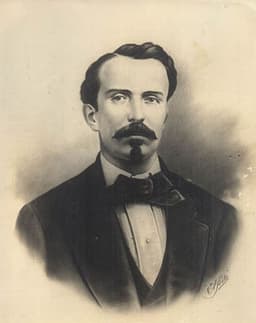
Carlos Manuel de Cespedes
Revolutionary · Modern
44.4Total

Zumbi dos Palmares
Revolutionary · Modern
44.4Total
Basic Information
Born
1819
1655
Died
1874
1695
Era
Modern
Modern
Nationality
Cuba
Brazil
Occupation
Revolutionary
Revolutionary
Civilization
Western
Western
Score Comparison
Military (10%)
50.0
45.0
Political (20%)
27.9
27.9
Influence (20%)
58.0
55.7
Legacy (20%)
50.0
49.2
Leadership (15%)
30.0
36.9
Strategy (15%)
36.8
40.0
TOTAL
44.4
44.4
Carlos Manuel de Cespedes — Complete Timeline
1868 AD
Grito de Yara (1868)Political Action
Carlos Manuel de C
IndependenceRevolutionTen Years' War
Impact: nationalprogressive
1869 AD
President of the Republic in Arms (1869)Political Action◆ Major
Céspedes was elected President of the Republic of Cuba in Arms by the Assembly of Guáimaro. He led the rebel government during the early years of the Ten Years' War, advocating for independence and the abolition of slavery. His leadership was marked by internal divisions.
PresidencyRebel GovernmentWar
Impact: national
1873 AD
Deposed and Killed (1873-1874)Political Action◆ Major
Céspedes was deposed as president by the rebel assembly in 1873 due to disagreements over military strategy and political direction. He was killed in a skirmish with Spanish troops in 1874. His death made him a martyr for Cuban independence.
DepositionDeathMartyr
Impact: nationaltragic
Zumbi dos Palmares — Complete Timeline
1670 AD
Escape from CaptivityPolitical Action◆ Major
Zumbi escaped from Portuguese captivity as a child, returning to Quilombo dos Palmares. He grew up within the maroon community, learning military tactics and becoming a leader in the resistance against Portuguese slave raids.
EscapeMaroon CommunityResistance
1680 AD
Leadership of Quilombo dos PalmaresPolitical Action◆ Major
Zumbi became the leader of Quilombo dos Palmares, the largest community of escaped slaves in colonial Brazil. Under his leadership, Palmares grew to a population of over 20,000, organizing a self-sufficient society with agriculture, trade, and military defense.
LeadershipMaroon SocietyResistance
Impact: regionalconstructive
1694 AD
Fall of PalmaresWar
Portuguese forces under Domingos Jorge Velho launched a massive assault on Palmares, capturing the main settlement after a prolonged siege. Zumbi escaped but the destruction of Palmares marked the end of the largest maroon community in the Americas.
SiegePortuguese ConquestEnd of Palmares
Impact: regionaltragic
Refusal of Portuguese Peace TreatyPolitical Action◆ Major
Zumbi rejected a peace treaty offered by Portuguese authorities that would have recognized Palmares' autonomy in exchange for accepting Portuguese sovereignty. He chose continued resistance over submission, leading to intensified military campaigns against Palmares.
Peace TreatyResistancePortuguese Colonialism
Impact: regional
1695 AD
Capture and DeathPolitical Action◆ Major
Zumbi was captured by Portuguese forces after being betrayed by a former lieutenant. He was executed, with his head displayed in Recife to discourage further slave revolts. His death became a symbol of resistance against slavery in Brazil.
ExecutionSlavery ResistanceMartyrdom
Impact: regionaltragic
Expert Analysis
Origins
Carlos Manuel de Céspedes was born on April 18, 1819, in Bayamo, Cuba, into a wealthy landowning family. He studied law at the University of Havana and later in Spain, where he was exposed to liberal and independence ideas. Returning to Cuba in 1844, he inherited a sugar plantation, La Demajagua, and became a prosperous planter. Despite his privileged background, Céspedes grew increasingly opposed to Spanish colonial rule and the institution of slavery, which he personally benefited from.
Zumbi dos Palmares was born around 1655 in the captaincy of Pernambuco, Brazil, but was captured as a child and given to a Portuguese missionary, Father Antônio Melo. He was baptized as Francisco and educated in Portuguese and Latin. At age 15, Zumbi escaped and returned to Quilombo dos Palmares, the largest community of escaped slaves in colonial Brazil. He grew up among the maroons, learning military tactics, leadership, and the values of resistance and freedom. Unlike Céspedes, Zumbi's early life was shaped by captivity and the struggle for survival.
Rise to Power
Céspedes's rise began on October 10, 1868, when he issued the Grito de Yara (Cry of Yara) from his plantation, freeing his slaves and declaring Cuba's independence from Spain. This act sparked the Ten Years' War (1868–1878), Cuba's first major independence struggle. Céspedes's leadership was quickly recognized, and in 1869 he was elected President of the Republic in Arms by the Assembly of Guáimaro. His political authority, however, was contested by other rebel leaders who favored a more centralized government and military strategy.
Zumbi's rise to power within Palmares occurred after the death of the previous leader, Ganga Zumba. Zumbi distinguished himself as a fierce warrior and strategist, opposing any compromise with Portuguese authorities. In 1678, when Ganga Zumba accepted a peace treaty that would relocate Palmares residents to a reservation under Portuguese control, Zumbi led a revolt, killed Ganga Zumba, and assumed leadership. He refused to submit to Portuguese sovereignty, insisting on complete autonomy. His rise was thus marked by internal conflict and a rejection of negotiated peace.
Leadership & Governance
Céspedes governed as a liberal reformer, aiming to establish a republic with democratic institutions. He freed his own slaves and advocated for gradual abolition, but his reliance on the planter class limited radical social change. His leadership score of 30.0 reflects his inability to maintain political unity. Céspedes's governance was hampered by factionalism; the Assembly of Guáimaro created a civilian government that often clashed with military commanders, particularly General Máximo Gómez. Céspedes's political score of 27.9 indicates his struggles in balancing war and governance.
Zumbi led Palmares as a militarized community with a council of leaders, but he held ultimate authority. His leadership score of 36.9 shows more effective command in a crisis. Zumbi enforced strict discipline and organized Palmares into a fortified state capable of withstanding repeated Portuguese assaults. He rejected any form of subjugation, even when offered autonomy. His political score of 27.9 matches Céspedes's, reflecting the challenges of governing a fugitive slave society under constant threat. Zumbi's governance was more authoritarian, suited to survival, while Céspedes attempted democratic structures in wartime.
Triumph & Tragedy
Céspedes's greatest triumph was igniting the Cuban independence movement, which ultimately led to freedom from Spain in 1898. His Grito de Yara is celebrated as the birth of the Cuban nation. However, his tragedy was his deposition by his own side in 1873 due to disagreements over military strategy and his subsequent death in 1874, killed by Spanish troops while hiding in the mountains. He died isolated, his reputation tarnished by internal conflicts. His military score of 50.0 reflects limited direct command, while his legacy score of 50.0 shows his foundational role.
Zumbi's triumph was sustaining Palmares for over a decade against superior Portuguese forces, becoming a symbol of resistance. He successfully repelled multiple attacks and expanded the community. His tragedy was the final fall of Palmares in 1694 after a prolonged siege by the bandeirante Domingos Jorge Velho. Zumbi escaped but was betrayed by a former lieutenant, captured in 1695, and executed. His head was displayed in Recife to deter rebellion. His military score of 45.0 reflects effective guerrilla tactics, while his legacy score of 49.2 underscores his enduring symbolic power.
Character & Destiny
Céspedes was an idealist and a democrat, committed to liberal principles even when they hindered the war effort. His character—principled but inflexible—led to his downfall. He refused to compromise with more authoritarian military leaders, resulting in his deposition. His destiny was to be a martyr for Cuban independence, but his failure to unify the rebellion limited his immediate impact. Historical assessments note his courage but also his political naivete.
Zumbi was a pragmatist and a fighter, shaped by the brutality of slavery. His refusal to negotiate with the Portuguese, even when offered autonomy, demonstrated his uncompromising stance. This determination inspired his followers but also prevented any peaceful resolution. His character—resolute and strategic—made him a legendary figure, but also led to his violent death. Historians see Zumbi as a symbol of black resistance in the Americas, his legacy amplified by his martyrdom.
Legacy
Céspedes is revered as the "Father of the Cuban Nation." His Grito de Yara is a national holiday, and his image appears on Cuban currency. However, his legacy is overshadowed by later figures like José Martí. His influence score of 58.0 shows his importance, but his direct impact on Cuba's eventual independence was indirect. The Ten Years' War he started exhausted Spain and laid groundwork for later struggles.
Zumbi's legacy is immense in Brazil and globally. He is a symbol of Afro-Brazilian resistance and pride. The Dia da Consciência Negra (Black Consciousness Day) on November 20 commemorates his death. His influence score of 55.7 is slightly lower than Céspedes's, but his cultural resonance is profound. Zumbi represents the fight against slavery and oppression, inspiring movements for racial equality. His legacy score of 49.2 reflects his enduring status as a hero.
Conclusion
While both scored identically at 44.4 overall, Zumbi dos Palmares had a greater impact in terms of symbolic and cultural legacy. Céspedes's political and leadership scores were lower, and his failure to maintain unity diminished his effectiveness. Zumbi's higher leadership (36.9 vs 30.0) and strategy (40.0 vs 36.8) scores reflect his ability to lead a community under constant siege. Zumbi's refusal to compromise and his martyrdom created a more powerful and lasting symbol of resistance. Céspedes's role as a founder is significant, but Zumbi's legacy transcends national boundaries, representing global black liberation. Therefore, Zumbi dos Palmares is the more impactful figure.
Rankings
🥇
Carlos Manuel de CespedesLeader
Mil: 50.0Pol: 27.9Inf: 58.0
44.4
🥈
Zumbi dos Palmares
Mil: 45.0Pol: 27.9Inf: 55.7
44.4
How This Comparison Works
Algorithm
Each figure is scored on 6 dimensions (0—100 scale) based on structured historical data: Military (10%), Political (20%), Influence (20%), Legacy (20%), Leadership (15%), Strategy (15%). The weighted total produces the final ranking.
Data Sources
Scores are computed from structured sub-indicators in the database. Scale factors adjust for era (Ancient ×0.85, Modern ×1.0) and civilization size (Eastern ×1.05, Other ×0.80) to account for differences in population and military scale.
Maximum 3 Figures
Comparisons are limited to 2—3 figures to ensure readability and statistical meaningfulness.
Error Margins
±5 points per dimension — Sub-scores are derived from historical records with inherent uncertainty. Two figures within 5 points on a dimension should be considered roughly equivalent in that area.
Total Score Accuracy
±3 points overall — The weighted combination of 6 dimensions produces a total score with approximately ±3 points of uncertainty. Differences of less than 3 points are not statistically significant— the figures are effectively tied.
Known Limitations
- Historical records are incomplete and uneven across civilizations
- Figures from oral-tradition societies may be underrepresented
- Occupation labels can misclassify multi-role figures
- Scores measure capability and impact, not moral character
- Quantitative scoring is a comparison tool, not absolute truth
Capability Radar
Military (10%) — Battles & Warfare
Battles
30
35
Win Rate
25
30
Expansion
10
30
Political (20%) — Governance & Reform
Reform
40
35
Diplomacy
25
20
Economy
15
25
Influence (20%) — Cultural & Global Reach
Cultural
60
55
Global
50
50
Legacy (20%) — Historical Impact
Historical
65
60
Longevity
55
55
Leadership (15%) — Power & Stability
Tenure
30
30
Stability
10
20
Strategy (15%) — Tactics & Innovation
Strategy
25
35
Tactics
20
40
Reform
15
25
Similar Comparisons
Comments & Discussion
No comments yet. Be the first to share your thoughts!