Loading...
Chandragupta II vs Marcus Aurelius
Chandragupta II leads by 6.2 pts · 2 figures compared
…
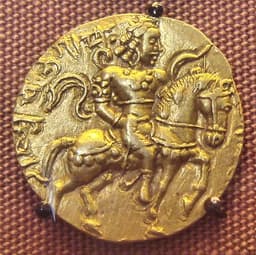
Chandragupta II
Emperor · Ancient
74.7Total

Marcus Aurelius
Emperor · Ancient
68.5Total
Basic Information
Born
380
121
Died
415
180
Era
Ancient
Ancient
Nationality
India
Roman Empire
Occupation
Emperor
Emperor
Civilization
Indian
Western
Score Comparison
Military (10%)
74.0
70.0
Political (20%)
78.0
72.0
Influence (20%)
88.0
68.0
Legacy (20%)
65.0
65.0
Leadership (15%)
72.0
79.8
Strategy (15%)
65.4
55.0
TOTAL
74.7
68.5
Chandragupta II — Complete Timeline
380 AD
Accession to the Gupta ThronePolitical Action
Chandragupta II succeeded his father Samudragupta as emperor of the Gupta Empire. He inherited a vast territory and continued the expansionist policies, further consolidating Gupta power in northern India.
Gupta EmpireSuccessionExpansion
Impact: regional
385 AD
Marriage Alliance with the VakatakasPolitical Action◆ Major
Chandragupta II married his daughter Prabhavatigupta to the Vakataka king Rudrasena II. After Rudrasena's death, Prabhavatigupta ruled as regent, effectively bringing the Vakataka kingdom under Gupta influence and securing the Deccan frontier.
VakatakaAllianceDeccan
Impact: regionalconstructive
395 AD
Conquest of the Western SatrapsWar◆ Major
Chandragupta II defeated the Western Kshatrapas (Saka rulers) in Gujarat and Malwa, annexing their territories. This conquest gave the Gupta Empire access to the Arabian Sea ports and control over lucrative trade routes with the Roman Empire.
Western SatrapsGujaratTrade
Impact: regional
400 AD
Patronage of the Golden Age of Gupta CultureCultural◆ Major
Chandragupta II's court included the poet Kalidasa, the astronomer Varahamihira, and other scholars. This period saw the flourishing of Sanskrit literature, art, and science, often considered the peak of classical Indian culture.
Golden AgeKalidasaSanskrit Literature
Impact: regionalconstructive
405 AD
Visit of the Chinese Pilgrim FaxianCultural
The Chinese Buddhist monk Faxian visited the Gupta Empire during Chandragupta II's reign. Faxian recorded the prosperity, religious tolerance, and efficient administration of the empire, providing valuable historical documentation.
FaxianChinese PilgrimBuddhism
Impact: regionalconstructive
Marcus Aurelius — Complete Timeline
161 AD
Became Roman EmperorPolitical Action◆ Major
Marcus Aurelius succeeded Antoninus Pius as Roman Emperor in 161 CE, initially co-ruling with Lucius Verus. His accession marked the beginning of a reign that would be defined by constant warfare and the Antonine Plague, testing his Stoic principles.
SuccessionRoman EmpireCo-Emperor
Impact: global
165 AD
Endured the Antonine PlagueOther◆ Major
The Antonine Plague, likely smallpox, swept through the Roman Empire during Marcus Aurelius's reign, killing an estimated 5-10 million people. The epidemic weakened the military and economy, contributing to the empire's long-term decline and forcing the emperor to recruit slaves and gladiators.
PlaguePandemicRoman Empire
Impact: globaltragic
166 AD
Fought the Marcomannic WarsWar◆ Major
Marcus Aurelius led Roman forces in a series of campaigns along the Danube frontier against the Marcomanni, Quadi, and other Germanic tribes. The wars lasted from 166 to 180 CE, straining the empire's resources and requiring the emperor to spend years on the front lines.
Danube FrontierGermanic TribesWar
Impact: regional
170 AD
Wrote MeditationsCultural
During his military campaigns, Marcus Aurelius composed his personal philosophical writings, later known as Meditations. The work, written in Greek, consists of Stoic reflections on duty, mortality, and self-discipline, and has become a foundational text of Western philosophy.
PhilosophyStoicismLiterature
Impact: globalconstructive
177 AD
Appointed Commodus as SuccessorPolitical Action◆ Major
Marcus Aurelius appointed his son Commodus as co-emperor and successor, breaking the tradition of adopting capable successors. Commodus's subsequent tyrannical rule is often cited as a turning point in Rome's decline, marking the end of the Pax Romana.
SuccessionCommodusPax Romana
Impact: globaltragic
Expert Analysis
Origins
Chandragupta II, born circa 380 CE, was the son of Samudragupta, the second Gupta emperor. He belonged to the Gupta dynasty, which had risen from a small kingdom in Magadha to a major power. His mother was likely a queen of the Licchavi clan. Little is known of his early education, but he was trained in statecraft and military arts. He ascended the throne around 380 CE, inheriting a vast empire that stretched from the Indus to the Bay of Bengal.
Marcus Aurelius was born on April 26, 121 CE, in Rome, into a prominent senatorial family. His father died young, and he was raised by his grandfather and mother. He was educated by private tutors, including the philosopher Diognetus, who introduced him to Stoicism. At age 17, he was adopted by Emperor Antoninus Pius as part of Hadrian's succession plan, grooming him for rule. He married Faustina the Younger in 145 CE.
Rise to Power
Chandragupta II rose to power by succeeding his father Samudragupta, who had conquered numerous kingdoms. Chandragupta II continued expansionist policies, but his most significant military achievement was the conquest of the Western Satraps (Saka rulers) in Gujarat and Malwa around 395-409 CE. This campaign eliminated a major rival and gave the Gupta Empire access to the Arabian Sea ports, boosting trade. He also secured a marriage alliance with the Vakataka kingdom, marrying his daughter Prabhavatigupta to Rudrasena II. After Rudrasena's death, she ruled as regent, effectively bringing the Vakataka realm under Gupta influence.
Marcus Aurelius became Roman emperor in 161 CE, co-ruling with Lucius Verus. He was the adopted heir of Antoninus Pius, who had groomed him for the role. His accession was peaceful, but his reign was immediately challenged by wars and plague. He faced the Parthian War (161-166 CE) led by Verus, and after Verus's death in 169 CE, Marcus took sole command. He spent most of his reign on the Danube frontier fighting the Marcomannic Wars (166-180 CE) against Germanic tribes.
Leadership & Governance
Chandragupta II ruled through a centralized bureaucracy with provincial governors. He maintained a tolerant religious policy, supporting Hinduism, Buddhism, and Jainism. His administration was efficient, with low taxes and a stable currency. The Chinese pilgrim Faxian visited during his reign and recorded prosperity, noting that people were free to travel without passports and that the government provided hospitals and rest houses. Chandragupta II's patronage of culture was exceptional: his court hosted the poet Kalidasa, the astronomer Varahamihira, and the grammarian Amarasimha. This period saw the composition of classics like *Shakuntala* and *Meghaduta*.
Marcus Aurelius governed as a philosopher-king, deeply influenced by Stoicism. He emphasized duty, justice, and resilience, as recorded in his *Meditations*. He improved Roman law and administration, but his reign was dominated by crisis. He sold personal belongings to fund the war effort during the Antonine Plague (165-180 CE), which killed 5-10 million people. He appointed capable generals like Avidius Cassius, but also faced rebellions. His leadership score of 79.8 reflects his personal integrity and dedication, but his political score of 72.0 is lower due to his failure to manage succession effectively.
Triumph & Tragedy
Chandragupta II's greatest triumph was the conquest of the Western Satraps, which expanded the Gupta Empire to its maximum territorial extent. He also fostered a cultural golden age, with Sanskrit literature and science reaching new heights. His scores of 88.0 in influence and 65.4 in strategy highlight his cultural impact but moderate strategic brilliance. His tragedy was that his successors, particularly Kumaragupta I and Skandagupta, faced Hunnic invasions that weakened the empire. While Chandragupta II's reign was stable, he did not fully address the threat of nomadic invasions from the northwest.
Marcus Aurelius's triumph was his steadfast defense of the Roman Empire during multiple crises. He successfully repelled Germanic invasions and stabilized the Danubian frontier. His *Meditations* remain a foundational text of Stoic philosophy, earning him a lasting influence score of 68.0. His tragedy was the Antonine Plague, which devastated the population and army, and his choice of his son Commodus as successor. Commodus's misrule (180-192 CE) led to civil war and the end of the Pax Romana. Marcus's military score of 70.0 and strategy score of 55.0 indicate he was a competent but not brilliant commander.
Character & Destiny
Chandragupta II was known as Vikramaditya (Sun of Power), a title reflecting his martial and cultural achievements. He was pragmatic, forming alliances through marriage and conquest. His character was shaped by a confident, expansionist mindset. However, his reliance on a centralized bureaucracy made the empire vulnerable to weak successors. His destiny was to preside over India's classical age, but his dynasty's decline began within a century.
Marcus Aurelius was a Stoic philosopher who valued reason and duty. His *Meditations* reveal a man grappling with the burdens of power, war, and mortality. He was disciplined but sometimes indecisive, as when he pardoned the rebel Avidius Cassius. His character led him to prioritize personal virtue over political pragmatism, especially in appointing Commodus. His destiny was to be the last of the Five Good Emperors, after which Rome descended into instability.
Legacy
Chandragupta II's legacy is the Gupta Golden Age, which set standards for Indian classical culture. His reign influenced literature, art, and science for centuries. The Gupta Empire became a model for later kingdoms. His influence score of 88.0 reflects this enduring cultural impact. In contrast, Marcus Aurelius's legacy is twofold: as a philosopher-king whose *Meditations* inspire readers today, and as the emperor who failed to secure a stable succession. His legacy score of 65.0 is lower because his philosophical work overshadows his political achievements.
Conclusion
Chandragupta II had greater impact on civilization than Marcus Aurelius. His rule created a stable, prosperous empire that fostered cultural and scientific achievements, influencing a large portion of Asia. Marcus Aurelius, while personally admirable, presided over a period of decline and his philosophical writings, though significant, did not prevent the empire's deterioration. Chandragupta II's total score of 74.7 vs Marcus's 68.5 reflects this: Chandragupta excelled in influence (88 vs 68) and strategy (65.4 vs 55), while Marcus only led in leadership (79.8 vs 72). Chandragupta II's legacy of a golden age outweighs Marcus Aurelius's stoic endurance.
Rankings
🥇
Chandragupta IILeader
Mil: 74.0Pol: 78.0Inf: 88.0
74.7
🥈
Marcus Aurelius
Mil: 70.0Pol: 72.0Inf: 68.0
68.5
+6.2 behind
How This Comparison Works
Algorithm
Each figure is scored on 6 dimensions (0—100 scale) based on structured historical data: Military (10%), Political (20%), Influence (20%), Legacy (20%), Leadership (15%), Strategy (15%). The weighted total produces the final ranking.
Data Sources
Scores are computed from structured sub-indicators in the database. Scale factors adjust for era (Ancient ×0.85, Modern ×1.0) and civilization size (Eastern ×1.05, Other ×0.80) to account for differences in population and military scale.
Maximum 3 Figures
Comparisons are limited to 2—3 figures to ensure readability and statistical meaningfulness.
Error Margins
±5 points per dimension — Sub-scores are derived from historical records with inherent uncertainty. Two figures within 5 points on a dimension should be considered roughly equivalent in that area.
Total Score Accuracy
±3 points overall — The weighted combination of 6 dimensions produces a total score with approximately ±3 points of uncertainty. Differences of less than 3 points are not statistically significant— the figures are effectively tied.
Known Limitations
- Historical records are incomplete and uneven across civilizations
- Figures from oral-tradition societies may be underrepresented
- Occupation labels can misclassify multi-role figures
- Scores measure capability and impact, not moral character
- Quantitative scoring is a comparison tool, not absolute truth
Capability Radar
Military (10%) — Battles & Warfare
Battles
75
70
Win Rate
80
65
Expansion
80
40
Political (20%) — Governance & Reform
Reform
80
70
Diplomacy
75
75
Economy
90
60
Influence (20%) — Cultural & Global Reach
Cultural
95
85
Global
70
80
Legacy (20%) — Historical Impact
Historical
90
90
Longevity
85
95
Leadership (15%) — Power & Stability
Tenure
85
85
Stability
85
65
Strategy (15%) — Tactics & Innovation
Strategy
75
75
Tactics
70
60
Reform
65
55
Similar Comparisons
Comments & Discussion
No comments yet. Be the first to share your thoughts!