Loading...
Chandragupta II vs Napoleon Bonaparte
Chandragupta II leads by 3.8 pts · 2 figures compared
…
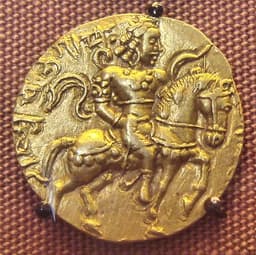
Chandragupta II
Emperor · Ancient
74.7Total

Napoleon Bonaparte
General · Modern
70.9Total
Basic Information
Born
380
1769
Died
415
1821
Era
Ancient
Modern
Nationality
India
France
Occupation
Emperor
General
Civilization
Indian
Western
Score Comparison
Military (10%)
74.0
94.0
Political (20%)
78.0
72.0
Influence (20%)
88.0
40.0
Legacy (20%)
65.0
80.0
Leadership (15%)
72.0
78.0
Strategy (15%)
65.4
90.0
TOTAL
74.7
70.9
Chandragupta II — Complete Timeline
380 AD
Accession to the Gupta ThronePolitical Action
Chandragupta II succeeded his father Samudragupta as emperor of the Gupta Empire. He inherited a vast territory and continued the expansionist policies, further consolidating Gupta power in northern India.
Gupta EmpireSuccessionExpansion
Impact: regional
385 AD
Marriage Alliance with the VakatakasPolitical Action◆ Major
Chandragupta II married his daughter Prabhavatigupta to the Vakataka king Rudrasena II. After Rudrasena's death, Prabhavatigupta ruled as regent, effectively bringing the Vakataka kingdom under Gupta influence and securing the Deccan frontier.
VakatakaAllianceDeccan
Impact: regionalconstructive
395 AD
Conquest of the Western SatrapsWar◆ Major
Chandragupta II defeated the Western Kshatrapas (Saka rulers) in Gujarat and Malwa, annexing their territories. This conquest gave the Gupta Empire access to the Arabian Sea ports and control over lucrative trade routes with the Roman Empire.
Western SatrapsGujaratTrade
Impact: regional
400 AD
Patronage of the Golden Age of Gupta CultureCultural◆ Major
Chandragupta II's court included the poet Kalidasa, the astronomer Varahamihira, and other scholars. This period saw the flourishing of Sanskrit literature, art, and science, often considered the peak of classical Indian culture.
Golden AgeKalidasaSanskrit Literature
Impact: regionalconstructive
405 AD
Visit of the Chinese Pilgrim FaxianCultural
The Chinese Buddhist monk Faxian visited the Gupta Empire during Chandragupta II's reign. Faxian recorded the prosperity, religious tolerance, and efficient administration of the empire, providing valuable historical documentation.
FaxianChinese PilgrimBuddhism
Impact: regionalconstructive
Napoleon Bonaparte — Complete Timeline
1799 AD
Coup of 18 BrumaireOther◆ Major
Napoleon Bonaparte, with support from his brother Lucien and key political figures, overthrew the Directory in a bloodless coup. He established the Consulate with himself as First Consul, effectively becoming the ruler of France. This event ended the French Revolution's most unstable period.
French RevolutionCoupRise to Power
Impact: regional
1804 AD
Promulgation of the Napoleonic CodeOther◆ Major
Napoleon enacted the Civil Code of the French, known as the Napoleonic Code, a comprehensive set of laws that replaced the fragmented feudal legal systems. The code established legal equality, protected property rights, and secularized law. It became the basis for legal systems in many European and world countries.
Legal ReformNapoleonic CodeCivil Law
Impact: globalconstructive
1805 AD
Battle of AusterlitzWar◆ Major
Napoleon's Grande Arm
Napoleonic WarsBattleDecisive Victory
Impact: global
1812 AD
Invasion of RussiaWar◆ Major
Napoleon led the Grande Arm
Napoleonic WarsInvasionDisaster
Impact: globaldestructive
1815 AD
Battle of WaterlooWar◆ Major
Napoleon's French army was defeated by the combined forces of the Duke of Wellington's Anglo-Allied army and Gebhard Leberecht von Bl
Napoleonic WarsBattleFinal Defeat
Impact: globaldestructive
Expert Analysis
Origins
Chandragupta II, also known as Chandragupta Vikramaditya, was born around 380 CE into the Gupta dynasty, the son of the great emperor Samudragupta. He inherited a realm that already spanned much of northern India. His early life was steeped in the traditions of Hindu kingship and military training, but little specific detail survives. In contrast, Napoleon Bonaparte was born in 1769 on the island of Corsica, shortly after its annexation by France. His family was minor nobility, and he was educated at military schools in mainland France. His early years were marked by ambition and resentment against the French establishment, which he later came to dominate.
Rise to Power
Chandragupta II ascended the Gupta throne around 380 CE, following his father Samudragupta's death. He continued the expansionist policies, but his rise was not marked by dramatic coups. Instead, he consolidated power through strategic marriages and military campaigns. His major turning point was the conquest of the Western Kshatrapas (Saka rulers) in Gujarat and Malwa around 395-410 CE, which gave the Gupta Empire access to key trade routes. Napoleon's rise was far more meteoric. He first gained fame as a young artillery officer during the Siege of Toulon in 1793, then rose through the ranks during the Italian campaign of 1796-1797. His coup of 18 Brumaire (November 9, 1799) overthrew the Directory, making him First Consul. By 1804, he crowned himself Emperor of the French.
Leadership & Governance
Chandragupta II ruled as a monarch with a decentralized administration. He maintained the Gupta tradition of granting autonomy to local rulers while collecting tribute. His governance was marked by religious tolerance, as seen in the accounts of the Chinese pilgrim Faxian, who visited during his reign. Faxian recorded a prosperous, peaceful kingdom with efficient justice and free hospitals. Chandragupta's court was a hub of culture, patronizing scholars like the poet Kalidasa and the astronomer Varahamihira. In contrast, Napoleon centralized power in France, streamlining the bureaucracy and implementing the Napoleonic Code, which standardized laws across Europe. His governance was efficient but authoritarian, suppressing dissent and controlling the press. While Chandragupta's leadership fostered cultural flourishing, Napoleon's focused on legal and administrative modernization.
Triumph & Tragedy
Chandragupta II's greatest triumph was the conquest of the Western Satraps, which expanded Gupta territory to the Arabian Sea and boosted trade. His patronage led to the Gupta Golden Age, producing masterpieces of Sanskrit literature and art. However, his empire faced challenges from the Huns later, and his reign saw no major military disasters. His tragedy lay in the eventual decline of the Gupta Empire after his death, partly due to weak successors. Napoleon's triumphs include the Battle of Austerlitz (1805), where he defeated the combined Russian and Austrian armies, and the Napoleonic Code, which influenced legal systems worldwide. His catastrophic failures were the invasion of Russia in 1812, where he lost over 400,000 men, and the Battle of Waterloo in 1815, which ended his rule. He died in exile on Saint Helena in 1821.
Character & Destiny
Chandragupta II was known as Vikramaditya (Sun of Valor), reflecting his reputation for bravery and justice. He was a shrewd diplomat, using marriage alliances to extend influence. His character was shaped by Hindu ideals of kingship, balancing conquest with patronage. Napoleon was a brilliant strategist with an insatiable ambition, leading him to overreach. His personality combined charisma with arrogance, alienating allies and provoking coalitions against him. His destiny was shaped by his inability to stop, leading to his downfall. Historians note that Chandragupta's moderate approach ensured stability, while Napoleon's relentless drive caused his empire to collapse.
Legacy
Chandragupta II's legacy is the Gupta Golden Age, which set high standards in art, literature, and science. He is remembered as a model Hindu king, and his era is often called the classical age of India. The cultural achievements of his court influenced Indian civilization for centuries. Napoleon's legacy is more complex: he spread the ideals of the French Revolution through his conquests, reformed European law, but also caused immense destruction. His military tactics are still studied, and his code remains foundational in many countries. In terms of lasting impact, Napoleon's political and legal influence is broader geographically, while Chandragupta's cultural legacy is deeper within India.
Conclusion
Comparing Chandragupta II (total score 67.9) and Napoleon (82.4) reveals two different kinds of greatness. Napoleon's military genius (94.0 vs 63.2) and political impact reshaped Europe, but his failures were catastrophic. Chandragupta's moderate scores reflect a different style: he built a stable, culturally rich empire that endured for generations after his death. While Napoleon's influence spread across continents, Chandragupta's golden age left a more profound cultural legacy within India. Ultimately, Napoleon's greater total score aligns with his broader global impact, but Chandragupta's achievement in fostering a golden age under stable governance is equally remarkable in its own context.
Rankings
🥇
Chandragupta IILeader
Mil: 74.0Pol: 78.0Inf: 88.0
74.7
🥈
Napoleon Bonaparte
Mil: 94.0Pol: 72.0Inf: 40.0
70.9
+3.8 behind
How This Comparison Works
Algorithm
Each figure is scored on 6 dimensions (0—100 scale) based on structured historical data: Military (10%), Political (20%), Influence (20%), Legacy (20%), Leadership (15%), Strategy (15%). The weighted total produces the final ranking.
Data Sources
Scores are computed from structured sub-indicators in the database. Scale factors adjust for era (Ancient ×0.85, Modern ×1.0) and civilization size (Eastern ×1.05, Other ×0.80) to account for differences in population and military scale.
Maximum 3 Figures
Comparisons are limited to 2—3 figures to ensure readability and statistical meaningfulness.
Error Margins
±5 points per dimension — Sub-scores are derived from historical records with inherent uncertainty. Two figures within 5 points on a dimension should be considered roughly equivalent in that area.
Total Score Accuracy
±3 points overall — The weighted combination of 6 dimensions produces a total score with approximately ±3 points of uncertainty. Differences of less than 3 points are not statistically significant— the figures are effectively tied.
Known Limitations
- Historical records are incomplete and uneven across civilizations
- Figures from oral-tradition societies may be underrepresented
- Occupation labels can misclassify multi-role figures
- Scores measure capability and impact, not moral character
- Quantitative scoring is a comparison tool, not absolute truth
Capability Radar
Military (10%) — Battles & Warfare
Battles
75
95
Win Rate
80
90
Expansion
80
95
Political (20%) — Governance & Reform
Reform
80
95
Diplomacy
75
80
Economy
90
85
Influence (20%) — Cultural & Global Reach
Cultural
95
85
Global
70
90
Legacy (20%) — Historical Impact
Historical
90
95
Longevity
85
90
Leadership (15%) — Power & Stability
Tenure
85
85
Stability
85
70
Strategy (15%) — Tactics & Innovation
Strategy
75
95
Tactics
70
98
Reform
65
92
Similar Comparisons
Comments & Discussion
No comments yet. Be the first to share your thoughts!