Loading...
Charles Augustus of Saxe-Weimar vs Ferdinand VII of Spain
Charles Augustus of Saxe-Weimar leads by 10.7 pts · 2 figures compared
…

Charles Augustus of Saxe-Weimar
Emperor · Modern
55.8Total
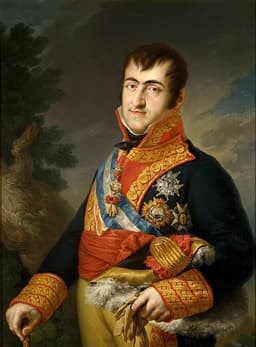
Ferdinand VII of Spain
Emperor · Modern
45.1Total
Basic Information
Born
1757
1784
Died
1828
1833
Era
Modern
Modern
Nationality
Saxe-Weimar
Spain
Occupation
Emperor
Emperor
Civilization
Western
Western
Score Comparison
Military (10%)
20.0
14.9
Political (20%)
70.0
32.2
Influence (20%)
55.0
51.0
Legacy (20%)
52.0
41.7
Leadership (15%)
82.0
74.0
Strategy (15%)
42.3
45.0
TOTAL
55.8
45.1
Charles Augustus of Saxe-Weimar — Complete Timeline
1775 AD
Patronage of Johann Wolfgang von GoetheCultural◆ Major
Charles Augustus invited Goethe to Weimar and appointed him to various governmental positions. This patronage created the Weimar Classicism cultural movement and made Weimar a major intellectual center in Europe.
Weimar ClassicismGoetheCultural Patronage
Impact: globalconstructive
1806 AD
Joined the Rhine ConfederationPolitical Action◆ Major
Charles Augustus allied Saxe-Weimar with Napoleon's Confederation of the Rhine, gaining territorial enlargement and sovereign status. This decision preserved his duchy's autonomy during the Napoleonic Wars but tied it to French hegemony.
Napoleonic WarsConfederation of the RhineAlliance
Impact: regional
1813 AD
Fought at the Battle of LeipzigWar◆ Major
Charles Augustus switched sides and fought with the Allied coalition against Napoleon at the Battle of Leipzig. His troops participated in the decisive defeat of Napoleon, contributing to the liberation of German states from French control.
Battle of LeipzigNapoleonic WarsCoalition
Impact: regional
1816 AD
Granted the Constitution of 1816Political Action◆ Major
Charles Augustus issued a constitution for Saxe-Weimar-Eisenach, making him the first German ruler to grant a constitution. This established a bicameral parliament and guaranteed basic rights, setting a precedent for constitutionalism in the German states.
ConstitutionConstitutionalismGerman States
Impact: nationalprogressive
Ferdinand VII of Spain — Complete Timeline
1808 AD
Accession to the thronePolitical Action◆ Major
Ferdinand VII became King of Spain after the abdication of his father Charles IV. His reign was interrupted by Napoleon's intervention and the Peninsular War, but he was restored in 1814.
SuccessionMonarchy
Impact: national
1814 AD
Abolition of the Constitution of 1812Political Action
Upon returning to Spain, Ferdinand VII abolished the liberal Constitution of 1812 and restored absolute monarchy. He persecuted liberals and reinstated the Inquisition, reversing the reforms of the Cortes of C
ConstitutionAbsolutismReaction
Impact: nationaldestructive
1820 AD
Trienio LiberalPolitical Action◆ Major
A military revolt led by Rafael del Riego forced Ferdinand VII to reinstate the Constitution of 1812, beginning the Trienio Liberal. Ferdinand was effectively a constitutional monarch for three years.
Liberal RevolutionConstitutionRevolt
Impact: national
1823 AD
French intervention and restoration of absolutismWar◆ Major
A French army, the Hundred Thousand Sons of Saint Louis, invaded Spain to restore Ferdinand VII's absolute power. The liberal government fell, and Ferdinand resumed repressive rule.
InterventionAbsolutismCongress of Vienna
Impact: regionaldestructive
1830 AD
Pragmatic Sanction of 1830Political Action◆ Major
Ferdinand VII issued the Pragmatic Sanction, abolishing Salic Law and allowing his daughter Isabella to inherit the throne. This led to the Carlist Wars after his death.
SuccessionLawCarlist Wars
Impact: national
Expert Analysis
Ferdinand VII of Spain vs Charles Augustus of Saxe-Weimar
### The King Who Chose Chains
In the autumn of 1816, as the embers of Napoleon’s wars still smoldered across Europe, two German dukes could have been forgiven for feeling trepidation. The Congress of Vienna had redrawn the map, and the forces of reaction were ascendant. Yet in the small duchy of Saxe-Weimar-Eisenach, Duke Charles Augustus did something extraordinary: he granted his subjects a constitution, the first German ruler to do so. Across the Pyrenees, in the vast and crumbling Spanish Empire, King Ferdinand VII had returned from French captivity two years earlier with a very different agenda. He tore up the liberal Constitution of 1812, restored the Inquisition, and reimposed an absolute monarchy that would plunge his nation into a century of civil war. Why did these two men, both products of the Enlightenment and the Napoleonic upheaval, choose such opposite paths? The answer lies not in the era they shared, but in the men they were.
### Origins
Charles Augustus was born in 1757 into a small, cultivated German court. His mother, Duchess Anna Amalia, was a formidable patron of the arts, and his upbringing was steeped in the humanist ideals of the Enlightenment. When he came of age, he did not merely rule; he befriended and employed the era’s greatest mind, Johann Wolfgang von Goethe, whom he invited to Weimar in 1775. This was not a cynical political move but a genuine intellectual partnership. Charles Augustus grew up believing that a ruler’s duty was to cultivate culture, reason, and the well-being of his people.
Ferdinand VII, born in 1784, was the son of a weak king and a domineering queen, raised in the paranoid and decaying court of Charles IV. He was taught that power was a zero-sum game, that authority was divine, and that any concession was a surrender. While Charles Augustus read Goethe’s poetry, Ferdinand learned to distrust his own father and to see liberalism as a French disease. The Spanish monarchy had already been hollowed out by the loss of its American colonies and the trauma of the French Revolution. For Ferdinand, the only security lay in absolute control.
### Rise to Power
Charles Augustus’s rise was steady and unremarkable—he inherited the duchy in 1775 and spent decades building a model state. His power came from his ability to navigate the Napoleonic storm. In 1806, he pragmatically joined the Confederation of the Rhine, gaining territory and sovereignty. But when the tide turned in 1813, he switched sides and fought with the Allies at the Battle of Leipzig, a decision that required both military courage and political foresight. His troops fought well, and he emerged from the Congress of Vienna with his duchy enlarged and respected.
Ferdinand’s rise was a catastrophe. In 1808, he became king only after his father abdicated under French pressure—then was immediately imprisoned by Napoleon. For six years, he was a puppet and a prisoner, while a liberal constitution was drafted in his absence by the Cortes of Cádiz. When he returned in 1814, he was greeted by a nation exhausted by war and ready for reform. Instead, he saw the constitution as a personal insult. He abolished it, arrested liberal deputies, and restored the old order. His first act as a free king was to chain his own people.
### Leadership & Governance
Charles Augustus governed like a philosopher-king. His constitution of 1816 was not a radical document, but it established a representative assembly, guaranteed basic rights, and limited the duke’s own power. He did not need to be forced; he believed that a stable state required the consent of the governed. He reformed education, supported the arts, and built a bureaucracy that was efficient and just. His leadership score of 82.0 reflects a ruler who understood that power, to be lasting, must be shared.
Ferdinand VII governed like a man besieged. His political score of 51.5 is mediocre, but his military score of 32.2 is abysmal—he was not a warrior, but a schemer. He ruled through a network of spies, censors, and loyalists, reversing every reform of the Napoleonic era. When a military revolt in 1820 forced him to reinstate the Constitution of 1812, he spent three years (the Trienio Liberal) secretly plotting its destruction. In 1823, he invited a French army, the Hundred Thousand Sons of Saint Louis, to invade his own country and restore his absolute power. He was willing to burn Spain to rule its ashes.
### Triumph & Tragedy
Charles Augustus’s greatest moment was the Battle of Leipzig in 1813, where he led his troops in person against Napoleon. It was a triumph of courage and timing. His tragedy was that his small state could never become a great power; his constitution remained a local experiment, not a national model. Yet he died in 1828, mourned by his people, his legacy secure.
Ferdinand’s triumph was the Pragmatic Sanction of 1830, which abolished Salic Law and allowed his daughter Isabella to inherit the throne. It was a masterstroke of dynastic politics, but it sowed the seeds of the Carlist Wars that would tear Spain apart for decades. His tragedy was that he never understood that a monarchy that cannot adapt will be destroyed. He died in 1833, leaving a nation divided between liberals and absolutists, a civil war brewing, and a daughter too young to rule.
### Character & Destiny
Charles Augustus was a man of curiosity and courage. He did not fear ideas; he embraced them. His friendship with Goethe was not a patronage but a dialogue. He believed that a ruler’s greatness lay in the flourishing of his people. Ferdinand VII was a man of suspicion and resentment. He saw every reform as a threat, every liberal as a traitor. He once said, “I am the state,” but he was wrong—he was merely its jailer. His character shaped a destiny of decline.
### Legacy
Charles Augustus is remembered as the father of German constitutionalism, a patron of the Weimar Classicism that shaped German culture, and a model of enlightened rule. His legacy score of 68.8 is modest, but his influence on Goethe, Schiller, and Herder is immeasurable. Ferdinand VII is remembered as the “Desired One” who became the “King of Chains.” His legacy is the Carlist Wars, the loss of the American empire, and a century of instability. His influence score of 70.4 is high, but it is the influence of a cautionary tale.
### Conclusion
Both men faced the same historical challenge: how to rule in an age of revolution. Charles Augustus chose to adapt, to share power, to build. Ferdinand VII chose to resist, to crush, to destroy. The difference was not in their circumstances but in their souls. One saw his people as partners; the other saw them as subjects. One built a legacy of light; the other, a shadow that still falls across Spain. In the end, the king who granted a constitution is remembered with gratitude, while the king who abolished one is remembered with grief. History is not written by the powerful, but by the wise.
Rankings
🥇
Charles Augustus of Saxe-WeimarLeader
Mil: 20.0Pol: 70.0Inf: 55.0
55.8
🥈
Ferdinand VII of Spain
Mil: 14.9Pol: 32.2Inf: 51.0
45.1
+10.7 behind
How This Comparison Works
Algorithm
Each figure is scored on 6 dimensions (0—100 scale) based on structured historical data: Military (10%), Political (20%), Influence (20%), Legacy (20%), Leadership (15%), Strategy (15%). The weighted total produces the final ranking.
Data Sources
Scores are computed from structured sub-indicators in the database. Scale factors adjust for era (Ancient ×0.85, Modern ×1.0) and civilization size (Eastern ×1.05, Other ×0.80) to account for differences in population and military scale.
Maximum 3 Figures
Comparisons are limited to 2—3 figures to ensure readability and statistical meaningfulness.
Error Margins
±5 points per dimension — Sub-scores are derived from historical records with inherent uncertainty. Two figures within 5 points on a dimension should be considered roughly equivalent in that area.
Total Score Accuracy
±3 points overall — The weighted combination of 6 dimensions produces a total score with approximately ±3 points of uncertainty. Differences of less than 3 points are not statistically significant— the figures are effectively tied.
Known Limitations
- Historical records are incomplete and uneven across civilizations
- Figures from oral-tradition societies may be underrepresented
- Occupation labels can misclassify multi-role figures
- Scores measure capability and impact, not moral character
- Quantitative scoring is a comparison tool, not absolute truth
Capability Radar
Military (10%) — Battles & Warfare
Battles
5
10
Win Rate
5
5
Expansion
5
5
Political (20%) — Governance & Reform
Reform
75
5
Diplomacy
60
20
Economy
55
10
Influence (20%) — Cultural & Global Reach
Cultural
65
15
Global
40
20
Legacy (20%) — Historical Impact
Historical
60
30
Longevity
50
20
Leadership (15%) — Power & Stability
Tenure
70
60
Stability
65
10
Strategy (15%) — Tactics & Innovation
Strategy
5
5
Tactics
5
5
Reform
10
5
Similar Comparisons
Comments & Discussion
No comments yet. Be the first to share your thoughts!